
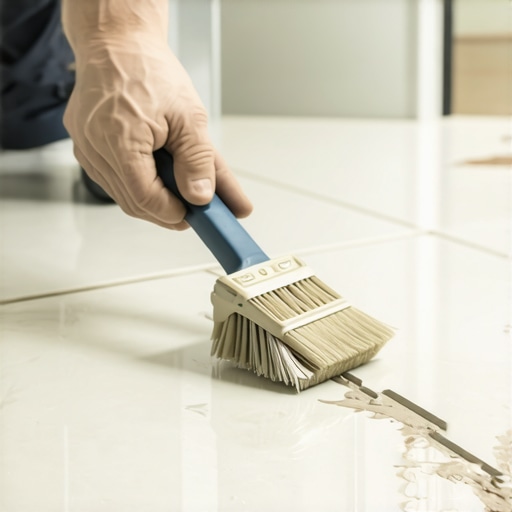
The secret to a floor that lasts decades is not found in the tile itself. It is found in the chemistry of the grout and the structural integrity of the slab beneath. Most guys skip the leveling compound. They think the underlayment will hide the dip. It won’t. I spent three days grinding concrete on a job last month just so the floor wouldn’t click like a castanet. That same level of obsession must be applied to your grout joints. If you think sealing is just a cosmetic spray and wipe job, you are mistaken. You are dealing with a porous cementitious matrix that wants to suck up every drop of dirty mop water and soap scum it touches. To seal grout in under an hour, you need a technical understanding of the sixty minute window and the right chemical carriers.
The microscopic sponge in your shower
Grout is a highly porous material composed of Portland cement and sand that acts like a structural sponge between tiles. This cementitious product contains millions of interconnected voids at a molecular level. When water or oils touch an unsealed joint, capillary action pulls those liquids deep into the core of the grout. This lead to permanent staining and the growth of sub-surface pathogens. A proper sealer does not just sit on top. It penetrates these voids and lines them with hydrophobic polymers that change the surface tension of the internal pores. This ensures that liquids bead on the surface rather than disappearing into the floor. If you fail to address this porosity, you are essentially leaving a doorway open for moisture to attack your thin-set and subfloor.
The chemistry of the sixty minute window
Achieving a professional seal in under an hour requires the use of high quality aerosol penetrating sealers or rapid dry solvent carriers. These products are designed to evaporate quickly while leaving behind a dense network of fluoropolymers. Water based sealers often require hours of cure time before they can resist moisture, but solvent based alternatives can reach a state of initial repellency in minutes. The application process is a race against the evaporation rate of the carrier fluid. You must saturate the joint to the point of refusal without letting the excess dry on the tile surface. This is where the skill of the mechanic comes into play. You have to move with speed and precision to ensure the sealer reaches the bottom of the grout joint before the solvent flashes off.
“A floor is only as good as the subfloor beneath it; deflection is the enemy of every joint.” – Master Flooring Axiom
The physics of solvent based barriers
Solvent based sealers utilize smaller molecular structures than their water based counterparts. This allows them to penetrate deeper into the dense grout lines found in porcelain tile installations. When you apply a solvent sealer, the liquid acts as a transport mechanism for the solids. As the solvent evaporates, it leaves behind a chemical shield that is resistant to both water and oil based contaminants. This is vital in a kitchen environment where hot grease can easily penetrate a standard water based sealer. The bond formed at the molecular level is permanent until the top layer of grout is physically worn away. Using a high pressure aerosol delivery system ensures that the sealer is driven into the grout with enough force to displace any trapped air in the pores.
| Sealer Category | Penetration Depth | Cure Time | Resistence Type |
|---|---|---|---|
| Water Based | Moderate | 4 to 24 Hours | Hydrophobic |
| Solvent Based | High | 1 to 2 Hours | Oleophobic |
| Aerosol Rapid | Deep | 20 to 60 Minutes | Dual Action |
Why Florida humidity ruins your tile work
Regional climate conditions like the high humidity found in Florida dictate the timing and selection of your grout sealing products. In a swampy environment, the moisture content of the air prevents water based sealers from evaporating at the necessary rate. This can lead to a cloudy finish known as blushing. I have seen countless jobs in Miami where the grout turned white and chalky because the installer did not account for the ambient vapor pressure. In these regions, you must use a moisture insensitive solvent sealer. These products can displace the humidity within the grout pores and create a reliable bond even when the air is thick with salt and water. You should always use a moisture meter to verify that the grout is below 5 percent moisture content before you even think about opening a bottle of sealer.
The equipment for the professional installer
To get this done in under an hour, you cannot rely on a rag and a bucket. You need professional grade tools that allow for rapid delivery and immediate cleanup of the excess. I use a pressurized sprayer with a fine tip nozzle specifically sized for the grout joint width. This prevents wasted product and keeps the sealer off the face of the tile. You also need a microfiber weighted mop to follow behind and buff the tile surface. If you leave sealer to dry on a polished porcelain tile, you will be spending the next day with a razor blade scraping off the hazy residue. The goal is to keep the sealer in the grout and off the ceramic. This requires a two handed operation where one hand applies the product and the other manages the surface tension.
- Verify the grout has cured for at least 48 hours before sealing.
- Clean the joints with a pH neutral oxygenated cleaner.
- Remove all dust and debris with a HEPA filtered vacuum.
- Apply the sealer in a continuous motion to avoid lap marks.
- Buff the tile surface within three minutes of application.
- Test the seal with a drop of water after twenty minutes.
Mistakes that lead to mold growth
The most common error in rapid sealing is trapped moisture which leads to efflorescence and mold under the sealer layer. If you seal grout that is still damp from cleaning, you are essentially laminating a layer of water into your floor. This water will eventually try to escape, pushing up minerals and creating a white crusty powder on your joints. This is not just an aesthetic issue. It is a sign that your sealer has failed and that moisture is now trapped in the subfloor. I have seen 3/4 inch plywood subfloors rot out from under a beautiful tile job because the installer was in too much of a rush to seal a damp floor. You must ensure the slab is dry. There are no shortcuts for the laws of physics. If the water has nowhere to go, it will find a way to destroy your work.
“Cementitious grout is naturally porous and must be protected to prevent moisture migration into the thin-set bed.” – Tile Council of North America
The cost of cheap hardware store sprays
Professional grade sealers have a higher concentration of solids compared to the cheap cans you find at big box retailers. The discount products are mostly water or cheap mineral spirits with just enough silicone to make water bead for a week. A real sealer uses silanes or siloxanes that chemically react with the silica in the grout. This creates a covalent bond that cannot be washed away with standard cleaners. While the professional product might cost three times as much, it saves you from having to reapply it every six months. In my experience, homeowners who buy the cheap stuff end up with black grout in their showers within a year. You are paying for the density of the protective layer. Do not be cheap when it comes to the only thing standing between your subfloor and a flood.
The final verification of the bond
Once you have completed the application, you need to verify the performance. After thirty minutes, place a small bead of water on the grout line. If the water sits there like a glass bead, you have succeeded. If it darkens the grout even slightly, the sealer was not thick enough or the grout was too porous. In those cases, a second coat is required immediately. This is the only way to guarantee the integrity of the installation. A floor is a structural system. The grout is the weakest link in that system. By reinforcing it with a high quality penetrant, you are ensuring that the thousands of dollars spent on tile and labor are not wasted by a single spill. The process is fast, but the results are measured in decades. Do it right or do it twice. It is that simple.