
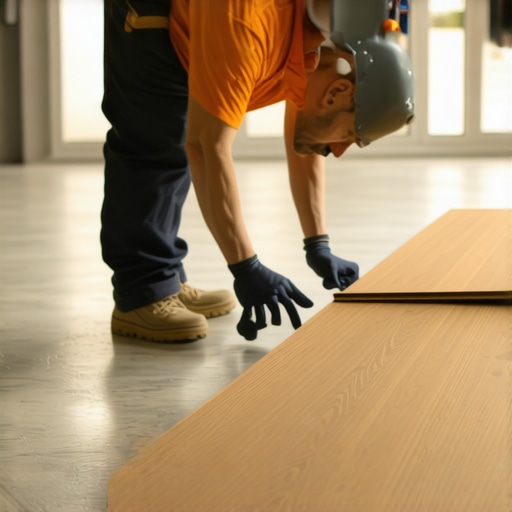
The invisible math of hardwood failure
I once walked into a house where a $15,000 wide plank walnut floor was cupping so bad it looked like a potato chip because the installer did not check the crawlspace humidity. The homeowner was devastated. The boards were literally lifting off the subfloor, snapping the fasteners with a sound like small gunshots in the middle of the night. This disaster was completely avoidable. It was the result of arrogance and a lack of respect for the physics of organic materials. Hardwood is not a static product like tile or grout. It is a biological tissue that reacts to every molecule of water in the air. When you ignore the acclimation process, you are not just skipping a step. You are gambling with the structural integrity of the home. I spent three days on my hands and knees with a moisture meter on that job, proving to the insurance company that the wood was delivered at 6 percent moisture and installed into a room that was hovering at 14 percent. That 8 percent difference is a death sentence for wide planks. Most installers want to get in and out. They want the check. But wood does not care about your schedule. It only cares about equilibrium.
Why moisture levels dictate your floor life
Acclimatizing hardwood floors is the process of adjusting the moisture content of the wood flooring to the environment in which it will perform. This prevents excessive expansion or contraction that leads to gaps, cupping, or buckling. The goal is to reach the Equilibrium Moisture Content or EMC, where the wood neither gains nor loses moisture from the surrounding atmosphere. This state is non-negotiable for a professional finish. If the wood is too dry when installed, it will swell as it absorbs humidity, potentially pushing walls out of alignment or humping up in the center of the room. If it is too wet, it will shrink, leaving gaps wide enough to swallow a dime between every board. Wood cells are essentially a series of microscopic straws called tracheids. These straws hold water in two ways. There is free water in the cell cavities and bound water within the cell walls. Acclimation focuses on the bound water. When the humidity drops, the cell walls release water and the wood shrinks. When humidity rises, the cell walls swell. This is the fundamental law of wood science.
“Wood flooring will perform best when the wood moisture content is brought into balance with the ambient temperature and relative humidity of the environment in which it will be installed.” – Master Flooring Axiom
The ghost in the expansion gap
Expansion gaps are the mandatory spaces left around the perimeter of a room to allow the floor to breathe and move. A proper 3/4 inch expansion gap is often hidden by baseboards and shoe molding, but its presence is what allows the wood to survive seasonal changes without self-destructing. Many people think that because they have a high-end HVAC system, they do not need to worry about this. They are wrong. Even in a controlled environment, wood is dynamic. I have seen laminate floors fail because they were installed tight against a door frame. Unlike hardwood, laminate is a composite of sawdust and resin, but it still moves. Hardwood is even more aggressive. If you do not leave that gap, the wood will find the space it needs by buckling upward. It is simple physics. The force of expanding oak can snap trim and move heavy furniture. It is a slow motion car wreck that happens over the course of three months.
| Wood Species | Janka Hardness | Recommended Acclimation Time | Stability Rating |
|---|---|---|---|
| White Oak | 1360 | 7 to 10 Days | High |
| Hickory | 1820 | 10 to 14 Days | Medium |
| Brazilian Cherry | 2350 | 14 to 21 Days | Low |
| Engineered Oak | 1360 | 3 to 5 Days | Excellent |
Why your subfloor is lying to you
Subfloor moisture testing is the only way to verify if a surface is ready for a hardwood installation. You cannot look at a concrete slab or a plywood sheet and know if it is dry. You need a calibrated moisture meter. I have seen installers lay wood over a slab that looked bone dry, only for the moisture from the concrete to migrate into the wood and ruin the finish. This is especially dangerous in areas near showers or high moisture zones. The concrete acts like a battery, storing water and releasing it slowly over years. If you do not use a moisture barrier, that water has only one place to go. It goes into your expensive floor. While most people want the thickest underlayment, too much cushion actually causes the locking mechanisms on laminate or LVP to snap under pressure. You want a firm, flat surface. Flatness is more important than levelness. If a floor has a dip of 1/8 inch over six feet, the wood will bridge that gap and flex every time you walk on it. That flex leads to squeaks and eventually breaks the tongue and groove joints.
- Test the subfloor in at least 20 locations per 1,000 square feet.
- Check the moisture content of the hardwood bundles upon delivery.
- Maintain the home at occupancy temperature for 14 days prior to wood arrival.
- Cross-stack the wood in the room where it will be installed.
- Never store hardwood in a garage or an unfinished basement.
The math of moisture equilibrium
Equilibrium Moisture Content calculation involves measuring the temperature and relative humidity of the room and comparing it to the wood moisture content. For most of the United States, the ideal indoor moisture content for hardwood is between 6 and 9 percent. In the swampy humidity of Houston or Miami, you might aim for 10 percent. In the bone dry air of Phoenix, you might need to get it down to 5 percent. If the wood is delivered at 11 percent and your room is at 6 percent, you must wait. You cannot rush the evaporation of water from the cellular structure of timber. The wood must be stacked in a way that air can circulate around every board. This is called sticker-stacking or cross-stacking. If you leave the wood in sealed boxes or tight piles, only the boards on the outside will acclimate. The boards in the middle will stay at their original moisture level. When you nail them down, the floor will behave inconsistently, leading to a wavy appearance known as telegraphing.
“A floor is only as good as the subfloor beneath it; deflection is the enemy of every joint.” – Master Flooring Axiom
The 1/8 inch that ruins everything
Subfloor prep is where the real work happens. I spend more time with a floor grinder and leveling compound than I do with a nail gun. If the subfloor is not within 3/16 of an inch over a 10 foot radius, the floor is going to fail. People ask why their new floors click and pop. It is because the installer was too lazy to fill the low spots. They think the underlayment will hide the dip. It won’t. I spent three days grinding concrete on a job last month just so the floor wouldn’t click like a castanet. This is the difference between a floor that lasts 50 years and one that needs to be ripped out in five. You have to respect the substrate. Whether it is plywood or a concrete slab, it must be clean, dry, and flat. Any deviation is a point of failure. When you combine a poorly prepped subfloor with unacclimated wood, you are inviting a disaster that no amount of wood filler or sanding can fix. You have to do it right the first time because there is no second chance with solid oak.