
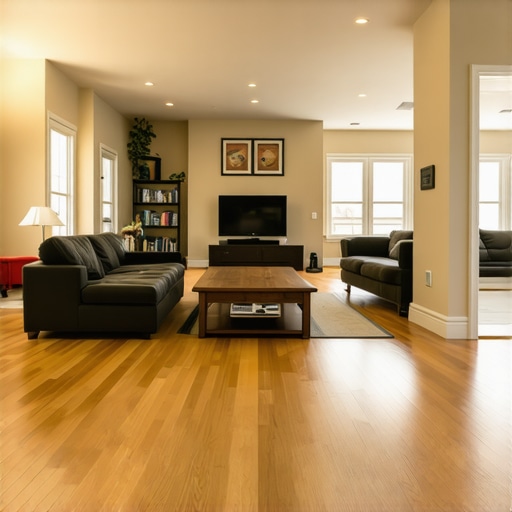
The structural reality of basement flooring
Engineered hardwood stands as the superior choice for below-grade installations due to its cross-laminated construction which provides dimensional stability against moisture. Unlike solid wood, engineered planks utilize multiple layers of plywood or HDF that counteract the natural expansion and contraction caused by subterranean humidity and temperature fluctuations. I once walked into a house where a $15,000 wide-plank walnut floor was cupping so bad it looked like a potato chip because the installer didn’t check the crawlspace humidity. It was a tragedy of professional negligence. The homeowner had insisted on solid 3/4 inch walnut in a walk-out basement. Within six weeks, the hygroscopic nature of the solid lumber had pulled so much moisture from the concrete slab that the cells in the wood expanded beyond the capacity of the fasteners. The staples were literally pulling out of the subfloor with audible pops in the middle of the night. This is the inherent risk of choosing aesthetics over engineering. When we talk about basement flooring, we are not talking about interior design. We are talking about managing a hydrostatic environment where moisture vapor is constantly trying to move from the high-pressure soil through the porous concrete into the low-pressure living space. Solid hardwood is a single, continuous piece of cellulose fiber. When it gets wet, it expands in one direction. Engineered hardwood is a structural assembly. It uses layers oriented in opposing directions to create a internal tension that prevents the plank from warping. This is basic physics applied to forestry products.
“A floor is only as good as the subfloor beneath it; deflection is the enemy of every joint.” – Master Flooring Axiom
The ghost in the expansion gap
The expansion gap is the vital perimeter space left around a floor to allow for the inevitable movement of wood fibers during seasonal changes. In basements, this gap must be meticulously calculated based on the maximum expected relative humidity of the space to prevent the floor from buckling. Most installers treat the expansion gap as a suggestion. They jam the planks tight against the drywall or the baseboard. In a basement, this is a death sentence. Concrete is a sponge. Even if it looks dry, it is constantly emitting moisture vapor. This process, known as moisture vapor transmission, increases when the ground outside is saturated. Engineered hardwood is designed to handle this, but it still needs room to breathe. The cross-ply construction limits the movement to a fraction of what solid wood would experience, but that fraction still matters over a twenty-foot span. If the floor has nowhere to go, it will lift. It will create a hollow sound when you walk on it. Eventually, the tongue and groove joints will shear off under the pressure. I have seen 4,000 square feet of flooring destroyed because a crew forgot to pull the spacers before they put the baseboards on.
The physics of the subterranean slab
Concrete slabs in basements act as a semi-permeable membrane that regulates the exchange of moisture between the earth and your home environment. A properly prepared slab must be tested for moisture using calcium chloride or in-situ relative humidity probes to ensure it meets the flooring manufacturer’s specifications. Before a single plank is laid, we have to look at the chemistry of the concrete. New concrete contains thousands of pounds of water that must evaporate before it is stable. Even old concrete can be a problem if the vapor barrier under the house has failed. We use the ASTM F2170 standard to measure the relative humidity inside the slab. If that reading is over 75 percent, you cannot just throw a floor down. You need a high-performance moisture mitigator. I prefer a two-part epoxy resin that bonds to the concrete pores and creates a literal shield. This prevents the moisture from ever reaching the bottom of your engineered planks. Many people think a thin plastic sheet is enough. It isn’t. You need a solution that addresses the molecular drive of the water.
The 1/8 inch that ruins everything
Subfloor flatness is the single most important factor in the longevity of an engineered hardwood installation in a basement. Any deviation greater than 1/8 inch over a ten-foot radius will cause vertical deflection, leading to premature failure of the locking mechanisms and annoying clicking sounds. People spend weeks picking out the right species of oak or maple, but they won’t spend two days grinding down the high spots in their concrete. If your subfloor isn’t flat, your floor will fail. It is that simple. When an engineered plank spans a dip in the concrete, it acts like a bridge. Every time you step on it, the plank flexes. This puts immense stress on the tongue and groove. Over thousands of footfalls, the wood fibers at the joint will fatigue and break. This is why I spent three days grinding concrete on a job last month just so the floor wouldn’t click like a castanet. It is dirty, loud, and expensive work, but it is the only way to ensure the floor lasts forty years instead of four.
| Metric | Solid Hardwood | Engineered Hardwood | LVP (Vinyl) |
|---|---|---|---|
| Moisture Resistance | Very Low | High | Excellent |
| Dimensional Stability | Poor | Excellent | Good |
| Refinishing Potential | High (3-5 times) | Moderate (1-2 times) | Zero |
| Installation Level | Above Grade Only | Any Level | Any Level |
The chemical bond of modern adhesives
Adhesives used for engineered hardwood in basements are sophisticated polymers designed to provide a flexible yet permanent bond while acting as a secondary moisture barrier. Silane-terminated polymers are the industry standard for their ability to resist high pH levels and moisture common in concrete. When we glue a floor down in a basement, we aren’t just using wood glue. We are using a structural adhesive that has elastic properties. Wood moves. The adhesive must be able to stretch and contract without losing its grip on the concrete or the wood. These modern adhesives are also designed to be moisture-tolerant. Some can handle up to 90 percent relative humidity in the slab. But you have to use the right trowel. The notch size on the trowel determines the thickness of the adhesive bed. If you use a trowel that is too small, you won’t get enough coverage to create a moisture seal. If you use one that is too large, you’ll have adhesive oozing up through the joints. It is a game of millimeters.
“A floor is a performance surface; it must withstand the mechanical stresses of life while managing the environmental pressures of its location.” – Structural Flooring Guidelines
Why too much cushion is a liability
While most people want the thickest underlayment possible for comfort, too much cushion actually causes the locking mechanisms on engineered floors to snap under pressure. A high-density underlayment with low compression is required to support the structural integrity of the planks. This is the most common mistake I see. A homeowner buys a beautiful engineered floor and then buys the thickest, softest foam padding they can find. They think it will make the basement feel warmer and softer. What it actually does is create a trampoline effect. The wood planks are rigid. The foam is soft. When you walk, the planks sink into the foam, and the joints are forced to bend. Most engineered hardwood joints are not designed for that kind of movement. They will crack. Within a year, the floor will feel loose and bouncy. You want an underlayment that is thin, dense, and has a high IIC (Impact Insulation Class) rating for sound, but it must be firm enough to support the weight of the floor and furniture without compressing more than a fraction of a millimeter.
The essential basement floor preparation checklist
- Conduct a 72-hour moisture test using ASTM standards before ordering material.
- Grind all high spots and fill all low spots in the concrete slab to within 1/8 inch.
- Acclimate the engineered planks in the basement for at least 48 hours with the HVAC running.
- Check the pH level of the concrete to ensure compatibility with adhesives.
- Ensure the exterior drainage and gutters are moving water away from the foundation.
- Verify that the wear layer of the chosen product is at least 3mm for future refinishing.
The chemistry of the wear layer
The wear layer of an engineered hardwood floor consists of the actual hardwood species bonded to the core and is protected by multiple coats of aluminum oxide or ceramic bead finishes. These finishes are engineered at the molecular level to resist abrasion and UV degradation in high-traffic areas. Not all engineered floors are created equal. You look at a sample in a showroom and it looks great. But you have to look at the cross-section. A cheap floor has a wear layer that is less than 1mm thick. You can’t even sand that if it gets scratched. A quality engineered floor has a wear layer of 3mm to 6mm. This allows for the floor to be refinished later in its life, much like a solid floor. The finish itself is also a feat of engineering. We used to use simple oil or polyurethane. Now, manufacturers bake aluminum oxide particles into the finish. These particles are incredibly hard. They protect the wood from the micro-scratches caused by dirt and grit. In a basement, where people often track in debris from the outside, this hard finish is a requirement for a floor that lasts.
The myth of waterproof wood
No wood product is truly waterproof; however, engineered hardwood is water-resistant enough to handle the occasional spill or minor humidity spike without structural failure. The term waterproof in the flooring industry is often a marketing exaggeration that ignores the cellular reality of organic materials. I hear the word waterproof a lot these days. Usually it is used to sell LVP. When people ask if engineered hardwood is waterproof, I tell them the truth. It is wood. If you submerge it in water, it will eventually rot. But engineered hardwood is much better at surviving a basement than solid wood. If you have a small leak from a water heater and you catch it quickly, an engineered floor will likely survive. The finish and the glue layers provide a barrier. Solid wood would soak that water up like a wick and expand until it hit the walls. The key is maintenance. You have to keep the humidity in your basement between 35 and 55 percent. If you do that, the floor will stay stable for decades. If you don’t, even the best engineering in the world won’t save you from the laws of nature.