
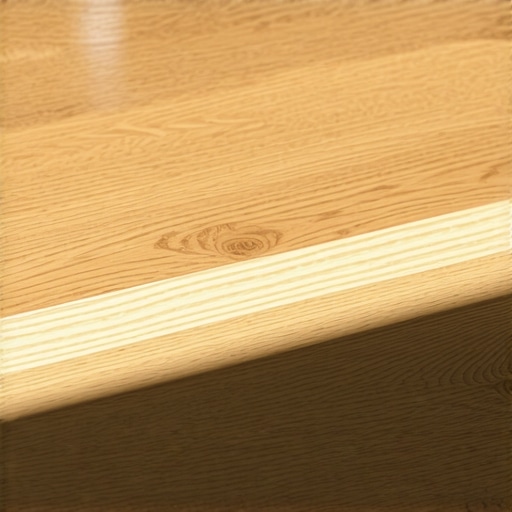
Most guys skip the leveling compound. They think the underlayment will hide the dip. It won’t. I spent three days grinding concrete on a job last month just so the floor wouldn’t click like a castanet. I can still smell the oak dust and WD-40 on my shirt from that job. When you see your laminate transitions popping up as the temperature drops, it is a sign that the structural physics of your home are fighting against the installation. A floor is a living, moving system. It is not a static surface like a countertop. In the winter, the humidity in your home drops, the wood fibers in your laminate core shrink, and the tension on those small plastic tracks becomes unbearable. If the subfloor was not flat within 1/8 inch over a 10 foot span, that movement is amplified until the T-molding simply gives up and let’s go.
The physics of winter shrinkage
Laminate flooring, T-molding transitions, and subfloor fasteners fail in winter because of thermal contraction and low relative humidity. When the air dries, the high-density fiberboard core loses moisture and shrinks. This pulls the planks away from the transition tracks, causing them to pop. This is not a defect in the product. It is a failure to account for the hygroscopic nature of the wood fibers. Every plank of laminate is composed of compressed wood particles held together by resins. When the furnace kicks on in November, it sucks the moisture out of the air. The floor responds by pulling toward its center. If you have a thirty foot run of flooring, that shrinkage can total nearly half an inch. If your transition was installed too tight against the edge of the planks, the floor will pull the entire track out of the subfloor as it retreats.
“A floor is only as good as the subfloor beneath it; deflection is the enemy of every joint.” – Master Flooring Axiom
The ghost in the expansion gap
Expansion gaps are the most misunderstood part of any flooring installation because they must account for both expansion and contraction. An installer who leaves a gap in July might find that gap is gone by January. This happens because the floor is not just a surface, it is a hydraulic system. When you walk across a floor that has shrunk, you are putting vertical pressure on a joint that is already under horizontal tension. If the transition molding is pinched, the energy has nowhere to go but up. I have seen guys try to solve this by putting more glue in the track. That is like trying to stop a train with a piece of tape. You are fighting the molecular movement of the wood fibers. You must give the floor the room it needs to breathe, or it will find that room by breaking your moldings.
The chemistry of failed adhesive bonds
Construction adhesives and urethane glues often fail in the winter because the bond line becomes brittle at low temperatures. If your laminate transitions were glued down instead of mechanically fastened, the cycle of thermal expansion will eventually shear the adhesive. Most big box store adhesives are water-based. They are fine for a bedroom but they cannot handle the torque of a floating floor system in a high traffic area. You need a moisture-cured polyurethane if you are going to bond anything to a concrete slab. Even then, if the slab is emitting vapor at a rate higher than 3 pounds per 1,000 square feet, the glue will eventually emulsify and fail. I always prefer a mechanical track screwed into the subfloor with Tapcon fasteners or wood screws. It gives the T-molding a physical anchor that does not care about the humidity.
[IMAGE_PLACEHOLDER]
Why your subfloor is lying to you
Subfloor flatness is different from subfloor levelness, and ignoring this distinction is why laminate transitions pop. A floor can be slanted but still flat. If there is a birdbath or a dip right where your transition sits, the T-molding will never stay seated. Every time someone steps near the doorway, the floor deflects into the dip. This movement acts like a crowbar, prying the molding out of its track. This is why I spend so much time with a grinder and a bag of self-leveler. If you do not fix the substrate, the finish floor is doomed. I have walked into million dollar homes where the hardwood floors were beautiful but the laminate in the basement was clicking because the builder was too lazy to check the slab with a straightedge. You cannot hide a bad foundation with a pretty transition.
| Material Core | Expansion Rate | Acclimation Time |
|---|---|---|
| Standard HDF | High | 48 Hours |
| Water Resistant HDF | Medium | 72 Hours |
| SPC Core | Low | 24 Hours |
The myth of the waterproof floor
Waterproof laminate and LVP are often sold as indestructible, but they still require expansion gaps and proper transition tracks. People think because the floor is waterproof, it is also dimensionally stable. This is a lie. Even if the core is plastic, the top layer and the locking mechanisms are subject to temperature changes. In the winter, the cold air from a crawlspace can chill the floor from below while the room air stays warm. This temperature gradient causes the planks to bow. This bowing puts immense pressure on the T-molding. If you are near showers or bathrooms, the moisture from the steam can make the laminate swell while the rest of the house is shrinking. This creates a localized stress point at the bathroom door. You might think your grout and tile are safe, but the laminate next to them is pushing and pulling with every weather front.
“Laminate flooring must be allowed to expand and contract freely; any vertical obstruction acts as a fulcrum for failure.” – NWFA Technical Publication
The solution for popping tracks
Fixing a popped transition requires a re-evaluation of the gap and the mechanical fastening system. First, remove the old molding and check the distance between the flooring edge and the track. If the floor has moved so far that it is touching the track, you must trim the planks back with a undercut saw or a oscillating tool. You need a minimum of 1/4 inch of space. Next, ensure the track is screwed into the subfloor, not just glued. If you are on concrete, drill a pilot hole and use a plastic anchor. When you snap the molding back into the track, use a small bead of silicone in the groove. The silicone remains flexible, allowing for some movement without letting the piece vibrate loose. This is the only way to ensure the floor survives the next cold snap.
Winter maintenance checklist
- Check the indoor relative humidity and keep it between 35 and 55 percent.
- Inspect the perimeter baseboards to ensure the floor is not tight against the walls.
- Verify that no heavy cabinetry or kitchen islands are pinned to the floating floor.
- Tighten any loose transition tracks with mechanical fasteners.
- Replace plastic transition tracks with heavy-duty metal versions.
The final word on subfloor integrity
While most people want the thickest underlayment, too much cushion actually causes the locking mechanisms on laminate to snap under pressure. This extra compression allows the floor to dive when you step on it, which pulls the edges away from the transitions. I always recommend a high-density foam or a felt underlayment. These materials do not compress as much, which keeps the floor on a single plane. If you have a floor that pops every winter, stop looking at the molding and start looking at the air and the earth. The air is too dry, and the earth under your house might be too damp. Fix the environment, fix the subfloor, and your transitions will finally stay where you put them. Don’t be the homeowner who thinks a bit of wood glue is a permanent fix. Do the work. Grind the concrete. Level the plywood. Your knees will hurt, but your floor will be silent.