
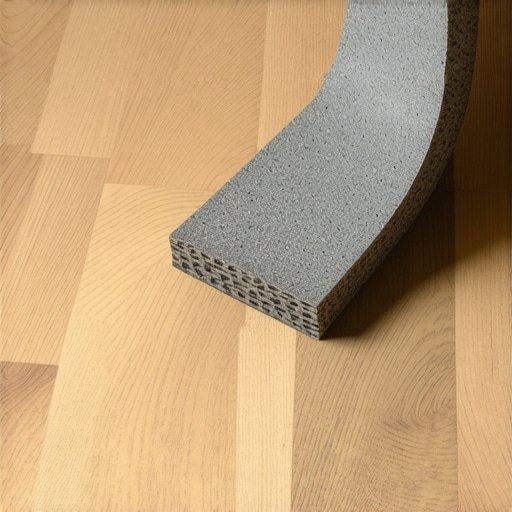
The marketing of modern flooring has shifted toward extreme convenience. Manufacturers now ship millions of square feet of luxury vinyl plank and laminate with a thin layer of foam or cork glued to the bottom. They call it a time saver. They claim it eliminates the need for extra steps. Most of it is garbage. I have spent twenty five years with sawdust under my nails and the smell of WD-40 on my clothes. I have seen what happens when these integrated pads meet a subfloor that is not perfectly flat. It is not pretty. Most guys skip the leveling compound. They think the underlayment will hide the dip. It won’t. I spent three days grinding concrete on a job last month just so the floor wouldn’t click like a castanet. The homeowner thought the pre-attached padding was enough. It was barely two millimeters of low-density foam. By the time I was done, we had a floor that actually felt solid, but only because we ignored the marketing fluff and treated the subfloor like a structural component.
The myth of the all in one solution
Pre-attached padding often fails to provide adequate moisture protection, sound dampening, or subfloor compensation. Specialized standalone underlayments offer superior density and vapor barriers that prevent joint failure and mold growth in laminate and hardwood floors. Skipping the integrated pad allows for a customized structural foundation tailored to specific site conditions. This convenience comes at a heavy cost to the mechanical integrity of the locking system. When you use a floor with an integrated pad, you are locked into whatever cheap material the factory decided was most profitable to glue to the plank. Usually, this is a low-grade polyethylene foam. It lacks the compressive strength to support the tongue and groove joints under heavy furniture. Over time, the foam collapses. The joint then takes the full weight of every footstep. Eventually, the plastic locking mechanism shears off. The floor is ruined. You cannot fix a sheared locking joint. You have to replace the whole room. This is why a separate, high-density underlayment is always the better choice for a professional finish.
“A floor is only as good as the subfloor beneath it; deflection is the enemy of every joint.” – Master Flooring Axiom
The physics of the hollow click
Air gaps are the enemy of a quiet home. When a plank with a pre-attached pad sits over a minor dip in the concrete or plywood, it creates a drum chamber. Every step produces a high-pitched, hollow sound that screams cheap laminate. A standalone underlayment is often thicker and more pliable, allowing it to bridge those microscopic gaps and dampen the vibration before it turns into noise. We look at the Sound Transmission Class and the Impact Insulation Class. Integrated pads rarely hit the numbers required for high-rise condos or quiet bedrooms. The cellular structure of the foam matters. Closed-cell cross-linked polyethylene is the gold standard because it does not absorb water and maintains its shape. Most pre-attached pads are open-cell junk that flattens out within eighteen months of use. This leads to the trampoline effect. You can feel the floor move. It is unsettling. It feels like walking on a sponge rather than a solid surface.
| Feature | Pre-Attached Padding | High-Density Underlayment |
|---|---|---|
| Density (lb/ft³) | 2 to 4 | 6 to 12 |
| Vapor Barrier | Minimal or None | Integrated 6-mil Poly |
| Compression Resistance | Low | High |
| Acoustic Rating (IIC) | 50-55 | 65-72 |
The chemical reality of moisture barriers
Concrete is a sponge. It looks dry, but it is constantly exhaling moisture vapor. This is the moisture vapor transmission rate. If you put a floor with a pre-attached pad directly onto a concrete slab, you are asking for a mold colony. The glue used to attach the pad at the factory often breaks down when exposed to high alkalinity in the concrete. The pad becomes a moisture trap. It holds the dampness against the underside of your flooring. In hardwood floors, this leads to cupping. In laminate, the core swells and the edges peak. A separate moisture barrier, usually a six-mil polyethylene film, is a requirement for any grade-level or below-grade installation. Most installers get lazy and think the pre-attached pad counts as a barrier. It does not. It is a cushion, not a shield. You need a dedicated layer that is taped at the seams to create a literal envelope of protection for your investment.
The trap of the double cushion
One of the biggest mistakes DIY homeowners make is buying a floor with a pre-attached pad and then adding another layer of padding underneath it. They think they are making the floor softer. They are actually destroying the floor. This creates too much vertical movement. The locking systems on modern LVP and laminate are engineered with very tight tolerances. They are designed for a specific amount of deflection. If you double up on the padding, the floor flexes too far. The tongue snaps. The groove splits. You now have a floating floor that is literally floating away from itself. If the floor comes with a pad, and you must use a separate underlayment for moisture or sound, you have to be extremely careful about the total thickness and density. Usually, the best move is to scrape off the factory pad or, better yet, don’t buy the product with the pad in the first place. You want a firm foundation. You want the subfloor to be the star of the show.
“Surface prep is eighty percent of the job; the remaining twenty percent is just making sure the pieces fit.” – Master Flooring Axiom
The 1/8 inch that ruins everything
Precision is not optional. If your subfloor has a deviation of more than one-eighth of an inch over a ten-foot span, the floor will fail. Integrated pads are too thin to compensate for these variances. When I am out on a job, I use a ten-foot straightedge. I mark every low spot. I fill it with a high-strength, cement-based floor patch. I don’t trust the padding to do the work of a leveler. The mechanical bond between the plank and the subfloor depends on that flatness. If the floor is not flat, the planks will bridge over the gaps. Every time you walk over that bridge, the joint bends. This is the primary cause of the annoying clicking sound in modern floors. It is the sound of plastic rubbing against plastic under tension. It is the sound of a floor that is dying. You can avoid this by using a high-density rubber or cork underlayment that provides a true flat plane for the floor to rest upon.
- Check subfloor moisture levels with a calibrated pin-less meter.
- Grind down high spots in concrete using a diamond cup wheel.
- Fill low spots with a self-leveling underlayment or feathered patch.
- Vacuum the entire surface to remove all grit and dust.
- Install a dedicated 6-mil vapor barrier over concrete slabs.
- Stagger underlayment seams away from flooring seams.
Structural integrity versus marketing convenience
Big box retailers love pre-attached padding because it makes the product easier to sell to people who want to finish a project in a weekend. They sell the dream of a fast install. They don’t sell the reality of a ten-year lifespan. For a floor to last thirty years, it needs to be treated as an engineering challenge. This means selecting a separate underlayment that matches the specific needs of the room. If you are installing over a crawlspace, you need a heavy-duty vapor barrier. If you are in a condo, you need a high-end acoustic mat. If you are over a radiant heat system, you need an underlayment with a low R-value so the heat can actually reach your feet. An integrated pad is a one-size-fits-all solution that usually fits nobody well. It is a compromise. And in the world of high-end floor installation, compromise is just another word for future failure. Stick to the basics. Build from the subfloor up. Use quality components that were designed to work together, not just glued together for a sales pitch.