
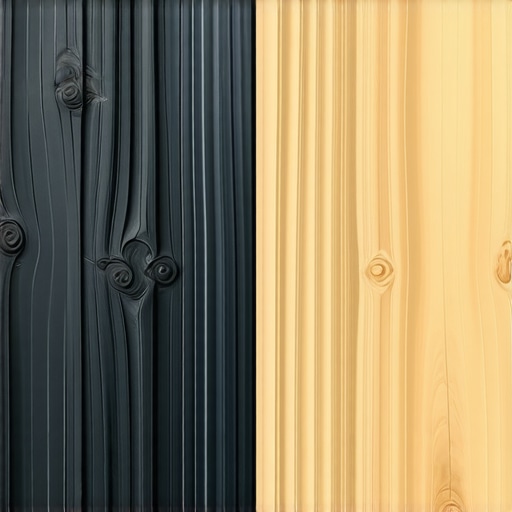
I once walked into a house where a $15,000 wide-plank walnut floor was cupping so bad it looked like a potato chip because the installer didn’t check the crawlspace humidity. The homeowner thought it was just the afternoon sun hitting the floor too hard, but the truth was much wetter and more expensive. You can smell the oak dust and the machine oil on my hands as I tell you this, because I have spent twenty-five years on my knees fixing these exact mistakes. A floor is not just a pretty face for your house. It is a structural engineering project. When you see a change in your flooring, you need to know if you are fighting the sun or fighting a leak. It is the difference between buying a new rug and tearing out your subfloor. It will buckle if you ignore it. Buy a moisture meter. It is the only way to be sure.
The visual betrayal of your hardwood investment
Water damage and sun fading often look similar to the untrained eye because they both alter the color and finish of your wood or laminate floors. However, the physical texture and the localization of the damage are the primary indicators that distinguish a UV reaction from hydrostatic pressure or capillary action. Sunlight typically bleaches the wood uniformly across the area of exposure, while water creates irregular staining, dark edges, and physical deformation of the wood fibers. You have to look at the wood cells. Wood is hygroscopic. It drinks. When it drinks too much, the cell walls swell and the lignin bonds begin to fail. Sunlight is a different animal. It is a photochemical reaction that breaks down the tannins in the wood, especially in species like Brazilian Cherry or American Walnut. One is a surface issue. The other is a structural failure.
“A floor is only as good as the subfloor beneath it; deflection is the enemy of every joint.” – Master Flooring Axiom
The microscopic war between ultraviolet rays and wood lignin
Sun fading is a photochemical degradation process where ultraviolet radiation breaks down the lignin and extractives within the wood. This process is most visible in hardwood floors located near large windows or glass doors where UV rays are concentrated. The damage is strictly aesthetic and does not affect the structural integrity of the plank. You can test this easily. Move a piece of furniture that has been sitting in the sun for a year. If there is a perfect, dark shadow of the chair on the floor, you have sun fading. The wood is not damaged, it is just tanned. The physics of this are simple. Photons hit the wood surface and excite the electrons in the organic compounds. This causes a color shift. In some woods, like cherry, it gets darker. In most others, it bleaches out. It stays flat. It does not move. It does not click when you walk on it. It just looks different.
Why water creates a structural nightmare that light cannot match
Water damage involves moisture infiltration that causes dimensional instability in the flooring material and the subfloor. Unlike the sun, water causes cupping, crowning, and buckling because the cellulose fibers in the wood absorb liquid H2O and expand. When the bottom of the board gets wetter than the top, it cups. The edges rise. You can feel this through your socks. If you are looking at laminate, the HDF core acts like a sponge. It will swell at the seams. That is why they call it peaked seams. Once that core swells, it never goes back. You can dry it out with a dehumidifier, but the glue bonds are broken. The floor is toast. I have seen guys try to sand down a cupped floor while it was still wet. That is a crime. You end up with a crowned floor once it finally dries out. You have to wait. You have to measure. You have to be patient.
| Characteristic | Water Damage | Sun Fading |
|---|---|---|
| Texture | Cupping, crowning, or soft spots | Smooth to the touch |
| Color | Dark stains, black edges, or grey rot | Pale, bleached, or yellowish |
| Smell | Musty, damp, or earthy odors | No change in odor |
| Scope | Random patches or near water sources | Uniform areas near windows |
| Structural | Floorboard movement or soft grout | Integrity remains intact |
The 1/8 inch that ruins everything
Expansion gaps are the most misunderstood component of a professional floor installation. If an installer fails to leave at least a quarter-inch gap around the perimeter, even minor humidity changes can cause the entire floor to lift off the subfloor. This is often confused with water damage because the floor feels spongy. But if you pull the baseboard and see the wood tight against the drywall, you found your ghost. The floor has nowhere to go. It is like a bridge without expansion joints. In showers or bathrooms, this issue is magnified. If the grout is cracking at the corners, it is usually because of deflection or lack of movement joints. People think grout is waterproof. It is not. It is a sieve. The waterproof membrane behind the tile is what matters. If that fails, the subfloor starts to rot, and no amount of sun is going to fix that. You will see efflorescence, which is that white crusty powder. That is the salt coming out of the concrete or the thin-set. It is a dead giveaway for a leak.
“Moisture is the primary driver of dimensional instability in all cellulose-based flooring products.” – Hardwood Engineering Standards
Detecting the invisible threat in your subfloor
Moisture meters are the only objective tools for diagnosing floor failure. A pinless meter uses electromagnetic signals to check the moisture content of the wood without leaving holes, while pin-type meters measure electrical resistance between two probes. If your hardwood floors show a moisture content (MC) of more than 4 percent difference between the subfloor and the finish floor, you are in the danger zone. I have seen slabs in Houston that were sweating because the vapor barrier was punctured during construction. The homeowner thought the laminate was just cheap. No, the laminate was being attacked from below. In Phoenix, the opposite happens. The air is so dry the wood shrinks until the tongue and groove joints pull apart. That is not sun damage. That is desiccation. You need a hygrometer to track the relative humidity in your house. Keep it between 30 and 50 percent. Anything else is asking for trouble.
- Check the edges of the boards for raised lips or ridges.
- Use a flashlight at a low angle to spot unevenness in the finish.
- Inspect the grout lines for hairline fractures or powdering.
- Smell the area specifically for microbial growth or mustiness.
- Move a rug to see the shadow of the original color versus the exposed area.
How laminate reacts to the dual threats of heat and moisture
Laminate flooring is particularly vulnerable to moisture because its core is made of compressed wood fibers held together by resins. While sun fading will only affect the decorative paper layer, water damage will cause the edges to swell and the wear layer to delaminate. Most people want the thickest underlayment they can find for their laminate. That is a mistake. Too much cushion actually causes the locking mechanisms on LVP or laminate to snap under pressure. It creates too much vertical movement. You want a high-density underlayment, not a soft one. If your laminate looks like it is peaking at the joints, it is usually a moisture issue from the subfloor or improper mopping. You should never use a steam mop on laminate. You are literally injecting high-pressure vapor into the organic core. It is a death sentence for the floor. If the floor is just fading, the joints will stay tight and flat. If it is water, the joints will be the first thing to tell the truth.
The specific failure points of grout in humid environments
Grout failure is often the first sign of water intrusion in tiled areas or showers. When water seeps behind the tile, it weakens the bond between the thin-set and the substrate, leading to cracked or missing grout. This is not sun damage. UV rays might discolor epoxy grout over a decade, but they will not make it crumble. If you can scrape the grout out with your fingernail, it is saturated. In high-humidity regions, the concrete slab can hold onto moisture for months. You have to check the calcium chloride levels before you ever lay a floor down. I have seen commercial jobs ruined because the GC was in a hurry and didn’t let the slab cure for the full 28 days. The moisture comes up, hits the adhesive, and turns it back into a liquid. It is called re-emulsification. It smells like ammonia and looks like a mess. If you see that, the sun is the least of your worries. You have a chemistry problem that requires a complete tear-out.
A diagnostic guide for the panicked homeowner
Identifying the root cause of flooring degradation requires a systematic approach that looks at both environmental factors and physical symptoms. Start with the touch test. Run your hand across the area. Is it flat? If it is flat but off-color, it is likely sun fading. Is it wavy? If it is wavy, it is water. Check the proximity to water sources like dishwashers, refrigerators, or external walls. In basements, look for efflorescence on the concrete nearby. If you are in a humid climate, check your HVAC settings. A floor is a living thing. It breathes. It moves. If you treat it like a piece of plastic, it will fail you. Invest in window films to block UV if you have sunlight issues. Invest in a sump pump and a dehumidifier if you have water issues. Do not ignore the warning signs. A small cupped area today is a mold colony tomorrow. Keep your moisture meter handy and your subfloor dry. That is the only way to make a floor last fifty years.