
The day the walnut potato chip happened
I once walked into a house where a $15,000 wide-plank walnut floor was cupping so bad it looked like a potato chip because the installer didn’t check the crawlspace humidity before the nails went in. That job taught me that wood is a living, breathing mechanical system, not a static product you buy off a shelf. When you see a red wine stain on a light white oak floor, you are not just looking at a mess, you are looking at a chemical intrusion into the cellular structure of the timber. Most people panic and reach for bleach or abrasive cleaners. That is a mistake that ruins the finish. My hands are stained with years of oil-based poly and sawdust, and I have seen every DIY fix in the book. The white wine trick is one of the few that actually relies on basic chemistry rather than luck. It involves using the clear enzymes and tartaric acids in white wine to neutralize the anthocyanins, which are the pigments in red wine. This is not magic. It is physics and solvent interaction. If you treat your floor like a high-performance engine, you need the right fuel to clean it.
Molecular mechanics of a red wine spill
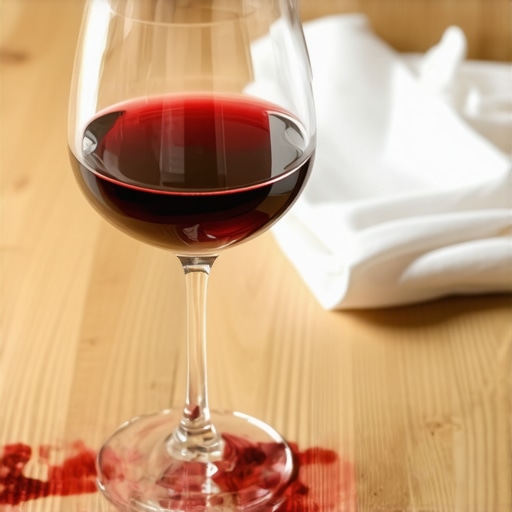
Red wine stains light hardwood because the porous nature of the wood fibers allows liquid to migrate past the finish and into the tracheids. This occurs when the surface tension of the wine overcomes the protective barrier of the polyurethane or hard-wax oil coating on the planks. Hardwood floors are composed of millions of microscopic tubes. When red wine hits the surface, those tubes act like straws. The pigment in red wine, known as anthocyanin, is water-soluble but highly adhesive to organic cellulose. If you have light wood like Maple or White Oak, these pigments are immediately visible. Light wood has fewer natural tannins to mask the intrusion. The chemical secret to using white wine as a cleaner lies in its acidity and its role as a solvent. White wine contains a similar chemical structure to red wine but without the chromophores. When you pour a small amount of white wine onto a fresh red wine stain, it dilutes the pigment and prevents it from bonding to the wood fibers. It keeps the pigment in a liquid state for longer, allowing you to lift it with a clean cotton rag before it undergoes the oxidation process that turns a spill into a permanent blemish.
The finish failure that invites the stain
The reason your floor stained in the first place is likely because your finish is failing. I see this in high-traffic areas near kitchens or entryways where the mil-thickness of the polyurethane has worn down to almost nothing. In my twenty five years on the job, I have noticed that homeowners often ignore the dull spots. Those dull spots are where the wood is thirsty. When wood is thirsty, it will drink anything. This includes wine, water from leaking showers, or even the moisture from a damp mop. The cellular structure of the wood is designed to move fluids. If the protective seal is gone, you are basically living on a giant sponge. We measure this with a moisture meter. A healthy floor should have a consistent moisture content between six and nine percent depending on the local climate. If your subfloor is pushing moisture up through the planks, it weakens the bond of the finish. This makes the wood even more susceptible to staining from the top down. It is a pincer movement of moisture that destroys the integrity of the installation.
“A floor is only as good as the subfloor beneath it; deflection is the enemy of every joint.” – Master Flooring Axiom
Why white wine actually works on oak
White wine works on light hardwood because it acts as a mild solvent that breaks down the darker pigments of red wine without introducing harsh chemicals that strip the wood finish. The tartaric acid in the white wine prevents the red pigments from setting into the grain patterns. You have to understand the Janka Hardness Scale to realize why some woods are harder to clean than others. White Oak has a Janka rating of 1360. It is dense, but it has large open pores. Red wine loves those pores. If you use a heavy chemical cleaner, you might remove the stain, but you will also create a chemical burn in the finish. This is why I tell people to use a bit of Sauvignon Blanc or Pinot Grigio. It has a pH level that is compatible enough with most modern water-based finishes to avoid damage while being acidic enough to lift the red color. You apply it, let it sit for no more than thirty seconds, and blot. Never scrub. Scrubbing pushes the liquid deeper into the springwood, which is the softer part of the grain that grows faster and is more absorbent.
| Wood Type | Janka Rating | Porosity Level | Stain Risk |
|---|---|---|---|
| White Oak | 1360 | High | Extreme |
| Hard Maple | 1450 | Low | Moderate |
| Black Walnut | 1010 | Medium | High |
| Brazilian Cherry | 2350 | Very Low | Low |
The 1/8 inch that ruins everything
Precision is the difference between a floor that lasts fifty years and one that needs replacing in five. When I install a floor, I am looking for a levelness of 1/8 inch over a ten-foot radius. If the subfloor has a dip, the planks will flex. That flexing creates microscopic cracks in the finish. You cannot see them with the naked eye, but they are there. When you spill red wine, it finds those cracks. It travels down into the tongue and groove joint. Once wine gets into the joint, the white wine trick will not save you. At that point, the liquid is sitting on the raw, unsealed edges of the wood. This leads to edge-swelling and eventual rot. I have seen laminate floors do the same thing. People think laminate is bulletproof, but the core of most laminate is high-density fiberboard, which is basically compressed sawdust and glue. If wine hits a laminate seam, it is game over. The edges will mushroom and the floor will never be flat again. Always check your joints. If you can feel a lip between planks, your floor is vulnerable.
Maintenance routines for high performance surfaces
Maintaining a light wood floor requires a strict adherence to moisture control and the use of pH-neutral cleaners to ensure the wear layer remains intact for its full lifespan. You must avoid abrasive tools that create micro-scratches where liquids can pool. Most people think the thickest underlayment is the best. It is not. While most people want the thickest underlayment, too much cushion actually causes the locking mechanisms on LVP or engineered wood to snap under pressure. You want a high-density, low-profile underlayment that provides support. Here is my professional checklist for floor longevity:
- Use a microfiber dust mop daily to remove abrasive grit.
- Check the grout lines in adjacent tile areas for cracks that could leak moisture.
- Ensure humidity is kept between 30 and 50 percent to prevent expansion gaps.
- Inspect the wear layer every six months for signs of thinning.
- Never use steam mops on hardwood or laminate floors.
Regional climate and finish durability
The climate where you live dictates how your floor handles a spill. In a high-humidity environment like New Orleans, the wood is already expanded. The pores are open. A spill here is a bigger emergency than it is in a dry climate like Denver. In dry areas, the wood shrinks, creating gaps between the boards. If you spill red wine in Denver, it goes straight to the subfloor. In Houston, the swampy humidity means solid wood is a risk, so most pros install engineered cores. These cores are more stable, but they still have a real wood veneer on top. That veneer is usually only 3mm to 6mm thick. You cannot sand it many times. If you stain it deep with red wine and cannot get it out with the white wine trick, you might only have one or two chances to sand it before you hit the glue line. Glue does not take stain. Once you hit the glue, the floor is ruined. This is why immediate action and chemical neutrality are vital for the modern homeowner.
“A floor is only as good as the subfloor beneath it; deflection is the enemy of every joint.” – Master Flooring Axiom