
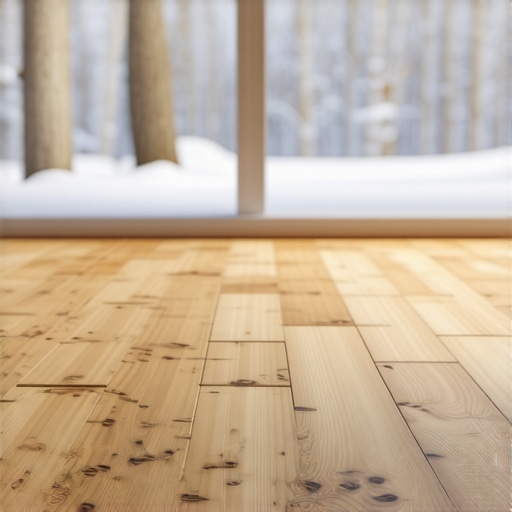
I once walked into a house where a $15,000 wide-plank walnut floor was cupping so bad it looked like a potato chip because the installer didn’t check the crawlspace humidity. It was a heartbreaking sight for any professional. The owner thought the wood was defective. The truth was far more scientific. Wood is a living, breathing material even after it has been milled into planks. It reacts to the environment with a predictability that many homeowners and fly-by-night contractors ignore. When winter arrives, the air inside your home dries out as your furnace kicks into high gear. This drop in relative humidity pulls moisture right out of the cellular structure of your hardwood floors, causing each individual board to shrink. If the installation did not account for this seasonal shift, you end up with those unsightly, wide gaps that collect dirt and look like a structural failure.
The ghost in the expansion gap
Floor gaps in winter occur because wood is hygroscopic, meaning it absorbs and releases moisture to stay in equilibrium with the surrounding air. When indoor relative humidity drops below 30 percent, wood cells lose bound water and contract. This physical shrinkage manifests as gaps between the floorboards. You cannot fight the laws of physics. Every piece of timber has a specific gravity and a tangential shrinkage coefficient. For example, white oak has a different movement profile than domestic maple or exotic Brazilian cherry. When the heat goes on, the water molecules stored within the lignin and cellulose fibers of the wood evaporate into the dry air of your living room. This is not just a surface level event. It happens at a molecular level throughout the entire thickness of the 3/4 inch solid plank. If your installer used wide-plank boards, the gaps will be even more noticeable because there are fewer joints to distribute the total movement across the room.
Why your subfloor is lying to you
The subfloor acts as the foundation for your flooring performance and often hides moisture issues that lead to winter gapping. If a concrete slab or plywood subfloor has high moisture content during installation, the boards will eventually shrink excessively once the house stabilizes in the winter. I spent three days grinding concrete on a job last month just so the floor wouldn’t click like a castanet. People think the underlayment will hide the dip. It won’t. If your subfloor is not flat to within 1/8 inch over a 10 foot radius, the boards will move vertically when you walk on them. This vertical movement stresses the tongue and groove joints. In the winter, when the wood is already at its smallest physical dimension, this stress causes the joints to pull apart even faster. A subfloor that is holding onto 12 percent moisture while the hardwood is at 6 percent is a recipe for a disaster that only shows its face when the snow starts falling.
“A floor is only as good as the subfloor beneath it; deflection is the enemy of every joint.” – Master Flooring Axiom
The molecular dance of cellulose and water
To understand why laminate and hardwood behave differently, we have to look at the core construction. Laminate is essentially a high-density fiberboard (HDF) core topped with a photographic layer and a wear layer. While it is more stable than solid wood, it is not immune to the dry air of January. The HDF core contains resins and wood fibers that still respond to vapor pressure. When the humidity drops, the entire floor system shrinks as a single unit. This is why laminate requires a substantial expansion gap at the perimeter of the room. If you or your installer jammed the flooring tight against the baseboards or a heavy kitchen island, the floor has no room to move. In the winter, the floor tries to pull toward the center of the room. If it is pinned down by a heavy object, the locking mechanisms will literally snap or pull apart, leaving a gap in the middle of your kitchen floor.
Hardwood floors and the shower humidity trap
It sounds counterintuitive, but the moisture from your showers can actually make winter gapping worse in the long run. If you have a master bathroom with a shower that vents poorly, that localized humidity can cause the wood nearby to swell. When the rest of the house is bone dry, you end up with extreme tension between the humid bathroom-adjacent planks and the dry bedroom planks. This localized stress often results in grout lines cracking at the transitions or the wood splitting along the grain. I always tell clients to run their vent fans for at least twenty minutes after a shower. You are trying to maintain a consistent environment across the entire floor plane. Sudden spikes in moisture followed by the dry heat of a furnace are what lead to the most violent wood movements.
The 1/8 inch that ruins everything
Precision is everything in flooring. We talk about the 1/8 inch rule because it is the threshold of human perception and mechanical failure. If your floor is gapping more than 1/8 inch, you are looking at a climate control issue or an installation error. Most people think they need the thickest underlayment possible for their laminate or LVP. This is a mistake. While most people want the thickest underlayment, too much cushion actually causes the locking mechanisms on LVP to snap under pressure. A thick, squishy pad allows the joint to deflect too much. When the floor is already stressed by winter shrinkage, that extra deflection is the final straw that breaks the click-lock joint. You want a high-density, low-compression underlayment that supports the joint while providing the necessary thermal break from the subfloor.
| Flooring Type | Janka Hardness | Movement Risk | Winter Gap Fix |
|---|---|---|---|
| Solid White Oak | 1360 | High | Humidification |
| Engineered Oak | 1360 | Medium | Acrylic Filler |
| Laminate (HDF) | N/A | Low | Floor Straps |
| Luxury Vinyl (SPC) | N/A | Very Low | Joint Tapping |
Technical steps to close the gaps
If you are staring at gaps right now, do not reach for the wood putty immediately. If you fill those gaps while the wood is at its smallest, the putty will be squeezed out and ruin your finish when the wood expands in the summer. To fix floor gaps in the winter, you must first stabilize the indoor environment to 35-45 percent humidity. Once the environment is stable, use a specialized flooring jack or a suction-cup floor strap to physically pull the planks back together, then secure them according to manufacturer specs. This is especially effective for floating laminate floors where a gap has opened up at a butt joint. For solid hardwood floors, the solution is often much more about long-term humidity management than a quick physical fix.
- Install a whole-house humidifier to maintain 40% Relative Humidity.
- Use a digital hygrometer to monitor every room.
- Avoid using steam mops which force moisture into the dry joints.
- Check that your perimeter expansion gaps are not blocked by debris.
- Ensure kitchen islands are not bolted through floating floors.
“Wood flooring is a product of nature, and its performance is governed by the laws of thermodynamics and moisture equilibrium.” – NWFA Technical Guidelines
The regional climate factor
In the Northeast or the Midwest, the swing in humidity between a humid August and a frigid January can be as high as 60 percent. This is why acclimation is the most ignored step in a bad installation. If you bring wood from a heated warehouse and install it immediately into a house that hasn’t had the heat turned on yet, you are asking for a disaster. The wood must sit in the room where it will be installed for at least 7 to 10 days to reach its Equilibrium Moisture Content. This allows the cells to stabilize. If you skip this, your winter gaps won’t just be 1/8 inch. They will be wide enough to drop a nickel through. Professional installers use moisture meters to verify that the subfloor and the flooring are within 2 to 4 percent of each other before the first nail is ever driven.