
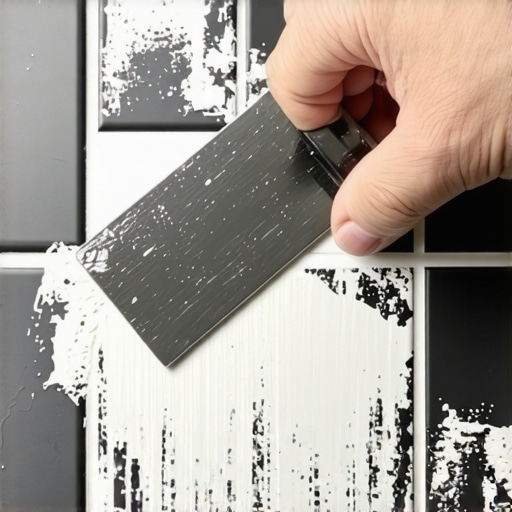
Most guys skip the leveling compound. They think the underlayment will hide the dip. It won’t. I spent three days grinding concrete on a job last month just so the floor wouldn’t click like a castanet. That job taught me that shortcuts always surface later. Whether it is a dip in the slab or a layer of grout haze that looks like a ghost on the tile, you cannot hide from physics. I have spent 25 years on my knees with a moisture meter and a level. I have seen million-dollar mansions with floors that sound like popcorn because someone did not respect the subfloor. Grout haze is the same brand of disrespect. It is a failure of process. It is a microscopic layer of polymer-modified Portland cement left on the tile surface after installation. If you leave it too long, it becomes part of the tile. Removing it requires breaking the bond without scratching the glazed surface. The razor blade trick works by using mechanical force at a specific 45-degree angle to shear the residue from the ceramic or porcelain body. It is a precise operation. It requires a steady hand and a deep understanding of surface hardness.
The hidden residue on your porcelain
Grout haze is a microscopic layer of polymer-modified Portland cement left on the tile surface after installation. Removing it requires breaking the bond without scratching the glaze. The razor blade trick works by using mechanical force at a specific angle to shear the residue from the ceramic or porcelain body. This residue is not just dust. It is a chemical bond. When you mix grout, you are initiating a hydration reaction. Calcium silicates react with water to form calcium silicate hydrate crystals. These crystals grow into the microscopic pores of the tile. If you do not wipe the tile perfectly during the initial set, those crystals lock onto the surface. This is especially true with modern high-performance grouts that contain latex or epoxy modifiers. These polymers are designed to be sticky. They are designed to stay put. When they dry on the face of a tile, they create a cloudy film that resists standard household cleaners. You cannot just mop this away. You need to understand the Mohs scale of hardness. A standard steel razor blade has a hardness of about 5.5. Most porcelain tiles have a hardness of 7 or 8. This gap in hardness is what allows us to scrape the haze without damaging the floor. However, if you are working with soft natural stone or certain glass tiles, this trick will ruin your investment. You must know your material before you touch it with steel.
The physics of the steel edge
The razor blade trick relies on the principle of shear force applied at a low angle to overcome the adhesive bond of the grout residue. By maintaining a forty-five degree pitch, the blade slides over the harder tile surface while catching the raised edges of the softer grout film. This is not about hacking at the floor. It is about a controlled glide. You need a brand-new, industrial-grade carbon steel blade. A used blade has microscopic burrs that will catch on the tile and cause scratches. I only use blades once. As soon as I feel a drag, the blade goes in the bin. The chemistry of the haze matters too. Standard cementitious grout is easier to scrape than epoxy grout. Epoxy is a two-part resin system. It does not just dry, it cures. If you have epoxy haze, a razor blade might not be enough. You might need heat to soften the resin. But for 90 percent of the jobs I see, the blade is the surgeon’s tool of choice. You must also consider the lubrication. Scrape a dry tile and you risk creating metal marks. I use a spray bottle with a very weak solution of white vinegar and water. The acid helps to slightly weaken the calcium carbonate bond of the grout while providing a slick surface for the blade to travel across. It is a delicate balance of mechanical and chemical action.
“A floor is only as good as the subfloor beneath it; deflection is the enemy of every joint.” – Master Flooring Axiom
Why your subfloor is lying to you
Subfloor flatness is often confused with subfloor levelness, but for grout integrity, flatness is the only metric that matters. A subfloor with a dip greater than one-eighth of an inch over ten feet will cause the tile to flex, leading to grout cracking and haze migration. I have seen guys try to level a floor with thin-set. That is a crime. Thin-set is an adhesive, not a filler. It shrinks as it hydrates. If you have a deep pocket and you fill it with thin-set, the tile will sink as the water leaves the mortar. This creates a lip. When you go to grout that lippage, you inevitably leave more haze because the sponge cannot reach the recessed areas. The razor blade then becomes your only hope to clean up the mess left by poor prep work. I always tell my apprentices that if they spend three days on the subfloor, the tile will lay itself in three hours. If they spend three hours on the subfloor, they will spend three weeks fixing the tile. This is why I am obsessed with self-leveling underlayments. I want a surface that is as flat as a pool table before I even open a bag of grout. When the surface is flat, the grout wipe is consistent. When the wipe is consistent, the haze is minimal. The razor blade trick is a recovery move. It is what we do when the process fails or the environment is too hot and the grout sets up too fast.
The 1/8 inch that ruins everything
Precision in flooring is measured in fractions of an inch, where a gap of one-eighth of an inch can lead to catastrophic failure of the locking mechanism or grout joint. In the context of grout haze, this minute measurement often represents the thickness of the residue layer. If the haze is too thick, a razor blade will simply skip over it. You have to understand the physical limits of the tool. Many installers forget that temperature and humidity play a massive role in how grout behaves. If you are working in a house without HVAC, the grout will flash dry. This leaves a thick, stubborn haze that feels like concrete because it is concrete. In these cases, you are not just scraping a film. You are essentially performing a miniature demolition on the surface of your tile. I have seen people try to use this trick on hardwood floors. That is a disaster. Hardwood is a living, breathing organic material. A razor blade will slice through the cellular structure of the oak or maple like butter. The same applies to laminate. Laminate is essentially a photograph glued to a fiberboard core with a melamine wear layer. Once you scratch that wear layer, the floor is dead. It will swell at the first sign of moisture. Keep the blades for the tile and the showers. That is where they belong. In a shower, the stakes are even higher. If you scratch the tile in a shower, you create a home for mold and mildew to grow. The smooth glaze is your first line of defense.
| Grout Type | Haze Risk Level | Hardness (Mohs) | Removal Difficulty |
|---|---|---|---|
| Sanded Grout | High | 3.0 – 4.0 | Moderate |
| Unsanded Grout | Medium | 2.5 – 3.5 | Easy |
| Epoxy Grout | Extreme | 5.0 – 6.0 | Very High |
| Acrylic Grout | Low | 2.0 – 3.0 | Low |
A chemical war on your tile surface
The interaction between grout chemicals and tile glazes is a battle of pH levels and crystalline growth. When grout haze persists, it is often because the polymers have cross-linked with the surface tension of the tile, requiring mechanical intervention to break the seal. I often see homeowners buy the cheapest grout they can find at big-box retailers. These products are loaded with fillers. They are difficult to work with. They leave a mess. When I walk onto a job, I bring my own materials. I want grout with high polymer content for flexibility, but that comes with the price of a more difficult cleanup. The razor blade is the equalizer. It allows me to use the best materials without fearing the cleanup. However, you must be careful with the metal itself. Not all razor blades are equal. Some are stainless steel. Others are high-carbon steel. Carbon steel is harder but rusts. Stainless is softer. I prefer carbon steel for porcelain because it holds an edge longer. If you are working on a large floor, you might go through fifty blades. Do not be cheap. A dull blade is a dangerous tool. It requires more pressure. More pressure leads to slips. Slips lead to cut fingers or gouged grout joints. I have a scar on my thumb from 1998 that reminds me of this every single day. The blade should do the work, not your muscles. If you are straining, you are doing it wrong.
“Cementitious grout is a porous matrix; once it hydrates, it becomes a structural component of the assembly.” – TCNA Handbook Principles
The checklist for a glass finish
Follow this protocol to ensure you do not destroy your tile while trying to save it. This is the exact process I use on my high-end commercial jobs. It has never failed me. It will not fail you if you have the patience to do it right.
- Vacuum the floor three times to remove any sand or grit that could get caught under the blade.
- Test a small, inconspicuous area behind a door or under a cabinet to ensure the tile does not scratch.
- Use a fresh high-carbon steel razor blade for every ten square feet of tile.
- Maintain a strict 45-degree angle. Never use the corners of the blade.
- Keep the surface lubricated with a light mist of water or a specialized haze remover.
- Wipe the area with a microfiber cloth immediately after scraping to check your progress.
- Dispose of used blades in a puncture-proof container.
The regional reality of moisture
The climate where you live changes everything. If you are in the swampy humidity of Houston, your grout will stay wet for a long time. This gives you a longer working window, but it also means the polymers stay active longer. They can seep deeper into the pores. If you are in the dry heat of Phoenix, the grout will dry before you can even get your sponge wet. This is where the razor blade trick is a life saver. In dry climates, haze is an inevitability. The water evaporates so fast that the cement particles crash out of solution and onto the tile face. I have seen guys in Arizona try to add more water to the mix to slow it down. That is a mistake. Too much water weakens the grout. It causes pigment washout. It leads to soft joints that will crumble in a year. You have to mix it to the manufacturer’s specifications. No exceptions. If that means you have to scrape the whole floor with a razor blade the next day, then that is what you do. You do not compromise the structural integrity of the grout for the sake of an easy cleanup. A floor is a performance surface. It has to withstand thousands of pounds of pressure and constant abrasion. The grout is the shock absorber. It has to be perfect.
The final word on tile maintenance
While most people want the thickest underlayment, too much cushion actually causes the locking mechanisms on LVP to snap under pressure. I know we are talking about grout, but the principle of structural rigidity applies everywhere. People think a soft floor is a good floor. They are wrong. A floor should be solid. When you walk on it, it should not move. If your tile moves, your grout will crack. If your grout cracks, moisture gets into the subfloor. Then you have rot. Then you have a five-figure repair bill. The razor blade trick is about more than just aesthetics. It is about removing the residue so you can see the true state of your joints. It allows you to inspect the bond. It allows you to ensure that the installation is up to NWFA and TCNA standards. Do not be afraid of the blade. Be afraid of the shortcut. Be afraid of the installer who says it is good enough. It is never good enough until it is perfect. I have spent my life chasing that perfection. It starts with the subfloor and it ends with a clean, haze-free tile. That is the only way I sleep at night. That is the only way you should accept a floor in your home. Use the blade. Take your time. Respect the chemistry of the materials. Your floor will thank you for it in twenty years when it still looks like the day it was laid.