
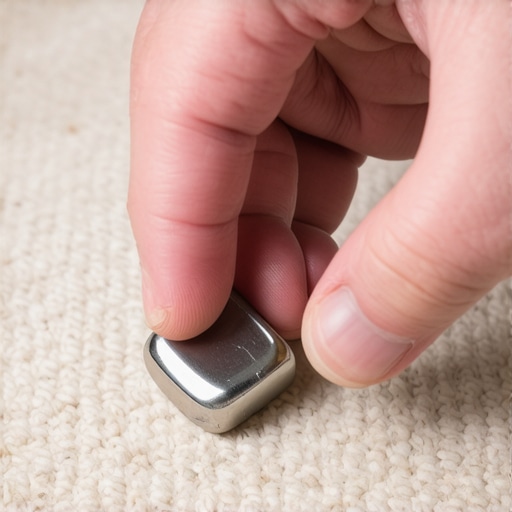
The magnet trick for finding hidden floor screws under carpet involves using high-powered neodymium magnets to locate the precise heads of steel fasteners through thick nylon or wool fibers and dense polyurethane padding. This technique allows contractors to identify the structural attachment points of the subfloor without pulling up the entire carpet installation. By locating these screws, you can tighten or replace them to eliminate the friction-based squeaks caused by wood-on-wood movement or shank deflection against the subfloor board. If you have ever lived with a floor that groans every time you step on a specific spot, you know the frustration of a subfloor that was never properly secured. Most guys skip the leveling compound. They think the underlayment will hide the dip. It won’t. I spent three days grinding concrete on a job last month just so the floor wouldn’t click like a castanet because the original installer thought a few extra staples would make up for a quarter-inch trough in the slab. They were wrong. A floor is a structural system, not a rug. If the base is junk, the finish is junk. Most homeowners think their carpet is the problem when the real culprit is a zinc-plated screw that has backed out of a Douglas Fir joist by just a few millimeters. This tiny gap allows the plywood to travel up and down the shank of the fastener, creating a high-pitched chirp that can drive a person mad. The magnet trick is the only way to find these ghosts without destroying the room. You need a magnet with a pull force of at least 20 pounds. Rare earth magnets are the standard here because ceramic magnets lack the flux density to penetrate the primary and secondary backings of a heavy-duty frieze carpet. When you drag that magnet across the surface, it will suddenly snap to a specific point. That is your target. This is where the structural integrity of your home is failing you in silence.
The physics of subfloor deflection and mechanical failure
Subfloor deflection is the vertical movement of the flooring material under a live load, which occurs when the joist spacing or subfloor thickness is insufficient to support the weight of the occupants. When a floor deflects, it puts immense stress on the fasteners, often causing the threads to lose their grip in the wood fibers of the support members below.
“A floor is only as good as the subfloor beneath it; deflection is the enemy of every joint.” – Master Flooring Axiom
This movement is particularly problematic when transitioning between different flooring types. For instance, moving from the soft cushion of a bedroom into a bathroom with showers and heavy tile requires a perfectly rigid substrate. If the subfloor moves near the bathroom threshold, the grout lines will crack, and the waterproof membrane under the tile will eventually fail. The same logic applies to hardwood floors. If you install solid oak over a subfloor that is already squeaking under carpet, those squeaks will simply telegraph through the new wood. You cannot hide structural failure with aesthetic upgrades. The magnet trick allows us to find the existing screws and add new ones into the joist without the guesswork that leads to a swiss-cheese subfloor. We are looking for the joist centers. Once the magnet finds a screw, you know exactly where the timber runs. I have seen guys try to use stud finders through carpet. It is a joke. The density of the padding confuses the sensors. A magnet does not lie. It reacts to the iron in the steel. If it sticks, there is metal. If there is metal, there is a joist. It is basic physics applied to home repair. You must understand the metallurgy of the fasteners too. Older homes often use nails, which have no threading to provide mechanical resistance. These nails are the primary cause of floor noise. By finding them with a magnet, you can drive a specialized break-away screw right next to them, pulling the plywood tight against the joist and permanently silencing the floor.
Why your subfloor is lying to you
Subfloor flatness is often confused with being level, but in the world of professional flooring, flatness is the only metric that prevents material failure. A floor can be sloped and still be perfectly functional, but a floor that is not flat within 1/8 inch over a 10-foot radius will eventually destroy any locking mechanism in a laminate installation. I once saw a $15,000 wide-plank walnut floor cup because the installer ignored the subfloor moisture. The boards literally curled because the plywood beneath them was pulling moisture from a damp crawlspace. If that installer had used the magnet trick to find the joists and then checked the moisture levels of the wood at those specific points, he would have known the floor was a ticking time bomb. The subfloor looks flat when you look at it from a standing position. But when you get on your knees with a 10-foot straight edge, the truth comes out. There are dips. There are crowns. There are screw heads that have popped up due to seasonal expansion and contraction. In the Pacific Northwest, where the humidity is constantly swinging, wood is always moving. A screw that was flush in July might be a 1/16th of an inch high in January. That tiny bump is enough to wear a hole through the back of your carpet or snap the tongue off a piece of engineered wood. By using the magnet trick, you can locate these high points. You can then use a specialized carpet tool to drive the screw deeper without snagging the fibers. This is the difference between a handyman and a floor architect. One covers up the problem. The other solves the engineering failure. I have spent decades listening to floors. They tell you exactly where they are weak. You just have to know how to listen and where to look. The magnet is your stethoscope.
The technical breakdown of fastener performance
The following table compares the most common fasteners found during a magnetic sweep and their impact on floor stability. Understanding these materials is vital for a successful repair.
| Fastener Type | Magnetic Signature | Pull-out Strength | Risk Factor |
|---|---|---|---|
| Common Wire Nail | Strong | Low | High squeak potential |
| Ring Shank Nail | Strong | Medium | Moderate stability |
| Zinc Plated Screw | Very Strong | High | Shear risk in old wood |
| Ceramic Coated Screw | Moderate | Very High | Low failure rate |
| Stainless Steel Screw | Weak/None | High | Corrosion resistance |
As the table shows, if you are searching for fasteners in a high-moisture environment like a laundry room or near entryways, you might run into stainless steel. This is where the magnet trick fails. Stainless steel is often non-magnetic or only weakly magnetic depending on the alloy. If your magnet is not sticking but the floor is still squeaking, you likely have stainless fasteners or even copper nails in some high-end older builds. In those cases, you have to rely on a structural survey of the joists from below. But for 90 percent of suburban homes, the zinc-plated screw is king. It is cheap. It is magnetic. And it is usually the thing that has failed.
The 1/8 inch that ruins everything
Underlayment compression is a factor that most DIY installers completely ignore, leading to the eventual collapse of the floor’s locking system. While most people want the thickest underlayment, too much cushion actually causes the locking mechanisms on laminate or LVP to snap under pressure. When the subfloor has a dip that you did not fill with a Portland-based leveling compound, the flooring material has to bridge that gap. When you walk over it, the floor flexes into the void. If you have a thick, squishy pad under there, it allows for even more movement. This vertical travel is what breaks the click-lock joints. You think you are being kind to your feet, but you are being cruel to your floor. The magnet trick helps you identify these voids. Often, a dip in the subfloor is caused by a joist that has twisted or bowed downward. By finding the fasteners on either side of the dip, you can map out the topography of the structural failure.
“Mechanical fasteners are the only reliable method for securing wood substrates; adhesives are merely a secondary backup.” – Structural Flooring Standards
You cannot just pour leveler over a squeak and hope for the best. You have to mechanically fasten the wood first. This is especially true in areas with high humidity. Wood is a hygroscopic material. It breathes. It swells. It shrinks. If it is not bolted down, it will find a way to move. I have seen hardwood floors buckle so hard they popped the baseboards off the wall. All because the installer did not secure the subfloor to the joists at 12-inch intervals. They did not check the