
I spent three days grinding concrete on a job last month just so the floor wouldn’t click like a castanet. Most guys skip the leveling compound. They think the underlayment will hide the dip. It won’t. I have spent twenty five years on my knees with a moisture meter and a straight edge, and if there is one thing I have learned, it is that a floor is a performance surface, not a rug. When you walk across a room and hear that cheap, hollow thud, it is not the laminate’s fault. It is a failure of the structural interface between the plank and the slab. My hands are stained with wood glue and my boots are heavy with the dust of a thousand rip cuts, but I will tell you the truth about that sound. It is the sound of air where there should be solid support. It is the sound of a homeowner who took a shortcut or an installer who wanted to get home early. To fix it, you have to understand the physics of deflection and the chemistry of the high density fiberboard sitting in your living room.
The physics of the drum effect
The hollow sound in laminate occurs when a vertical gap exists between the flooring and the subfloor, creating an echo chamber. This happens because of subfloor deflection, improper underlayment selection, or lack of perimeter expansion gaps which prevents the floor from laying flat against the base. When your foot strikes the plank, the air trapped in that void vibrates, magnifying the noise through the dense core of the laminate. This is a structural engineering challenge that requires more than just a quick tap with a rubber mallet. You are dealing with a floating system that depends entirely on the flatness of the substrate. If that substrate has a dip deeper than one eighth of an inch over a ten foot span, you are going to hear it every time you walk to the kitchen. Unlike hardwood floors that are nailed or glued down, laminate relies on gravity and the integrity of its locking joints to stay quiet.
“A floor is only as good as the subfloor beneath it; deflection is the enemy of every joint.” – Master Flooring Axiom
Why your subfloor is lying to you
Subfloors often appear flat to the naked eye but possess microscopic peaks and valleys that compromise the entire installation. A standard requirement is three sixteenths of an inch deviation over a ten foot radius, and failing to meet this ensures your laminate will bounce and echo. I have seen slabs that looked like a calm lake but were actually full of slow rollers that caused the planks to bridge. When the floor bridges a low spot, it becomes a literal drum head. You can check this by taking a long level or a straight edge and sliding it across the room. If you see light under the level, you have a problem. In many cases, the installer assumes the foam underlayment will act as a cushion to absorb these imperfections. That is a lie. Underlayment is for sound dampening and moisture protection, not for structural leveling. If the dip is there, the click will follow. This is as true for laminate as it is for the grout lines in a tiled shower where movement leads to cracks. Everything depends on the base.
The structural reality of underlayment
Selecting the correct underlayment is about balancing compression strength with sound transmission class ratings to eliminate the hollow resonance of the floor. While most people want the thickest underlayment, too much cushion actually causes the locking mechanisms on laminate to snap under pressure. You need a high density product that can support the weight of the floor and furniture without collapsing. If the underlayment is too soft, it allows the floor to deflect too much, which creates that bouncy, hollow sensation. The best products are often thin, dense membranes made of recycled rubber or high grade closed cell foam. They have a high STC rating, which stands for Sound Transmission Class, and an IIC rating, which is the Impact Isolation Class. These numbers tell you how well the material stops sound from traveling through the floor. A cheap, open cell foam is basically a bag of air that will flatten out in six months, leaving you with a floor that sounds like you are walking on empty soda cans.
| Underlayment Type | Density | Best Use Case | Sound Dampening |
|---|---|---|---|
| Standard Foam | Low | Budget installs | Poor |
| Closed Cell Foam | Medium | Moisture resistance | Good |
| Recycled Rubber | High | High traffic areas | Excellent |
| Cork Underlayment | High | Natural insulation | Very Good |
| Felt Padding | Medium | Echo reduction | Solid |
Mechanical fixes for the hollow click
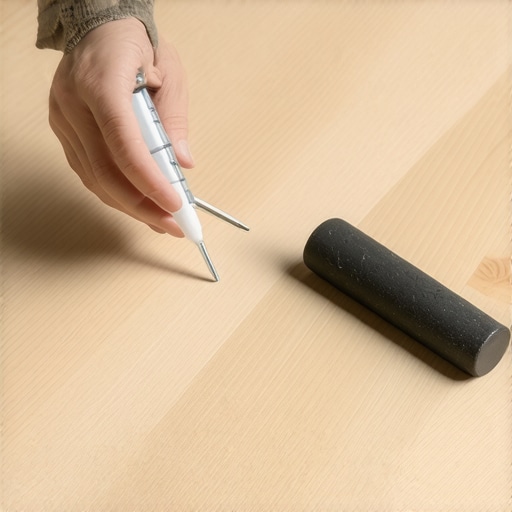
If the floor is already installed, you can use mechanical injection methods to fill the voids without tearing up the entire room. This involves drilling a tiny hole in a hidden spot and injecting a specialized, low expansion adhesive or resin that hardens to provide a solid base. You find the hollow spot by tapping the floor until the sound changes. Once identified, you drill a hole about the size of a finish nail, usually in a dark grain line of the wood pattern. Using a syringe, you pump in a floor repair adhesive. This adhesive must be specifically designed for floating floors, meaning it stays somewhat flexible or fills the void without bonding the floor to the subfloor in a way that prevents expansion. After the injection, you place a heavy weight on the area for twenty four hours. This forces the plank down and fills the gap. Finally, you use a color matched floor putty to hide the hole. It is a surgical strike that can save a room without the labor of a full teardown.
“Flatness is not levelness. A floor can be out of level and perform perfectly, but it must be flat within 1/8 inch over 6 feet.” – NWFA Professional Standard
The ghost in the expansion gap
A floor that is pinned against a wall or a heavy kitchen island cannot expand or contract properly, causing it to bow and create hollow sounds. Laminate is made of wood fibers held together by resin, and these fibers react to changes in humidity by growing or shrinking. If you do not leave at least a quarter inch gap around the entire perimeter, the floor will hit the wall and have nowhere to go but up. This upward bowing creates a massive air pocket. I have seen homeowners lock their floors down under heavy cabinets, which is a death sentence for a floating system. The floor needs to move as a single unit. If it is pinched, it will arch. Check your baseboards and transitions. If the floor is tight against the drywall, you need to take a multi tool and trim the edge of the laminate. Once the tension is released, the floor will often drop back down and the hollow sound will vanish. It is about giving the material room to breathe.
- Check perimeter gaps at every wall
- Ensure heavy islands are not pinned to the planks
- Verify T-molding is used in large spans over thirty feet
- Inspect door jambs for tightness
- Remove baseboards to confirm expansion space
The humidity factor in modern laminate
Changes in indoor climate affect the moisture content of the HDF core, leading to dimensional instability that manifests as a hollow echo. High humidity makes the planks swell, while low humidity makes them shrink. In a dry environment, the edges of the planks can lift slightly, a condition known as peaking. This creates a gap between the floor and the underlayment. In a swampy environment like Houston, the floor might swell so much that it crowns, pushing the center of the plank up. You must keep your home between thirty and fifty percent humidity to keep the floor stable. Acclimation is not a suggestion, it is a requirement. I tell people to let the boxes sit in the room for forty eight hours, but they never listen. They want the floor down today. But if those planks are not at equilibrium with the room before they are locked together, they will move later, and movement always brings noise. It is the basic chemistry of wood fiber and water.
When to walk away and start over
There are times when the subfloor is so poorly prepared that no amount of adhesive injection or gap trimming will fix the underlying hollow sound. If you walk across the room and the floor feels like a trampoline, the substrate is the enemy. At that point, you are throwing good money after bad. You have to pull the planks up. It is a painful realization, but it is better than living with a floor that irritates you every day. Once the planks are up, you can address the slab. You grind the high spots and fill the low spots with a high quality self leveling underlayment. I use a ten foot straight edge and mark the floor with a pencil, creating a topographical map of the failure. You fill the valleys until the pencil marks disappear. It is a messy, dusty process that requires a vacuum with a HEPA filter, but it is the only way to achieve silence. Once the floor is flat, you can reinstall the laminate. If you were careful during the teardown, you can even reuse the same planks. Just check the tongues and grooves for damage.