
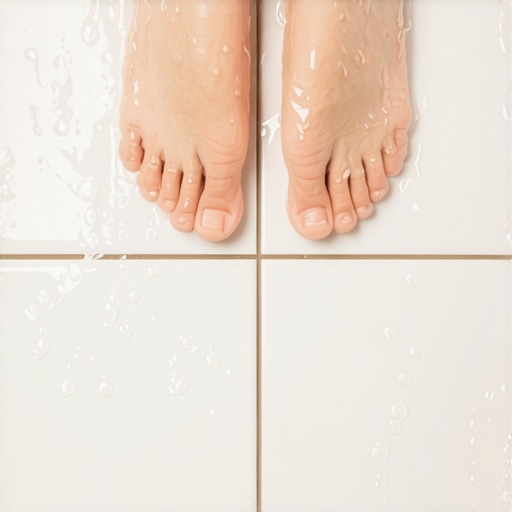
The structural reality of a shifting bathroom floor
Bathroom tiles feel loose after a shower because of excessive subfloor deflection or moisture ingress that compromises the bond between the tile and the substrate. High humidity levels and direct water contact can cause certain subflooring materials to expand, while improper thin-set application leads to hollow spots that eventually fail.
Most guys skip the leveling compound. They think the underlayment will hide the dip. It won’t. I spent three days grinding concrete on a job last month just so the floor wouldn’t click like a castanet. That job was a perfect example of why a floor is an engineering project. If the base is not flat to within one-eighth of an inch over ten feet, your tile is a ticking time bomb. When you step out of a hot shower, the heat and moisture increase the internal pressure of the air trapped in those tiny hollow voids beneath your tiles. This is the physics of floor failure. The moisture does not just sit on top. It finds its way through micro-fissures in the grout and begins a slow, invisible war against the adhesive bond. I have seen fifteen-thousand dollar marble floors ruined because an installer thought a bit of extra plywood would fix a bouncy joist. It never does. Structural integrity is binary. Either the floor meets the L over 360 deflection standard, or it is destined to crack and move under your weight.
The catastrophic impact of moisture vapor on adhesive bonds
Moisture vapor transmission from the shower area penetrates grout lines and settles into the mortar bed where it can cause re-emulsification of low-grade adhesives. This process softens the bond between the ceramic or stone and the subfloor, leading to that disconcerting shifting sensation underfoot.
The chemistry of the bond is everything. When you use a standard, unmodified thin-set in a high-moisture environment, you are asking for trouble. Water is the universal solvent. Over years of daily showers, the humidity levels in a bathroom fluctuate wildly. This creates a cycle of expansion and contraction. [IMAGE_PLACEHOLDER] If the mortar is not polymer-modified, it lacks the flexibility to handle this movement. You end up with a mechanical failure where the tile literally detaches from the bed. I often tell my clients that the grout is not a waterproof shield. It is a mineral filler. It is porous. Without a proper waterproofing membrane like a topical liquid-applied guard or a sheet-bonded system, that water goes straight to the subfloor. If that subfloor is plywood, it swells. If it is OSB, it turns into oatmeal. Once the substrate moves, the tile has no choice but to follow. You cannot fight the laws of thermodynamics with a bit of extra caulk.
“A floor is only as good as the subfloor beneath it; deflection is the enemy of every joint.” – Master Flooring Axiom
Why your subfloor is lying to you about its strength
A subfloor may appear solid but can suffer from structural fatigue or improper joist spacing that allows for vertical movement. This deflection is often only noticeable when the materials are stressed by the added weight of a human body and the thermal expansion caused by hot water.
You have to look at the joists. If your house was built with sixteen-inch on-center spacing, you might think you are safe. But if those joists are undersized for the span, the entire floor system acts like a trampoline. Ceramic tile has zero tensile strength. It cannot bend. When the plywood underneath it dips even a fraction of a millimeter, the bond snaps. It is a clean break. You might not see it, but you will hear it. It is that tiny, gritty crunch you feel under your heel. I have spent decades telling homeowners that adding a second layer of plywood is not just about thickness. It is about the orientation of the grain and the spacing of the fasteners. You need a specific screw pattern to ensure the two layers act as a monolithic slab. Without that, they rub against each other, creating heat and friction that further degrades the mortar bed. The industry standard is clear on this matter.
“The maximum allowable deflection for ceramic tile under all concentrated or uniform design loads is L/360.” – TCNA Handbook
| Material Type | Moisture Resistance | Deflection Rating | Expansion Potential |
|---|---|---|---|
| Cement Board | High | Excellent | Low |
| Exterior Grade Plywood | Medium | Good | Moderate |
| Standard OSB | Low | Poor | High |
| Uncoupling Membrane | Very High | Excellent | Neutral |
The chemical betrayal of improper thin set choice
Choosing the wrong mortar for a bathroom environment leads to adhesive failure when the substrate undergoes thermal expansion from hot shower water. Specialized modified mortars are required to provide the shear strength necessary to hold tile in place during these environmental shifts.
I despise the use of mastic in bathrooms. Mastic is basically organic glue. It is great for a dry kitchen backsplash, but in a bathroom, it is a liability. Once it gets wet, it turns back into a liquid. I have walked into bathrooms where the tiles were literally floating on a layer of slime because the original installer wanted to save ten dollars on a bag of proper thin-set. You need a latex-modified portland cement mortar. The polymers in the mix create a web of plastic-like strands that bridge the gap between the tile and the floor. This provides the flexibility needed when the bathroom heats up to eighty degrees in five minutes. If you use the wrong stuff, the bond becomes brittle. Brittle bonds break. It is that simple. I always check the date on the bag too. Mortar has a shelf life. If it has been sitting in a damp warehouse for six months, the chemistry is dead before it even hits your trowel.
- Check for cracked grout lines which indicate subfloor movement.
- Listen for a hollow sound when tapping tiles with a screwdriver handle.
- Inspect the perimeter expansion joints for signs of compression.
- Verify that the shower curb is not leaking into the main floor area.
- Monitor the humidity levels in the crawlspace or room below the bathroom.
The expansion gap that protects your grout lines
Perimeter expansion joints are essential in bathroom tiling to allow the entire floor assembly to expand and contract without building up internal pressure. Without these gaps, the tiles will push against the walls and eventually pop loose from the floor.
Most DIY installers run the tile tight against the drywall or the baseboard. That is a rookie mistake. Every floor needs room to breathe. When the humidity hits ninety percent during your morning shower, those tiles and the subfloor under them are going to grow. If there is no gap at the edges, the force has nowhere to go but up. This causes ‘tenting’ where the tiles lift in the middle of the room. I always leave a quarter-inch gap around the entire perimeter. I cover it with the baseboard or a bead of silicone. Silicone is the key. Unlike grout, silicone is elastomeric. It can compress and return to its original shape. If you have grout in your corners or where the floor meets the wall, it will crack. It has to crack because the two surfaces are moving in different directions. It is basic geometry. If your tiles feel loose, look at the edges. If they are tight against the wall, that pressure is what is killing your bond.
Waterproofing is not a suggestion for wet areas
Modern tile installations require a dedicated waterproofing layer between the tile and the subfloor to prevent water from reaching the structural wood components. Failure to include this layer leads to wood rot and the eventual total failure of the flooring system.
I have seen it a thousand times. A guy puts down cement board and thinks he is waterproofed. Cement board is water-stable, meaning it won’t fall apart when wet, but it is not a water barrier. Water passes right through it like a sponge. That water then sits on your wood joists. Wood rot happens at twenty percent moisture content. In a bathroom without a membrane, you hit that number easily. Once the wood starts to rot, it loses its structural capacity. It gets soft. The screws lose their grip. The floor starts to bounce. Then the tiles come loose. You cannot fix this by regrouting. You have to rip it all out and start over. It is a painful and expensive lesson. Using a product like a bonded waterproof membrane is the only way to ensure that the moisture from your shower stays in the drain and out of your structure. It is about managing the microscopic flow of vapor and liquid. If you ignore the science of moisture migration, the house will eventually win. You are building a system, not just laying down pretty squares. Every component from the joist to the sealer must work in harmony or the whole thing falls apart under your feet.