
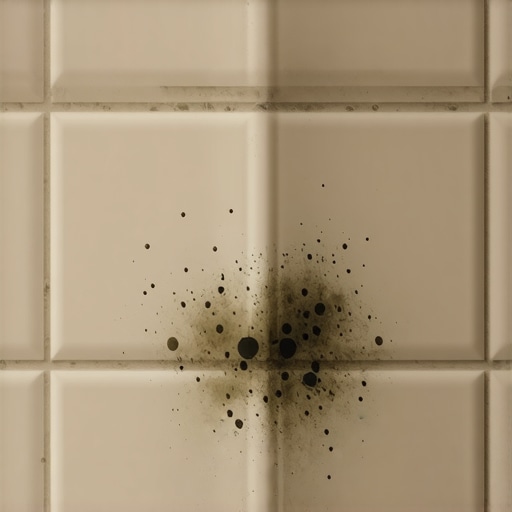
The Hidden Reason Your Shower Grout Always Gets Moldy in the Same Spot
Most homeowners assume that if they see mold on their shower grout, they just need to scrub harder or buy a stronger chemical. They are wrong. Mold in a shower is not a surface problem. It is a structural engineering failure. I have spent twenty-five years on my knees with a moisture meter and a grinder, and I can tell you that if mold keeps returning to the same spot, your substrate is holding water like a sponge. Most guys skip the leveling compound. They think the underlayment will hide the dip. It won’t. I spent three days grinding concrete on a job last month just so the floor wouldn’t click like a castanet. That same logic applies to your shower. If the underlying physics of water management are ignored, your grout becomes a petri dish regardless of how many times you spray it with bleach. You smell that? That is the scent of oak dust and WD-40 on my clothes, and it comes from years of ripping out ‘beautiful’ showers that were rotting from the inside out because an installer didn’t understand capillary action.
The lie of the waterproof surface
The porous grout and ceramic tiles used in most bathrooms are not actually waterproof barriers that prevent moisture migration into the wall cavity or floor. Capillary suction draws water through the micro-pores of the cementitious grout, eventually saturating the mortar bed or thin-set behind the tile. This is the first thing every installer needs to accept. Grout is a filter, not a dam. When you shower, dihydrogen monoxide molecules exploit the interconnected voids within the Portland cement matrix. They move through the joints and sit in the gaps between the tile and the waterproofing membrane. If that water cannot escape, it stagnates. Stagnant water combined with the organic matter found in soap scum creates the perfect environment for mold spores to thrive. This is why the mold is ‘hidden.’ It is growing from the back of the grout line to the front. You are only seeing the tip of the iceberg. Most big-box retailers sell ‘waterproof’ grout, but that is a marketing term. In the world of the TCNA, we focus on the rate of absorption. Even high-performance grout has a permeability rating that allows vapor and liquid to pass over time. If your shower was built with a traditional ‘water-in, water-out’ system, that water is supposed to hit a sloped liner and exit through weep holes. If those weep holes are clogged with thin-set, you have a permanent puddle under your feet.
“A floor is only as good as the subfloor beneath it; deflection is the enemy of every joint.” – Master Flooring Axiom
The structural failure of the shower pan slope
The pre-slope is the most frequently ignored component of a shower installation, leading to standing water underneath the tile surface. If the subfloor or the mortar bed does not have a one-quarter inch per foot pitch toward the drain, gravity will not move the water. I have seen countless ‘pro’ jobs where the installer leveled the subfloor but forgot to pitch the liner. They build a flat pan, put a liner on it, and then build a sloped mortar bed on top of the liner. What happens? The water goes through the grout, hits the flat liner, and just sits there. It never reaches the drain. This is often called a ‘birdbath’ in the industry. The water remains in that low spot for weeks. It never dries out. Every time you take a shower, you add more water to the reservoir. Eventually, the alkalinity of the concrete breaks down, and the mold starts migrating upward through the grout joints. This is usually the reason you see a dark, damp spot in one corner of the shower that never seems to go away. It is not a cleaning issue. It is a gravity issue. If the subfloor wasn’t prepped with the precision of a laboratory table, the water will find the lowest point and stay there until it rots the framing.
The chemistry of capillary suction
The interconnected porosity of cement-based grout creates a wicking effect that pulls liquid water into the substrate through surface tension. Think of grout as a series of tiny straws. When water hits the surface, the molecular attraction between the water and the cement walls of the grout pores pulls the liquid inward. This is the same physics that allows trees to pull water from their roots to their leaves. In a shower, this means the grout is constantly drinking. High-density porcelain tiles have a low absorption rate, usually less than 0.5 percent, but the grout joints between them are often 10 to 20 percent porous. If you used a cheap, builder-grade sanded grout, you essentially installed a sponge between your tiles. Some installers try to fix this by applying a topical sealer. However, sealers are breathable. They are designed to repel liquid for a short time, but they do not stop vapor drive. Over time, the sealer wears off or is scrubbed away by harsh cleaners, leaving the ‘straws’ wide open again. Once the water gets into the thin-set mortar, it encounters the chemical additives like polymers and latex. While these help the tile stick, they can also provide a food source for certain types of fungi if they remain damp indefinitely. [image-placeholder]
| Grout Type | Porosity Level | Mold Resistance | Best Use Case |
|---|---|---|---|
| Sanded Cement | High | Low | Large joints, low moisture |
| Unsanded Cement | High | Very Low | Wall tile, narrow joints |
| High-Performance | Medium | Moderate | Residential showers |
| Epoxy Grout | Near Zero | High | Commercial, heavy water |
Why your thin-set is holding water hostage
The mortar bond between the tile and the waterproofing membrane can act as a storage tank if the trowel ridges were not collapsed during installation. When an installer ‘swirls’ their trowel instead of combing in straight lines, they create air pockets. These air pockets are perfect little caves for water to hide in. The TCNA standards are very clear about this. You must use the flat side of the trowel to key the mortar into the substrate, then comb in straight lines. When you set the tile, you move it perpendicular to those lines to collapse the ridges. This ensures 100 percent coverage. If the installer was lazy, you have ‘trowel channels’ under your tile. Water enters through the grout, fills these channels, and stays there. Since there is no airflow under a tile, that water cannot evaporate. This is the hidden reason why your grout is moldy in the same spot. That specific spot has a pocket of water underneath it that is constantly feeding the mold. I have seen jobs where I pulled up a tile and water literally poured out of the ridges even though the shower hadn’t been used in two days. That is a failure of mechanical execution. No amount of scrubbing will fix a hollow spot in your thin-set.
“The presence of standing water within a tile assembly is the primary driver of microbial growth and bond failure.” – TCNA Quality Standards
The microscopic war inside the grout joint
The alkalinity of Portland cement usually inhibits fungal growth, but as soap scum and skin cells accumulate, the pH level of the grout surface drops. Fresh grout is very alkaline, which mold hates. However, as you use the shower, you are washing away soaps, oils, and dead skin. These organic materials get trapped in the pores of the grout. Over time, these materials break down and neutralize the alkalinity. Now, the grout is no longer a hostile environment. It is a buffet. The mold is not eating the grout itself. It is eating the residue trapped inside the grout. This is why textured tiles or wide sanded grout joints are more prone to mold. They have more ‘surface area’ to trap organic debris. If you live in a high-humidity region like the Gulf Coast, the air itself prevents the grout from ever reaching a state of total dryness. In these climates, the mold never stops growing. You need to use a non-porous grout, like an epoxy or a high-quality single-component resin grout, to stand a chance. These materials do not have the ‘straws’ that cement grout has. They are solid plastics. Water cannot get in, and food cannot get in. It is a more expensive installation, but it is the only way to win the microscopic war in a wet environment.
The hidden shelf life of topical sealers
Most homeowners fail to realize that grout sealers are sacrificial coatings that break down under alkaline cleaners and mechanical friction. When I finish a job, I tell the client they need to reseal every year. They never do. They think the sealer is a permanent shield. It isn’t. Every time you use a ‘scrubbing bubbles’ type of cleaner, you are eating away the sealer. Once the sealer is gone, the grout is vulnerable. Furthermore, if you seal grout that is already damp, you are actually trapping the moisture inside. This is a common mistake. People see mold, they scrub the grout, they let it dry for an hour, and then they slap on a sealer. They just locked the moisture and the mold spores inside the substrate. Now the mold can grow behind the sealer where your cleaning chemicals can’t reach it. This causes the grout to turn black or orange from the inside. If you want to seal your grout, you need to put a dehumidifier in that bathroom for forty-eight hours to ensure the substrate is bone dry. Only then should you apply a high-quality penetrating sealer. But remember, a sealer is a secondary defense. Your primary defense is a properly sloped subfloor and a high-quality waterproofing membrane like Schluter-Kerdi or Wedi board.
A checklist for a mold-free shower installation
- Verify the subfloor is structurally sound with zero deflection to prevent grout cracking.
- Ensure a pre-slope of 1/4 inch per foot is installed under the primary waterproofing liner.
- Use a liquid-applied or sheet-bonded waterproofing membrane directly behind the tile.
- Select a high-performance or epoxy grout to minimize water absorption and porosity.
- Directly collapse all thin-set ridges during tile setting to eliminate water-holding pockets.
- Clean only with pH-neutral cleaners to preserve the integrity of the grout and sealers.
- Maintain bathroom ventilation with an exhaust fan rated for the square footage of the room.
The mechanical reality of a lasting floor
The reality is that a moldy shower is usually a symptom of a ‘shortcut’ culture in the construction industry. Builders want things fast and cheap. They skip the drying times. They skip the pre-slope. They use the cheapest bags of thin-set they can find. If you are building a new shower or remodeling an old one, you have to be the stickler for the details. Check the slope with a level before the tile goes down. Ask your installer what kind of waterproofing system they are using. If they say ‘we just use greenboard and thin-set,’ fire them. That is a 1980s methodology that has been proven to fail. You need a modern, integrated bond tank system. You need to treat the shower like a piece of high-precision machinery. Every layer, from the plywood subfloor to the final bead of silicone in the corners, must be executed with the understanding that water is a relentless force. It will find every hole. It will sit in every dip. It will feed every spore. I have spent my life fixing these mistakes, and I can tell you that a little bit of extra work on the subfloor saves you ten thousand dollars in mold remediation five years down the road. Keep your tools clean, keep your levels true, and never trust a surface that hasn’t been properly prepped from the bottom up. That is the only way to keep the mold out of your grout for good. Flooring isn’t about what looks pretty. It is about what survives the physics of the house.