
I once walked into a house where a $15,000 wide plank walnut floor was cupping so bad it looked like a potato chip because the installer didn’t check the crawlspace humidity. It was a tragedy written in timber. That job taught me that wood is not a static building material. It is a biological corpse that still breathes, reacts, and moves. When you drop a heavy cast iron skillet on your oak floor, you are not just making a mark. You are physically crushing the cellular structure of the wood. You are collapsing the tracheids and vessels that once transported water through the tree. My name is a staple in the local flooring community because I look at these failures through a microscope, not a catalog. I have spent decades with sawdust in my lungs and a moisture meter in my pocket, and I am here to tell you that the ice cube trick is not magic. It is simple thermodynamics and capillary action.
The molecular reality of a dented plank
A dent in a hardwood floor is a localized compression of wood fibers where the lignin and cellulose walls have been crushed but not necessarily severed. To fix this, you must introduce moisture and heat to encourage those fibers to return to their original state. Unlike laminate flooring which is a photograph glued to a resin core, solid wood has a memory. When the wood cells are compressed by an impact, they stay flattened because the internal pressure is gone. By applying a controlled amount of water, you allow the hygroscopic nature of the wood to pull moisture into those flattened cells. This increases the internal turgor pressure of the wood fibers, causing them to swell back to their original dimensions. This process is most effective on open grain woods like oak or ash, where the cellular structure is more accessible to moisture than the dense, oily fibers of exotic species like teak or ipe.
The ice cube protocol for crushed fibers
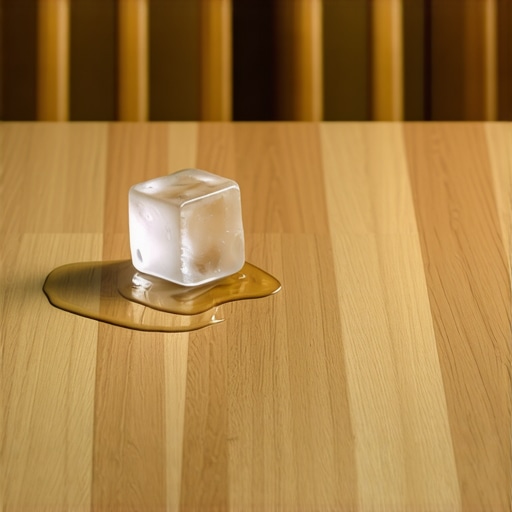
To execute the ice cube trick, place a single cube of deionized water directly on the center of the dent and allow it to melt completely over several hours. You need to understand the finish on your floor before you try this. If you have a modern factory-finished floor with an aluminum oxide coating, that finish acts like a plastic shield. The water will just sit on top and do nothing. You might need to lightly scuff the bottom of the dent with 320-grit sandpaper to create a pathway for the water. Once the water is absorbed, the wood cells will begin to expand. This is a slow process. You cannot rush the physics of wood. If the dent is shallow, the swelling action of the water alone might be enough to level the surface. If the wood is still depressed after the water has dried, you are going to need to graduate to the thermal expansion phase involving a damp cloth and a household iron.
“A floor is only as good as the subfloor beneath it; deflection is the enemy of every joint.” – Master Flooring Axiom
Why some dents are permanent scars
Dents that involve severed wood fibers or significant finish cracking cannot be fully recovered using the ice cube method because the structural integrity of the cell walls is lost. If the impact was sharp enough to cut into the wood, you are looking at a repair that requires wood filler or a dutchman patch. Similarly, if the dent is in a high traffic area where the wood has been polished smooth by friction, the water may not be able to penetrate the surface tension of the wood grain. I have seen guys try to fix dents in laminate using this method and it is a disaster. Laminate is essentially high density fiberboard. When you add water to a dent in laminate, you don’t lift the dent. You cause the edges of the plank to swell and peak, a condition known as blowing the core. Once a laminate core is blown, the only fix is replacement. Hardwood is the only surface that truly responds to this type of molecular resuscitation.
The ghost in the expansion gap
Proper floor movement depends on the expansion gap left at the perimeter of the room which prevents the floor from buckling during high humidity cycles. I have spent three days grinding concrete on a job last month just so the floor wouldn’t click like a castanet. People think the underlayment will hide a dip in the subfloor. It will not. If your subfloor is not level to within 1/8 inch over a 10 foot span, any repair you make to the surface will eventually fail. When you are working on a dent, you are focusing on the microscopic level, but the macroscopic level is what keeps the floor stable. If the floor is pinned against the wall, the tension in the planks can make the wood fibers more resistant to the swelling action of the ice cube trick. You need the wood to be in a relaxed state to achieve the best results from a fiber recovery standpoint.
| Wood Species | Janka Hardness Rating | Dent Recovery Potential |
|---|---|---|
| Douglas Fir | 660 | Excellent |
| Black Walnut | 1010 | Moderate |
| Red Oak | 1290 | High |
| Hard Maple | 1450 | Low |
| Brazilian Cherry | 2350 | Very Low |
The 1/8 inch that ruins everything
Precision in flooring is measured in fractions of an inch and any deviation in the subfloor levelness will manifest as noise or structural failure. While most people want the thickest underlayment, too much cushion actually causes the locking mechanisms on floors to snap under pressure. This same logic applies to fixing dents. If you over-saturate the wood, you can cause a localized mound that is harder to fix than the original dent. You want to add just enough moisture to fill the cells, not so much that you trigger rot or mold. If you are working near a bathroom or kitchen, be aware that the moisture levels in the air are already higher. In a shower area, the grout is designed to manage moisture, but wood is not. Never use the ice cube trick on a floor that is already showing signs of moisture distress like cupping or crowning.
The steam iron evolution for deep depressions
When the ice cube method fails, using a damp cotton cloth and a hot steam iron can provide the necessary energy to force moisture deep into the wood grain. This is the advanced version of the trick. Place the damp cloth over the dent and apply the iron on a high setting for 10 to 20 seconds. The heat turns the liquid water into steam, which has a smaller molecular size and can penetrate the wood fibers much more effectively. The heat also softens the lignin, the natural glue that holds wood cells together, making it easier for the fibers to be reshaped. This is a delicate balance. Too much heat will scorch the finish. Too little heat won’t move the fibers. You are looking for that sweet spot where the wood sighs and opens up. I always keep a bottle of WD-40 nearby to clean my tools, but never let it touch the raw wood during this process or you will never get a new finish to bond.
- Assess the finish type before applying water.
- Clean the dented area with a microfiber cloth to remove wax.
- Lightly sand the dent if the finish is non-porous.
- Use deionized water to avoid mineral staining in the wood grain.
- Allow the area to dry for 24 hours before assessing the repair.
- Apply a touch up finish to seal the newly expanded fibers.
“Wood is a hygroscopic material that expands and contracts with the relative humidity of the surrounding environment.” – NWFA Technical Standards
The chemistry of wood finishes and water penetration
The effectiveness of any moisture based repair is dictated by the chemical bond and permeability of the topcoat protecting the wood. Water based polyurethanes are more breathable than traditional oil based finishes. If your house was built in the last ten years, you likely have a high solids finish that is very difficult to penetrate. In these cases, the ice cube trick might take several applications to show any progress. You must be patient. I have seen homeowners get frustrated and pour a bucket of water on a dent. That is a fast way to ruin the entire room. You are performing surgery, not landscaping. Treat each dent as an individual structural challenge. Once the fiber has lifted, the wood will be slightly more porous in that spot. You must reseal it. If you leave the wood raw, it will absorb humidity from the air and eventually turn grey or black due to oxidation and dirt accumulation.
Maintenance and the long term health of your floor
Consistent climate control is the most effective way to prevent the wood from becoming brittle and prone to denting in the first place. Keeping your home between 30 and 50 percent humidity ensures that the wood cells remain flexible. When the air is too dry, the cellulose becomes brittle, and instead of denting, the wood will splinter. A splinter is much harder to fix than a dent. I always tell my clients that a humidifier is a flooring tool just as much as a hammer is. If you treat your floor like the engineered system it is, it will last a century. If you treat it like a piece of carpet, you will be calling me to replace it in five years. Hardwood is an investment in the architecture of your home. Treat it with the respect that a natural, living material deserves.