
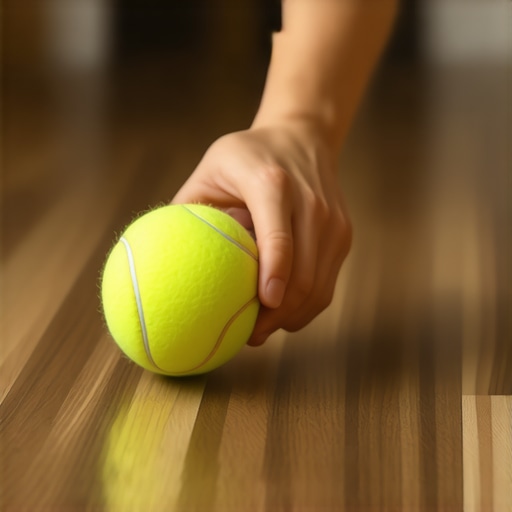
The friction science of yellow felt
A tennis ball removes scuffs from laminate by utilizing a specific friction coefficient that lifts rubber residue without abrading the aluminum oxide wear layer. This method relies on the soft, non-abrasive nature of the polyester and nylon felt covering the ball. When you apply pressure, the internal rubber core provides the structural integrity needed to grip the scuff mark while the felt acts as a buffer. Most guys skip the leveling compound. They think the underlayment will hide the dip. It won’t. I spent three days grinding concrete on a job last month just so the floor wouldn’t click like a castanet. That job was a nightmare because the homeowner had tried to fix ‘scuffs’ with steel wool, which is like taking a chainsaw to a silk tie. Laminate is essentially a photograph of wood glued to a pile of sawdust, protected by a thin layer of transparent armor. If you scratch that armor, the game is over. The tennis ball trick is the only way to maintain the surface without chemical intervention that might delaminate the edges. I have seen countless floors ruined by people who think more chemicals equals more clean. It does not. It just means you are dissolving the resins that hold your floor together.
The subfloor secret that contractors hide
A laminate floor is only as stable as the concrete or plywood beneath it because deflection creates micro-movements that lead to premature wear. Every time you walk on a floor with a void underneath, the locking mechanisms rub against each other. This friction creates heat and eventual structural failure. I remember a job in a coastal town where the humidity was sitting at eighty percent. The installer didn’t leave an expansion gap. Within two months, the floor had peaked so high you could trip over the joints. When we talk about scuffs, we are usually talking about rubber from shoes or plastic from furniture legs that has melted onto the surface. The aluminum oxide in your laminate wear layer is the third hardest mineral on earth. It is used in sandpaper. This means the scuff is almost always on the floor, not in the floor. If you use a tennis ball, you are using physics to your advantage. The rubber inside the ball has a higher tackiness than the laminate surface, so it grabs the scuff and pulls it away.
“A floor is only as good as the subfloor beneath it; deflection is the enemy of every joint.” – Master Flooring Axiom
“The longevity of a floating floor is directly proportional to the flatness of the substrate.” – Master Flooring Axiom
The 1/8 inch that ruins everything
Surface levelness must be within one eighth of an inch over a ten foot radius to prevent the click-lock joints from snapping. If your floor is uneven, every step causes the planks to flex. This flexing opens up the seams. Once a seam is open, moisture from a mop or even high humidity near showers can penetrate the HDF core. Once that core swells, it is finished. You cannot un-swell a laminate floor. This is why the tennis ball trick is so vital for maintenance. It allows you to clean without introducing moisture. You take a standard tennis ball, cut a small X in the top, and stick it on the end of a broom handle. This gives you the leverage to rub out scuffs without getting on your knees. It is about precision. I have seen people try to use magic erasers on laminate. That is a mistake. Magic erasers are actually a very fine melamine foam that acts like high-grit sandpaper. Over time, they will dull the finish. You will end up with a matte spot in the middle of your semi-gloss floor. Then you will call me, and I will tell you that the only fix is to replace the planks. Save yourself the money. Use the ball.
Comparing wear layers and surface resistance
The AC rating of your laminate determines how much abuse the wear layer can take before the decorative photograph is exposed. AC3 is standard for residential use, while AC4 and AC5 are meant for commercial traffic. The higher the rating, the more aluminum oxide is present in the wear layer. However, more is not always better for comfort. High AC ratings can feel cold and harsh underfoot. When you are dealing with scuffs on these surfaces, the density of the wear layer matters. A harder surface is actually easier to clean with a tennis ball because the scuff cannot ‘sink’ into the material. On a softer hardwood floor, a scuff might actually dent the wood fibers. On laminate, it just sits on top like a bad memory. Let’s look at the technical specifications of common flooring materials to understand the durability gap.
| Material Type | Janka Hardness / AC Rating | Moisture Resistance | Typical Wear Layer |
|---|---|---|---|
| Laminate (AC3) | Moderate Resistance | Low to Moderate | Aluminum Oxide (6-12 mil) |
| Solid White Oak | 1360 lbf | Low | Polyurethane / Oil |
| Luxury Vinyl (LVP) | N/A (Indentation resist) | High | Urethane (12-28 mil) |
| Engineered Oak | 1200-1400 lbf | Moderate | Veneer + Finish |
Why showers and laminate are enemies
Laminate should never be installed in bathrooms or near showers because the high humidity and standing water will cause the fiberboard core to expand. I don’t care what the box says about ‘waterproof’ laminate. It is usually just a wax coating on the joints. If water sits in the grout lines of a tile floor, it might mold. If water sits on a laminate floor, it destroys the structural integrity of the entire room. I have walked into houses where the laminate near the master shower looked like a mountain range. The planks had expanded so much they had nowhere to go but up. If you are cleaning scuffs in a room adjacent to a bathroom, ensure your tennis ball is bone dry. Even a damp ball can introduce enough moisture to the micro-cracks in the wear layer to start the swelling process. Stick to tile and grout in wet areas. Keep the laminate in the hallways and bedrooms where it belongs. I smell the oak dust every time I talk about this. People want the look of wood everywhere, but wood and water are a toxic relationship.
The maintenance checklist for high traffic zones
Maintaining a laminate floor requires a strict protocol of dry cleaning and localized spot treatment to preserve the resin bond. If you follow these steps, your floor will last twenty years. If you ignore them, you will be calling a contractor within five. Here is my professional checklist for keeping your laminate pristine without breaking the bank.
- Use a dry microfiber mop daily to remove abrasive grit that acts like sandpaper.
- Identify scuffs early and use the tennis ball on a stick method for removal.
- Place heavy-duty felt pads under all furniture legs to prevent deep gouges.
- Never use a steam mop as the pressurized heat will melt the adhesive bond.
- Maintain indoor humidity between 35 and 55 percent to prevent plank shrinkage.
- Ensure a minimum expansion gap of 3/8 inch at every wall and fixed vertical object.
The physics of the expansion gap
Every laminate installation requires a perimeter gap because the wood fibers in the HDF core expand and contract with seasonal humidity changes. Most DIY installers think they can push the planks tight against the drywall. They are wrong. When summer hits and the humidity rises, those planks grow. If they have no room to move, they will buckle in the center of the room. This is called ‘peaking.’ It is the most common failure I see. When you are rubbing out a scuff with a tennis ball, you are applying downward and lateral force. If your floor is properly installed with an expansion gap, it will have a tiny bit of ‘give’ that prevents the locking joints from snapping under your weight. If it is tight against the walls, that force has nowhere to dissipated. It stays in the joint. It is about the 1/8 inch. It is always about the 1/8 inch. If you are off by that much, the floor is doomed. I once saw a $10,000 floor ruined because the installer used a T-molding that was pinned through the laminate into the subfloor. It locked the floor in place. It couldn’t breathe. It literally tore itself apart. Don’t be that guy. Use the right tools. Use the tennis ball. Keep the floor floating. It is a machine. Treat it like one. The chemistry of the adhesives used in modern laminate is impressive, but it is not invincible. The resins are designed to hold the fibers together under compression, not under the tension of a buckled floor. Keep it flat. Keep it dry. Keep the scuffs off with the ball. That is the secret to a floor that looks as good in year ten as it did on day one. I smell the WD-40 on my hands as I write this, thinking about the last time I had to rip out a ‘waterproof’ floor that was anything but waterproof. It is a hard lesson to learn, but a tennis ball and a bit of knowledge will save you thousands in the long run.