
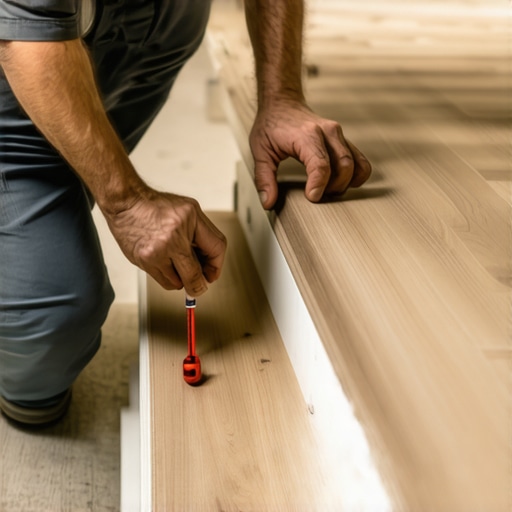
Fix a Loose Stair Nose on Laminate Steps Without Replacing the Whole Tread
Most guys skip the leveling compound. They think the underlayment will hide the dip. It won’t. I spent three days grinding concrete on a job last month just so the floor wouldn’t click like a castanet. That same level of disregard for the substrate is why your stair nose is wobbling right now. A loose stair nose is not just a nuisance. It is a structural failure waiting to trip your family. When you step on the edge of a stair, you are applying hundreds of pounds of pressure per square inch to a very small surface area. If there is even a millimeter of hollow space beneath that laminate molding, the physics of leverage will eventually snap the locking mechanism or shear the adhesive bond. To fix it properly, you have to understand the microscopic chemistry of the bond and the rigid physics of the stair stringer.
The 1/8 inch that ruins everything
A loose stair nose is caused by substrate deflection and adhesive failure where the molding meets the subfloor or the laminate plank. If the subfloor has a dip greater than one-eighth of an inch over a ten-foot span, the stair nose will bounce. This repetitive movement breaks the chemical bond of the glue. You must eliminate the void to ensure the nose remains stationary under the weight of a human adult. Most homeowners try to squirt some wood glue in the gap and call it a day. That is a mistake. Wood glue is for porous surfaces like raw oak or maple. Laminate is a non-porous HDF core wrapped in a resin-infused decor layer. You need a different chemical approach. I have seen countless DIY jobs fail because they treated laminate like it was a piece of 1950s furniture instead of the high-performance plastic-and-wood hybrid that it actually is. If you do not address the subfloor flatness, no amount of glue will save you.
“A floor is only as good as the subfloor beneath it; deflection is the enemy of every joint.” – Master Flooring Axiom
Why your stair nose is moving under pressure
Mechanical movement in a stair nose stems from the fact that laminate is a floating floor system while a stair nose must be a fixed point. This conflict of interests is where most installations go wrong. The flooring in your hallway wants to expand and contract with the humidity. The stair nose is supposed to be the anchor. When the hallway floor pushes against the nose during a humid summer, it puts immense shear stress on the adhesive. If you live in a place with high humidity like the Gulf Coast, your laminate will swell. If you are in the dry heat of Phoenix, it will shrink until the gap is visible. This constant tug-of-war is why mechanical fasteners like trim screws are often necessary alongside high-strength adhesives. You are fighting the natural thermodynamics of the material. Laminate is essentially a dense sponge made of sawdust and resin. It reacts to every change in the air. Without a proper expansion gap behind the nose, the floor will eventually win and push the nose right off the step.
The chemical reality of bonding laminate to wood
Fixing a loose stair nose requires a silane-modified polymer or a high-solids polyurethane adhesive that can bridge gaps and remain flexible. Standard construction adhesives often dry brittle. When the stair nose experiences vibration from foot traffic, a brittle bond will crack. You need an adhesive that acts like a structural gasket. I prefer adhesives with a high green grab strength so the piece does not slide while it is curing. Before applying any glue, the surface must be surgically clean. I have pulled up loose noses that had sawdust, old carpet pad remnants, and even dried grout stuck to the underside. None of those materials provide a stable bonding surface. You need to grind the subfloor back to clean plywood or concrete and wipe the underside of the laminate with denatured alcohol to remove any factory oils or dust. If the surface is not clean, you are just gluing dust to dust.
| Adhesive Type | Bond Strength | Flexibility | Best Use Case |
|---|---|---|---|
| PVA Wood Glue | Low (on laminate) | Very Low | Furniture only |
| Polyurethane (PL Premium) | Very High | Medium | Structural subfloor bonding |
| Silane-Modified Polymer | High | Very High | Stair noses and transitions |
| Hot Glue | None | Low | Temporary holding only |
Mechanical versus chemical fasteners in high traffic zones
The most effective way to secure a failing stair nose is to combine structural adhesive with countersunk trim screws. Many people hate the look of a screw head on their stairs, but a 1/16 inch hole filled with matching putty is better than a broken neck. I always use #6 trim head screws because they have a tiny head that disappears into the wood grain or the laminate pattern. You must pre-drill these holes. If you try to drive a screw directly into an HDF laminate core, it will mushroom or crack the decor layer. Use a bit that is slightly smaller than the shank of the screw. Sink the screw about 2 millimeters below the surface. This allows the adhesive to do the heavy lifting while the screw provides the clamping force needed for the glue to set. It also prevents the nose from lifting if the adhesive ever experiences thermal shock. This is the difference between a five-year floor and a twenty-year floor.
“Fastener schedule and adhesive coverage are the two non-negotiable pillars of stair safety in modern flooring.” – Master Flooring Axiom
The physics of the expansion gap failure
The gap between the laminate plank and the stair nose transition must be exactly one-quarter inch to allow for seasonal movement. If you jammed the plank tight against the nose, the floor has nowhere to go. It will act like a hydraulic ram. This is especially true for wide-plank laminate which has more surface area to expand. I have walked into homes where the hardwood floors in the adjacent room were cupping because the installer didn’t leave room for the transition to breathe. In showers or bathrooms where moisture is high, this problem is magnified. Laminate on stairs near a bathroom is particularly vulnerable. The steam from the shower enters the HDF core at the cut ends. This causes the edges to swell. If that swelling hits a rigid stair nose, something has to give. Usually, the nose is what breaks free first. You must ensure the expansion gap is clear of debris and that no glue has leaked into the gap, which would effectively lock the floor and cause a failure.
The step by step repair protocol
- Remove the loose stair nose carefully with a flat pry bar to avoid damaging the adjacent planks.
- Scrape away all old adhesive from both the subfloor and the underside of the molding using a sharp chisel.
- Vacuum the area with a HEPA filter to ensure no microscopic dust particles remain to interfere with the new bond.
- Dry fit the nose to check for wobbles or dips in the subfloor.
- Apply a thick bead of silane-modified polymer adhesive in a serpentine pattern to the subfloor.
- Press the stair nose into the adhesive and wiggle it to ensure full coverage and collapse any air pockets.
- Pre-drill and drive three trim screws into the nose at the center and both ends.
- Clean any squeeze-out immediately with a damp rag or mineral spirits depending on the glue type.
- Weights or blue painter’s tape should be used to hold the nose in place for at least 24 hours while the bond cures.
The ghost in the expansion gap
Humidity is the silent killer of stair nose stability in every climate. In the winter, your heater dries out the air, causing the wood fibers in the laminate core to shrink. This creates a tiny void. In the summer, the moisture returns, the fibers swell, and the pressure returns. This cycle happens twice a year, every year. If you did not acclimate your laminate for at least 72 hours in the room where it was installed, the floor is already under internal stress. I have seen guys pull flooring straight from a cold truck and install it in a humid house. The floor will literally grow half an inch in a week. That growth will pop every stair nose in the building. Acclimation is not a suggestion. It is a physical requirement of the material. If your nose is loose, it might be because the floor was never given time to reach equilibrium with the house. You have to fix the nose, but you also have to monitor the indoor relative humidity to keep it between 35 and 55 percent. Anything outside that range and you are asking for trouble.
Final structural considerations for stair safety
A stair nose that clicks or moves is a signal that the integrity of the staircase is compromised. You cannot ignore the sound. That clicking is the sound of the HDF core rubbing against the subfloor. Over time, that friction will turn the bottom of your laminate into fine powder. Once the core is powdered, there is nothing for the glue to bite into. If you wait too long to fix a loose nose, you will have to replace the entire piece. Do it now. Use the right chemistry. Use the right mechanical fasteners. Make sure the subfloor is flat. If you follow these steps, that stair nose will be the most stable part of your entire house. Do not let a small dip in the plywood cost you a full floor replacement. Fix the substrate, secure the bond, and walk with confidence. The floor is a performance surface. Treat it like one. Avoid the cheap fixes from the big-box discount retailers. Use professional-grade polymers and take your time with the preparation. Your knees and your family will thank you.