
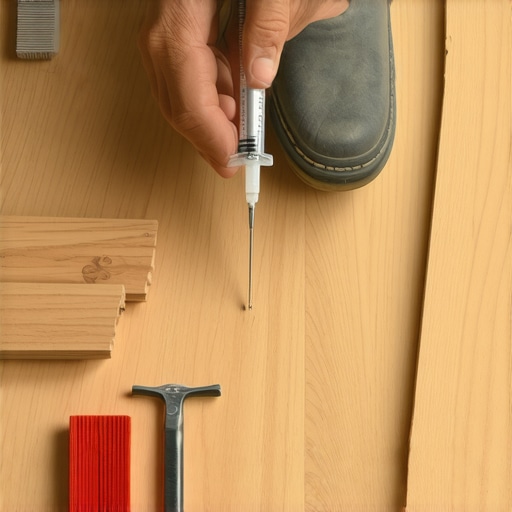
Most guys skip the leveling compound. They think the underlayment will hide the dip. It won’t. I spent three days grinding concrete on a job last month just so the floor wouldn’t click like a castanet. That job taught me that silence is earned with a grinder and a level, not bought in a bottle of cheap lubricant. When you walk across a floor and hear that high-pitched protest from the wood, you are hearing a failure of mechanical fasteners or a subfloor that was never flat to begin with. It is an engineering problem. My hands are covered in oak dust and my knees have seen better days, but I know how to silence a floor without ripping it out. We are talking about precision surgery for your boards.
The acoustic physics of a loose plank
Hardwood squeaks occur when friction exists between the flooring board and the subfloor or when the nail rubs against the wood. To stop this, you must introduce a bonding agent or lubricant to eliminate movement. Wood glue injected via syringe creates a structural bridge that halts noise. This friction is often the result of the wood cells rubbing against a steel nail that has lost its grip. When the house settles or the humidity drops, the wood shrinks. That tiny gap allows the board to move vertically. Every time you step on it, the board slides down the shank of the nail. The sound you hear is the resonance of that friction vibrating through the hollow space in the subfloor. It is not just a noise, it is the sound of your floor slowly wearing itself apart from the inside out.
“A floor is only as good as the subfloor beneath it; deflection is the enemy of every joint.” – Master Flooring Axiom
Why wood screams under your feet
The primary cause of squeaks in hardwood floors is seasonal movement leading to nail withdrawal or subfloor gaps. As wood expands and contracts with atmospheric moisture, the friction between the tongue and groove or the board and the joist creates sharp audible snaps. Most homeowners think their house is haunted, but it is just the physics of hygroscopic materials. Solid hardwood is a living thing. It breathes. If you installed your floors during a humid summer without proper acclimation, they will shrink in the winter. That shrinkage creates a void. When you walk on that void, the board deflects. If the subfloor is plywood that has delaminated or a slab that has a low spot, the board has nowhere to go but down. That movement is what we have to kill. If you have laminate in the next room, you might notice it sounds different, more of a hollow click than a sharp squeak. That is because laminate is a floating system, whereas hardwood is usually nailed or glued down. Even in tiled areas like showers where grout is the primary concern, the movement of the subfloor can cause cracks, but in hardwood, it causes the scream.
The chemistry of the syringe fix
Using a syringe to inject wood glue into a squeak site works by filling the microscopic voids between the flooring and the subfloor with a polyvinyl acetate polymer. Once the water evaporates, the glue creates a rigid plastic bridge that prevents the vertical movement causing the noise. I prefer a high-grade PVA glue for this. You need something with a low enough viscosity to flow through a 14 gauge or 16 gauge needle but enough solids to actually fill the gap. When you inject that glue, it travels along the grain and into the nail hole. It coats the shank of the nail and the surrounding wood fibers. As it cures, it pulls the wood together. This is not a temporary fix like spray-on lubricants that just coat the friction point for a month. This is a structural bond. You are essentially spot-welding your floor with liquid polymer. The capillary action of the wood helps draw the glue into the tightest spots where the squeak originates.
Locating the ghost in the joist
Finding the exact source of a squeak requires a two-person team to map the deflection points of the floor boards. One person walks slowly across the area while the second person stays at eye level with the floor to identify the specific board that moves. I use blue painter’s tape to mark every single squeak. You cannot just guess. If you miss the spot by half an inch, the glue will never reach the friction point. I look for movement at the butt joints and the long edges. Sometimes the squeak is not the board hitting the subfloor, but two boards rubbing against each other. In that case, you are looking for a friction squeak in the tongue and groove. This is common in older homes where the wood has dried out significantly over fifty years. If you are dealing with a subfloor issue from below in a crawlspace, that is a different beast, but for top-down repair, the syringe is your best friend.
“Fastener schedule and subfloor flatness are the two most critical factors in preventing floor noise long term.” – Master Flooring Axiom
Precision injection for structural silence
The injection process involves drilling a tiny pilot hole, usually 1/16th of an inch, directly into the site of the movement and forcing glue into the cavity. This hole must be small enough to be hidden by a touch-up pen but large enough for the needle. I always drill at a slight angle. This allows the glue to pool under the board rather than just sitting in the hole. Once the needle is inserted, you apply steady pressure. You might feel a bit of resistance, which is good. It means the glue is finding its way into the voids. After the injection, you must weight the board down. I use five-gallon buckets of paint or heavy toolboxes. You need to keep that board held tight against the subfloor for at least four hours while the glue sets. If you do not weight it down, you are just gluing the board in its raised, squeaky position, which solves nothing. You are trying to eliminate the gap, not just fill it.
| Wood Species | Janka Hardness | Glue Absorption Rate | Setting Time |
|---|---|---|---|
| Red Oak | 1290 | High | 4 Hours |
| White Oak | 1360 | Medium | 5 Hours |
| Hard Maple | 1450 | Low | 6 Hours |
| Brazilian Cherry | 2350 | Very Low | 8 Hours |
The structural limits of glue repairs
While wood glue injections are effective for minor squeaks, they cannot fix major structural issues like rotted joists or a completely detached subfloor. If the deflection is greater than an eighth of an inch, you may need mechanical fasteners. Sometimes I have to go in with a trim screw. I use the ones with the heads that snap off below the surface. But for eighty percent of the annoying chirps in a house, the syringe is the cleaner, more professional choice. It leaves almost no trace. If you have a room with a shower nearby, moisture can migrate through the wall and affect the hardwood. In those cases, the glue fix might fail if the wood is constantly swelling. You have to address the moisture first. A floor is a system. If one part of the system is wet, the rest will eventually fail. I have seen guys try to fix squeaks in laminate floors this way, but it does not work. Laminate is made of MDF or HDF and it does not take glue the same way solid wood does. Stick to solid hardwood for this method.
The pre-repair audit checklist
- Identify the exact board and mark it with tape
- Check the room humidity to ensure it is between 30 and 50 percent
- Test the glue viscosity to ensure it flows through the needle
- Ensure you have enough weight to hold the boards down
- Verify that the subfloor is not rotted or moisture-damaged
- Have color-matched wood filler ready for the drill holes
Environmental variables and wood movement
Temperature and humidity play a vital role in how wood reacts to adhesive repairs. Glue cures faster in warm, dry environments, but the wood itself is most stable when the indoor climate is controlled year-round. If you live in a place where the winters are freezing and the summers are like a sauna, your floors will always be moving. I tell my clients that a humidifier is the best floor maintenance tool they can buy. If you fix a squeak in the winter when the wood is at its driest, that repair has to hold when the wood expands in the summer. That is why the quality of the glue matters. You need a bond that has a tiny bit of flexibility. Brittle glues will just snap the first time the seasons change. The science of the bond is about managing that tension. You are fighting against the natural desire of the wood to warp and move. It is a constant battle, but with a syringe and a little patience, you can win. Don’t let anyone tell you that a squeaky floor is just character. It is a flaw, and it can be fixed.