
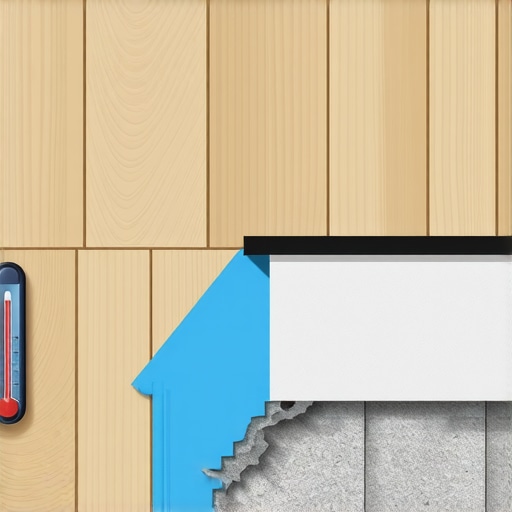
Most guys skip the leveling compound. They think the underlayment will hide the dip. It won’t. I spent three days grinding concrete on a job last month just so the floor wouldn’t click like a castanet. That client also complained their feet were freezing. It was not the floor itself. It was the air gap under the laminate acting like a refrigerator. I can still smell the mix of grinding dust and floor wax on my boots when I think about that job. If you want a floor that does not feel like an ice skating rink, you have to stop looking at the top layer and start looking at the chemistry of what is underneath.
The thermal bridge beneath your feet
Laminate floors feel cold because they act as a thermal bridge between the ambient air and the cold concrete or wood subfloor. Because laminate is a high-density fiberboard product, it lacks the natural insulation found in thicker solid hardwood floors. Using a high-quality thermal underlayment creates a necessary break. When you walk on a floor, your body heat is transferred into the material. This is physics. If there is a cold concrete slab sitting three millimeters below a thin plank, that slab will suck the heat right out of your skin. The floor is not technically cold. It is simply efficient at stealing your warmth. This is why a proper barrier is not just about sound; it is about stopping that energy transfer.
The ghost in the expansion gap
The expansion gap around the perimeter of a laminate floor is often the source of cold drafts that settle under the planks. If the baseboards are not sealed or if the gap is excessive, cold air from the wall cavities can circulate beneath the flooring. This creates a pocket of moving cold air. I have seen installers shove insulation into these gaps, but that is a mistake. The floor needs to move. Laminate expands and contracts based on the relative humidity of the room. If you lock it in place, it will buckle. You need a balanced approach where the underlayment extends to the edges, providing a continuous thermal envelope without hindering the mechanical movement of the floating floor system.
Why cheap underlayment is a heat sink
Thin blue foam underlayment provides almost zero thermal resistance and compresses over time which eliminates its insulating properties. Premium underlayments made of cross-linked polyethylene or heavy-density rubber provide a higher R-value and maintain their structure under the weight of furniture and foot traffic. Cheaper materials fail early. While most people want the thickest underlayment they can find, too much cushion actually causes the locking mechanisms on LVP or laminate to snap under pressure. You want density, not loft. A dense underlayment with a reflective foil face can bounce radiant heat back into the room. It is the difference between wearing a windbreaker and a parka.
“A floor is only as box-fresh as the subfloor beneath it; deflection is the enemy of every joint.” – Master Flooring Axiom
Molecular density and the HDF core
The molecular structure of High-Density Fiberboard or HDF determines how fast heat moves through the plank. Laminate is made by compressing wood fibers with resin under extreme pressure which creates a material that is much denser than natural wood. Higher density usually means faster thermal conduction away from your feet. This density is great for impact resistance, but it is terrible for keeping your toes warm. When we compare this to hardwood floors, the natural cellular structure of solid oak contains tiny air pockets that act as natural insulators. Laminate is a solid mass. It needs help from a secondary layer to slow down the heat loss.
The concrete slab heat sink effect
Concrete slabs are massive thermal batteries that hold onto the temperature of the earth below which is typically around fifty-five degrees Fahrenheit. Without a thermal break, the laminate floor will eventually reach the same temperature as the concrete. This process is known as thermal equilibrium and happens within hours. You can see this clearly with a thermal imaging camera. A floor with a cheap vapor barrier looks purple on the screen, indicating deep cold. A floor with a 3.0 mil polyethylene barrier and a cork underlayment looks orange or red.
R value ratings for premium underlayment
The R-value of a flooring underlayment measures its resistance to heat flow where a higher number indicates better insulating properties. Most standard foam underlayments have an R-value near zero point one while premium options can reach zero point five or higher. This difference is felt immediately during winter months. | Material | R-Value | Density | Compression Strength | | :— | :— | :— | :— | | Standard Foam | 0.10 | Low | 2.0 PSI | | XLPE Foam | 0.35 | Medium | 5.5 PSI | | Cork | 0.45 | High | 10.0 PSI | | Rubber | 0.25 | Very High | 15.0 PSI |
The moisture barrier and heat retention
A moisture barrier is required for laminate installations over concrete to prevent water vapor from warping the HDF core but it also serves as a thermal shield. When moisture rises from a slab, it carries cold with it through evaporative cooling. A sealed six-mil poly film stops this cold transfer. If you skip the poly film, you are asking for trouble. I have walked into jobs where the laminate was cupping because of a damp crawlspace. The cold air was literally being pulled through the floor joints. It smelled like mildew and failure.
“The thermal resistance of a flooring assembly is cumulative; every layer from the vapor barrier to the wear layer contributes to the final energy transfer rate.” – Flooring Engineering Standard
Subfloor leveling as a thermal strategy
Leveling a subfloor eliminates the air pockets that allow cold air to circulate and cause the floor to feel hollow and chilly. A perfectly flat subfloor ensures one hundred percent contact between the underlayment and the laminate which stabilizes the temperature of the surface. Dips cause cold spots. It takes time. You have to pour the leveler, wait for it to dry, and sand the ridges. But it is the only way to get a floor that feels solid. A floor that clicks is a floor that is losing heat.
Thermal Underlayment Installation Checklist
- Vacuum the subfloor until you could eat off it to ensure the underlayment lays flat.
- Check the concrete moisture with a calcium chloride test before laying the vapor barrier.
- Tape all seams of the underlayment with high-quality vapor tape to prevent air leaks.
- Run the underlayment up the wall by one inch then trim it after the baseboards are installed.
- Ensure the underlayment has a minimum density of 5 pounds per cubic foot.
The bottom line on floor temperature
Fixing a cold laminate floor requires a multi-layered approach that addresses conduction, convection, and radiation. By selecting a high-density underlayment with an R-value above zero point three and ensuring the subfloor is dead level, you can transform a frigid room. The physics of flooring does not lie. Do not be the person who spends five thousand dollars on planks and fifty dollars on the padding. You will regret it every morning when you step out of bed. Get the subfloor right. Get the barrier right. The rest is just decoration.