
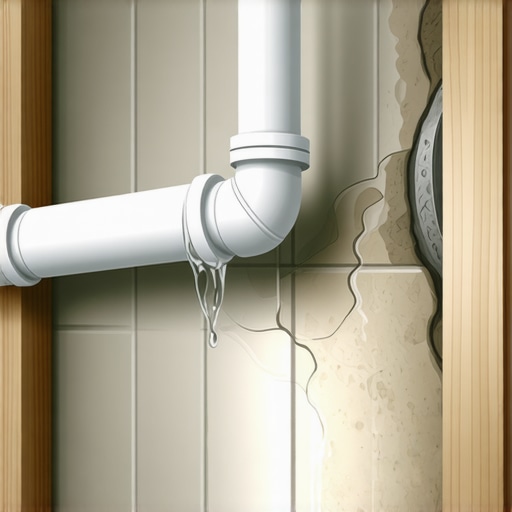
Most guys skip the leveling compound. They think the underlayment will hide the dip. It won’t. I spent three days grinding concrete on a job last month just so the floor wouldn’t click like a castanet. That job taught me that what happens beneath the surface dictates everything you see on top. Flooring is not a cosmetic layer. It is a structural record of every mistake made by the plumbers and framers who came before you. When a shower drain pipe disconnects behind a wall, the floor is the first thing to testify against the installer. I have seen fifteen thousand dollar walnut planks turn into potato chips because a single PVC coupling was not primed correctly. The water does not just sit there. It travels. It finds the path of least resistance through your joists and into your expensive finishes.
The phantom leak beneath the subfloor
Disconnected shower drains often manifest as localized moisture spikes in adjacent subflooring materials before becoming visible to the naked eye. Identifying a disconnected PVC pipe requires monitoring hydrostatic pressure and capillary movement within the wood joist system or concrete slab foundation to prevent structural rot and mold. You must understand that water is a solvent. It will dissolve the bonds of your flooring adhesives long before you see a puddle on the tile.
The mechanics of a disconnected drain are simple yet devastating. When the pipe separates from the shower flange or the P-trap, water exits the system and enters the wall cavity. This is not a pressurized leak like a supply line. It is a gravity-fed disaster. Every time someone steps into that shower, gallons of gray water are dumped directly onto the subfloor. If you have a concrete slab, the water will migrate through the pores of the concrete via capillary action. If you have wood joists, the timber will soak up the water like a sponge, leading to a loss of structural integrity. I always carry a moisture meter because your eyes will lie to you, but the electrical resistance of wet wood never does.
Visible indicators in the flooring and grout
Grout cracks and efflorescence are primary indicators that moisture is accumulating underneath the tile assembly due to a plumbing failure. When alkaline salts migrate to the surface of the cementitious grout, it confirms that the shower pan or drainage pipe is no longer containing waste water effectively. Grout is porous. It acts as a wick for the disaster happening in the dark spaces behind your drywall.
Look at the transitions. If the grout lines where the floor meets the wall are turning a dark, muddy color, you have a problem. This is not just dirt. It is the saturation of the thin-set mortar. When thin-set remains submerged, it undergoes a process of emulsification. The polymers break down. The bond fails. I have walked onto jobs where I could lift a twelve by twenty-four inch porcelain tile with my bare hands because the disconnected drain had turned the mortar back into a sandy slurry. If you see white, crusty powder forming on your grout, that is efflorescence. It is a sign that water is moving through the substrate and bringing minerals to the surface. It is a scream for help from your subfloor.
“A floor is only as good as the subfloor beneath it; deflection is the enemy of every joint.” – Master Flooring Axiom
The physics of water travel through subfloors
Capillary suction allows water from a disconnected drain to travel horizontally across a subfloor, often appearing several feet away from the leak source. This moisture migration is driven by the surface tension of water and the porosity of construction materials like plywood, OSB, and concrete. It defies gravity. It climbs up your studs. It ruins your baseboards.
Wood is an anisotropic material. It moves and swells differently depending on the direction of the grain. When a shower pipe leaks, the bottom of your subfloor gets wet first. This creates a moisture gradient. The bottom of the wood expands while the top remains dry, causing the wood to cup. This mechanical force is strong enough to snap floor staples and shear off adhesive bonds. If you are walking on your floor and hear a squelch or a crunch, the water has already compromised the cellular structure of the wood. At this point, the repair is no longer just plumbing. It is a full-scale structural remediation. You are looking at replacing joists that have been softened by fungal decay because a plumber forgot to use purple primer on a two-inch PVC joint.
Long term damage to hardwood and laminate
Hardwood floors respond to shower drain leaks through cupping and dimensional instability, while laminate flooring suffers from irreversible core swelling. Because laminate uses high-density fiberboard, even a small plumbing disconnect can cause the locking mechanisms to fail as the cellulose fibers absorb water. Once that core swells, it never goes back down. You can dry it out with a thousand fans, but the floor is still ruined.
Solid hardwood is a different beast. It has a memory. If it gets wet, it moves. If it stays wet, it rots. I have seen white oak floors turn black because the tannins in the wood reacted with the minerals in the leaking shower water. This staining is deep. You cannot sand it out. If you suspect a leak, check the moisture content of the wood. A normal floor should be between six and nine percent. If my meter hits twenty percent, I know there is a plumbing failure nearby. Laminate is even worse. Most people buy it because it is cheap, but it is essentially a pressed paper product. Water from a disconnected drain will wick into the edges of the planks, causing the seams to peak. It looks like a mountain range in your hallway. That is the physical manifestation of a plumbing failure behind the wall.
| Material Type | Moisture Sensitivity | Structural Reaction | Repair Potential |
|---|---|---|---|
| Solid Hardwood | High | Cupping and Blackening | Possible if caught early |
| Engineered Wood | Medium | Delamination of layers | Very Low |
| Laminate (MDF/HDF) | Extreme | Edge peaking and core rot | Zero |
| Porcelain Tile | Low | Bond failure and efflorescence | Requires substrate replacement |
Technical specifications for shower pan integrity
TCNA standards dictate that a shower assembly must be waterproof before the tile application, yet a disconnected drain pipe bypasses these secondary barriers entirely. When the clamping ring or no-hub coupler fails, the membrane integrity is irrelevant because the water is exiting the plumbing stack before it ever reaches the waste line. You are basically pouring water into a hole in your house.
The National Wood Flooring Association is very clear about the environment required for a stable floor. You cannot have a stable floor next to a failing wet room. The humidity in the subfloor must be within four percent of the flooring material. When a drain pipe is disconnected, the relative humidity under the floor hits one hundred percent. This creates a microclimate that promotes the growth of Stachybotrys chartarum. That is black mold. It eats the lignin in your wood. It destroys the air quality in your home. This is why a simple plumbing check is a requirement for any floor inspector. We do not just look at the boards. We look at the systems that support them.
“The presence of moisture in the subfloor is the most common cause of flooring failure and structural degradation.” – NWFA Technical Guidelines
Testing methods for hidden plumbing breaks
Static head testing involves plugging the shower drain and filling the basin to determine if the leak is in the pan or the downstream piping. A thermal imaging camera can also detect evaporative cooling signatures that indicate sub-surface moisture patterns consistent with a disconnected PVC joint. This is the scientific way to find a ghost.
- Check for soft spots in the subfloor immediately adjacent to the shower wall.
- Inspect the ceiling below the shower for circular water staining or sagging plaster.
- Use a pin-type moisture meter to probe the base of the drywall.
- Run the shower for twenty minutes and watch for water emerging from under the baseboards.
- Sniff the area for a musty, earthy odor that indicates active fungal growth.
- Look for gaps in the grout where the floor meets the shower curb.
The point of no return for your flooring
Structural remediation is mandatory once the subfloor moisture content exceeds fiber saturation point, which is typically around thirty percent. At this level, the wood cells are completely saturated, and mechanical failure of the floor system is imminent. You cannot wait. Water is not like wine. It does not get better with age. It only gets more expensive.
If you find that your drain is disconnected, the first thing you do is stop using that shower. The second thing you do is pull up the affected flooring. Do not try to save the laminate. It is gone. If you have hardwood, you might be able to save it by using a high-pressure vacuum drying system, but only if the water was clean. Since shower water contains soap, skin cells, and bacteria, it is considered Category 2 gray water. This means it carries a biological load. In many cases, the safest and only professional option is to strip the room to the studs and start over. I have spent decades seeing people try to cut corners. They try to caulk the gap. They try to ignore the smell. In the end, they always call me to rip it all out anyway. Do it right the first time or do it twice. There is no third option in flooring.