
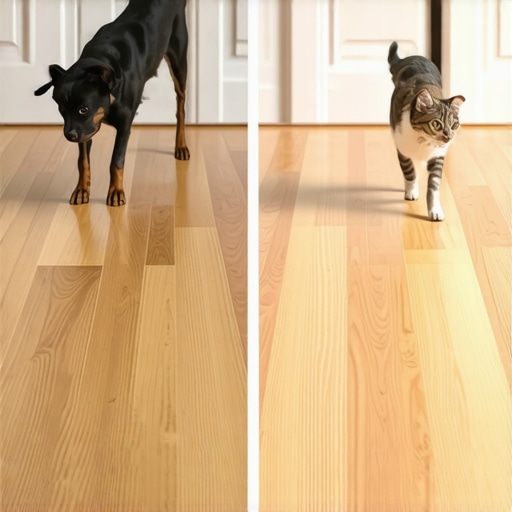
I once walked into a house where a $15,000 wide-plank walnut floor was cupping so bad it looked like a potato chip because the installer didn’t check the crawlspace humidity. The homeowner stood there with a golden retriever that had already gouged deep tracks into the soft wood near the back door. It was a heartbreak. After 25 years on my knees with a moisture meter and a circular saw, I can tell you that beauty is skin deep, but a pet’s impact goes straight to the core. My hands smell like oak dust and WD-40, and my knees pop every time I stand up, but I know exactly what happens when seventy pounds of muscle and claws hits a surface at twenty miles per hour. We are not talking about interior design here. We are talking about the physics of impact, the chemistry of uric acid, and the structural integrity of your subfloor. If you think your floor is just something to walk on, you have already lost the battle against your pets. It is a performance surface that must withstand the daily grind of sandpaper-like paws and the occasional liquid accident that can ruin a porous material in hours.
The microscopic war between dog nails and finish
Laminate flooring and hardwood floors compete in a brutal environment where Janka hardness and aluminum oxide finishes determine the durability of the surface. Pet claws act as abrasives that can penetrate the polyurethane layer of natural wood while laminate wear layers provide a scratch-resistant shield. The reality of pet ownership is that your floor is under constant bombardment. Hardwood is a biological material. It has cells and fibers that compress under pressure. When a dog runs, those claws act like tiny hammers. A high-quality laminate uses a resin-infused top layer that is significantly harder than almost any domestic wood species. While a Red Oak floor might have a Janka rating of 1290, a high-end laminate does not even use that scale because it is essentially a photographic image protected by a transparent layer of melamine and aluminum oxide. This chemical bond is far more resistant to the shearing forces of a canine’s gait. I have seen Hickory floors, which are quite hard, look like they were attacked by a bear after only three years of hosting a pair of labs. Meanwhile, an AC4 rated laminate in the same environment can look brand new after a decade. The difference is the molecular density of the surface. Hardwood relies on the density of the grain, but even the densest White Oak cannot compete with a factory-cured, heat-pressed synthetic shield. This is the first lesson in the shop. Do not mistake the price of the material for its ability to resist a scratch.
“A floor is only as good as the subfloor beneath it; deflection is the enemy of every joint.” – Master Flooring Axiom
Why AC ratings determine the life of your laminate
AC ratings provide a standardized measurement of abrasion resistance for laminate flooring products used in residential and commercial settings. An AC3 rating is standard for homes, but pet owners should look for AC4 or AC5 to ensure the wear layer survives heavy traffic. Most people walk into a big-box store and look at the color first. That is a mistake. You need to look at the AC (Abrasion Class) rating. This rating is determined by a Taber test where a machine rotates sandpaper over the surface until the pattern is worn through. An AC4 rating means that floor can handle a small office building. If you have two dogs over fifty pounds, you are essentially living in a high-traffic commercial zone. The High-Density Fiberboard (HDF) core of the laminate also matters. If the core is cheap, it will be soft. A soft core allows the top layer to flex under the point-load of a dog’s claw, which can cause the brittle wear layer to crack. You want a high-density core that provides a solid anvil for the wear layer to sit on. This prevents the microscopic fractures that eventually lead to visible peeling. Most installers will tell you that the thicker the board, the better the floor. That is not always true. A 12mm board with a poor AC rating is worse than an 8mm board with an AC5 rating. It is about the science of the skin. If the skin is tough, the floor survives. If the skin is weak, the wood byproduct underneath will soak up moisture and swell like a sponge. This is why I tell people to stop looking at the oak-look print and start reading the technical specifications on the back of the sample. The chemistry of the resin is what you are actually buying.
The hidden cost of pet accidents on natural fibers
Hardwood floors are highly porous and can absorb moisture and pet urine, leading to permanent staining and odor retention within the wood fibers. Laminate flooring with wax-coated edges offers better moisture resistance against surface spills but can still fail at the locking joints. This is where the debate gets messy. Urine is not just water. It is an acidic solution that breaks down the molecular bonds of floor finishes. On a site-finished hardwood floor, the liquid can seep between the planks and get into the end grain. Once it is in the grain, it is there forever. I have sanded down floors where the black stains from a cat’s favorite corner went two-thirds of the way through a three-quarter inch solid oak plank. You cannot sand that out. You have to replace the wood. Laminate is better at resisting the initial soak, but it has a different weakness. The joints. If liquid sits on a laminate joint, it will eventually find its way into the HDF core. Once that core gets wet, it expands. It will never go back down. This is called peaking. You see the edges of the boards lifting up, creating a lippage that the dog will then catch its claws on, further damaging the floor. Some modern laminates have hydrophobic coatings on the tongue and groove, which I highly recommend. It gives you a window of time, maybe twenty-four hours, to find the mess. But do not believe the marketing that says it is 100 percent waterproof. Nothing made of wood pulp is truly waterproof. If you want a floor you can submerge, go buy a luxury vinyl plank, but even then, the subfloor can rot if the water gets underneath. You have to treat the perimeter with a silicone sealant if you want a chance at a truly sealed system.
| Feature | Solid Hardwood | Engineered Hardwood | AC4 Laminate |
|---|---|---|---|
| Scratch Resistance | Low | Moderate | Extreme |
| Moisture Tolerance | Very Low | Moderate | Moderate High |
| Repairability | Very High | Moderate | Low |
| Average Lifespan with Pets | 15 Years (before refinish) | 10-15 Years | 15-20 Years |
| Janka Rating / AC Grade | 1200 to 1800 | 1200 to 2200 | AC4 Grade |
The 1/8 inch that ruins everything
Subfloor flatness is the most critical factor in the installation of click-lock laminate or engineered hardwood to prevent joint failure and creaking. A leveling compound or grinding concrete ensures that the expansion gap remains functional and the locking mechanism stays intact. I spent three days grinding concrete on a job last month just so the floor wouldn’t click like a castanet. Most guys skip the leveling compound. They think the underlayment will hide the dip. It won’t. When a heavy dog walks across a floor that has a void underneath it, the joint flexes. That flex is the beginning of the end. Over thousands of cycles, the thin plastic or wood tongue will snap. Once the tongue is gone, the boards will drift apart. Then you have a gap. That gap collects hair, dirt, and moisture. In the flooring world, we have a rule. The floor must be flat within 1/8 of an inch over a 10-foot radius. If it is not, you are building a trampoline, not a floor. This is especially true for pet owners because the dynamic load of a running animal is much higher than a human walking. The physics of deflection are unforgiving. If you are installing over a concrete slab, you also have to worry about hydrostatic pressure. Moisture can rise through the concrete and get trapped under your vapor barrier. This creates a breeding ground for mold and can cause the underside of your laminate to rot before the top even shows a scratch. I always use a 6-mil poly film and tape the seams with high-quality moisture-resistant tape. It is an extra fifty dollars and two hours of work that saves a five-thousand-dollar investment. People want to talk about colors and showers and grout, but they ignore the foundation. You can have the most expensive hardwood floors in the world, but if your subfloor is a mess, your pets will destroy that floor in eighteen months just by walking on it.
The truth about underlayment and joint stress
Underlayment provides sound dampening and a moisture barrier for floating floors, but excessive thickness can lead to structural failure of the locking system. Choosing a high-density foam or cork underlayment ensures the laminate planks remain stable under the weight of pets. While most people want the thickest underlayment, too much cushion actually causes the locking mechanisms on LVP or laminate to snap under pressure. It is a common mistake. You see a 6mm pad and think it will be soft on your feet and quiet for the neighbors. It will. But it will also act like a mattress. When your dog jumps off the sofa, the floor planks sink into that thick pad. The tongue and groove are not designed for that much vertical movement. They are designed to stay flat. I recommend a high-density pad no thicker than 3mm. You want something that feels more like rubber than a sponge. This provides the IIC (Impact Insulation Class) rating you need to keep the dog’s nails from sounding like a drum set while maintaining the structural integrity of the floor. If you are worried about the cold, look for a pad with a high R-value, but keep the density high. I have seen entire floors unzipped because the homeowner used a cheap, thick foam pad they bought on clearance. The floor literally pulled itself apart. You also need to consider the acclimation period. Hardwood needs to sit in the house for at least a week, sometimes two, until the moisture content matches the ambient humidity of the room. Laminate also needs time to adjust to the temperature. If you rush the install, the floor will expand after you put the baseboards on, and it will buckle. A buckled floor has no structural strength, and a dog’s paws will chew through the resulting peaks in a matter of days.
Pet-proofing your flooring installation checklist
- Check the subfloor for levelness using a 10-foot straight edge.
- Grind down high spots in concrete and fill low spots with self-leveling underlayment.
- Verify the moisture content of the subfloor and the new flooring material using a professional-grade meter.
- Select an AC4 or AC5 rated laminate if you have large dogs.
- Install a 6-mil moisture barrier over concrete slabs to prevent mold and core swelling.
- Maintain a consistent 1/2 inch expansion gap around the entire perimeter of the room.
- Apply a joint sealant to the locking mechanisms for added moisture protection in high-risk areas.
- Use transition strips at every doorway to allow for independent floor movement.
- Trim pet nails regularly to reduce the impact of mechanical abrasion on the wear layer.
- Clean up all liquid accidents immediately with a manufacturer-approved pH-neutral cleaner.
Comparing laminate and hardwood maintenance for pet owners
Maintenance routines for pet-friendly flooring require non-abrasive cleaners and microfiber mops to protect the surface finish from scratches and chemical damage. Refinishing hardwood is a long-term benefit that laminate does not offer, but the frequency of repairs is much higher with natural wood. If you choose hardwood, you are signing up for a lifetime of maintenance. You will be buffing and recoating every few years to keep the protective layer intact. With laminate, you are buying a finite lifespan, but that lifespan is often much easier to manage. You do not wax laminate. You do not steam clean it. Steam is the enemy of any wood product. It forces moisture into the joints at high pressure, which will destroy the bond of the HDF core. Just use a damp microfiber mop. For hardwood, you have to be careful with the products you use. Many