
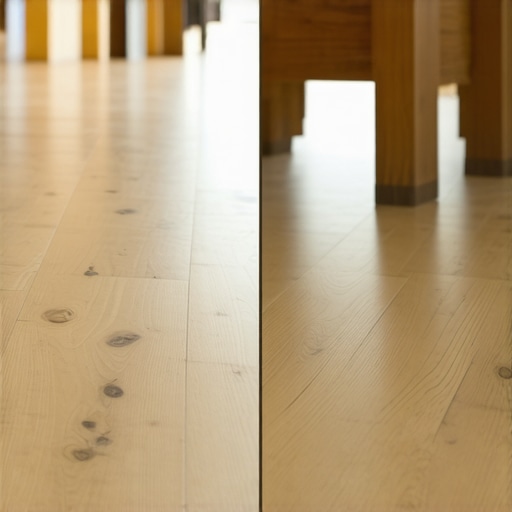
Stop Your Hardwood From Buckling with This Expansion Gap Secret
I once walked into a house where a $15,000 wide plank walnut floor was cupping so bad it looked like a potato chip because the installer did not check the crawlspace humidity. It was a tragedy of engineering. The homeowner was in tears, the contractor was ghosting her, and the beautiful black walnut was literally ripping the baseboards off the drywall. This is what happens when you treat flooring as a cosmetic choice instead of a structural engineering challenge. I have spent 25 years with sawdust under my nails and a moisture meter in my pocket, and I am here to tell you that your floor is alive. It breathes, it moves, and if you do not give it the space it needs, it will destroy itself. The secret is not just leaving a gap; it is understanding the physics of why that gap exists and how to calculate it based on the molecular reality of the wood species you chose.
The structural physics of wood cell expansion
Hardwood floor buckling happens because wood is a hygroscopic material that absorbs moisture from the air and subfloor, causing individual cells to swell. When these expanding planks run out of room at the perimeter, the internal pressure forces the boards upward, creating peaks, cupping, or full floor failure. Wood is composed primarily of cellulose, hemicellulose, and lignin. These organic polymers are designed by nature to transport water. Even after a tree is felled, milled, and kiln-dried, those cells remain thirsty. When the relative humidity in a room rises, the moisture vapor enters the wood cell walls, pushing them apart at a microscopic level. This is the tangential expansion of the wood. If you have a room that is twenty feet wide and each plank expands by just 1/64 of an inch, you are looking at nearly an inch of total lateral movement across the span. Without a dedicated expansion gap at the perimeter, that energy has nowhere to go but up.
“A floor is only as good as the subfloor beneath it; deflection is the enemy of every joint.” – Master Flooring Axiom
Why your subfloor is lying to you
A subfloor might look flat and dry, but it often hides hydrostatic pressure or high moisture vapor transmission rates that will inevitably buckle your hardwood floors. Professional installers must use calcium chloride tests or in-situ RH probes to verify that a concrete slab is below 3 lbs per 1,000 square feet before proceeding. Many DIYers and low-bid contractors think a quick glance at the plywood is enough. It is not. You need to know the moisture content (MC) of the subfloor and the MC of the flooring itself. The NWFA guidelines state that for solid strip flooring, there should be no more than a 4 percent difference between the wood and the subfloor. For wide plank floors, that margin drops to 2 percent. If you ignore this, you are locking a moisture bomb under your finish. The adhesive chemistry also matters. Using a moisture-cured urethane adhesive can provide a vapor retarder, but it is not a magic wand for a wet slab. You have to address the source of the moisture, whether it is a leaky pipe near the showers or a poorly ventilated crawlspace.
The expansion gap math that installers ignore
The standard expansion gap for most hardwood floors is 3/4 of an inch, which is typically the thickness of the flooring itself. This gap must be maintained around the entire perimeter of the room, including around door jams, pillars, and transitions to other materials like grout or tile. Most people hate the look of a wide gap, so they try to cheat it. They leave a 1/4 inch gap and think the baseboard will cover it. Then the humid season hits, the wood swells, hits the drywall, and the floor buckles. You must account for the specific species. A floor made of Brazilian Cherry has a different movement profile than White Oak. The Janka Hardness Scale tells you how tough the wood is against dents, but it does not tell you the stability. You need to look at the tangential and radial shrinkage coefficients. This is the molecular zooming that separates a master from an amateur.
| Wood Species | Janka Hardness | Stability Rating | Required Gap (20ft Span) |
|---|---|---|---|
| White Oak | 1360 | Medium | 3/4 Inch |
| Brazilian Cherry | 2350 | Low Stability | 1 Inch |
| Engineered Maple | 1450 | High Stability | 1/2 Inch |
| Hickory | 1820 | Very Low Stability | 1 Inch |
Regional humidity and the hygroscopic disaster
Climate plays a massive role in how expansion gaps perform, as the equilibrium moisture content of wood varies significantly between the swampy humidity of Houston and the dry air of Phoenix. Installers must acclimate the wood to the specific environment of the home while the HVAC system is running at normal occupancy levels. If you live in a coastal area, your wood is going to be naturally more swollen than in a desert. If you install wood that was stored in a damp warehouse directly into a dry, air-conditioned home in Arizona, those boards will shrink, leaving massive gaps. Conversely, installing bone-dry wood in a humid Florida summer without a massive expansion gap is a recipe for a buckled mess by August. You are not just laying boards; you are balancing an environmental equation.
The myth of the waterproof click lock floor
While laminate and LVP are often marketed as waterproof, their cores are still subject to thermal expansion and their locking mechanisms are incredibly fragile. Over-constraining a floating floor by placing heavy kitchen islands on top of it will cause the joints to snap and the floor to buckle. I see this every month. Someone buys a high-end laminate, installs it perfectly, and then bolts a 500-pound marble-topped island right in the middle. You just killed the floor. A floating floor must be allowed to move as a single monolithic slab. When the temperature changes, the plastic and resin in these floors expand. If one side is pinned by a cabinet and the other by a wall, the floor will peak at the weakest joint. This is why T-moldings are necessary in large spans, even if the minimalist curator in you hates how they look.
“Wood is a hygroscopic material; it is always seeking a state of equilibrium with its environment.” – NWFA Technical Manual
The checklist for a permanent floor
To ensure your hardwood floors or laminate never buckle, you must follow a strict protocol that begins long before the first plank is laid. This is the structural engineering approach to flooring.
- Acclimate the flooring for at least 5 to 7 days in the room where it will be installed.
- Use a moisture meter to verify the subfloor is within 2 to 4 percent of the flooring moisture content.
- Maintain a consistent indoor temperature between 60 and 80 degrees Fahrenheit.
- Keep relative humidity between 30 and 50 percent year-round using humidifiers or dehumidifiers.
- Leave a minimum 3/4 inch expansion gap for solid wood and 1/2 inch for engineered products.
- Never nail or glue baseboards to the flooring; they must be attached to the wall only.
- Use transition strips in any room span exceeding 30 feet to allow for independent movement.
The ghost in the expansion gap
The most common mistake is the hidden obstruction where an installer allows a single nail or a piece of debris to fall into the expansion gap, creating a pivot point that causes the floor to buckle. Maintaining a clean work environment is as vital as the measurement itself. Even a small pebble or a stray glob of drywall mud in that 3/4 inch gap can act as a fulcrum. As the floor tries to expand, it hits that one spot and the energy is diverted upward. It is a ghost in the machine that can be impossible to find once the baseboards are on. I have seen guys spend days tearing up a buckled floor only to find a single screw wedged against the bottom plate of the wall. Precision is not just about the saw cuts; it is about the purity of the space you leave behind.
Why showers and hardwood are a dangerous mix
Moisture migration from bathrooms and showers can travel through the subfloor and affect hardwood in adjacent hallways, making a high-quality moisture barrier essential at every transition. Grout lines in tile are not waterproof and can allow vapor to seep into the neighboring wood. If you have a walk-in shower, the humidity in that room can spike to 90 percent. That vapor finds the easiest path out, which is often under the door and into the wood flooring of the master bedroom. You need to use a high-quality silicone caulk at the transition between the tile grout and the wood. Never butt the wood directly against the tile. Leave the gap, fill it with a flexible color-matched caulk, and ensure your subfloor has a topical moisture membrane if you are anywhere near a wet area. It is about controlling the flow of molecules.