
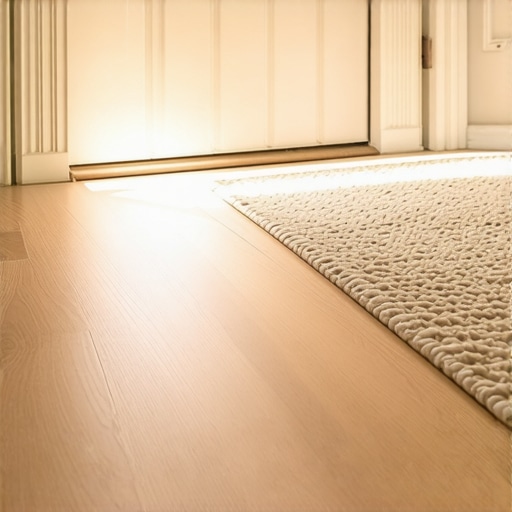
Most guys skip the leveling compound. They think the underlayment will hide the dip. It won’t. I spent three days grinding concrete on a job last month just so the floor wouldn’t click like a castanet. That is the reality of professional flooring. If you do not respect the subfloor, the subfloor will humiliate you within six months. When you are looking at the jump from a solid 3/4 inch white oak to a thick frieze carpet with a heavy 8 pound pad, you are not just looking at a color change. You are looking at a mechanical intersection that has to withstand thousands of footfalls without coming apart or becoming a trip hazard. The smell of WD-40 and fresh oak dust is still on my shirt, a reminder that every successful floor is built on a flat foundation, not a hope and a prayer.
The mechanics of the Z-bar transition
Z-bar transitions create the most professional finish when moving from hardwood floors to thick carpet because they allow the carpet to be tucked and tensioned against the wood edge. This method uses a metal transition strip hidden beneath the carpet pile to provide a flush surface and structural stability. The Z-bar protects the carpet edge from fraying while providing a clean, hardware-free look on the hardwood side. I have seen too many installers rely on cheap plastic T-moldings that snap the first time someone steps on them with a heavy boot. A Z-bar is different. It is a piece of metal that you nail to the subfloor. You wrap the carpet over it and tuck it into the crevice. This creates a tensioned edge that will not budge. If you are dealing with a thick pile, the Z-bar is your best friend because it can be adjusted to the height of the wood. Most people think you just slap a piece of wood over the gap. They are wrong. You need a mechanical lock. When the carpet is thick, the padding adds another layer of complexity. You have to ensure the padding is cut back exactly one inch from the wood edge so the carpet can transition downward into the tuck. If the pad is too close, you get a hump that looks like a buried garden hose.
Why your subfloor is lying to you
Subfloor flatness is the primary reason transitions fail because any vertical deflection or unevenness prevents the transition molding from seating properly. A flat subfloor requires a tolerance of 1/8 inch over 10 feet to ensure hardwood floors and thick carpet meet at a consistent, safe, and durable elevation. You walk into a room and it looks flat. You put a 10 foot straight edge down and suddenly you see the truth. There is a 3/16 inch dip right where the wood meets the carpet. If you ignore that, your transition will bounce. Every time you step on it, the nails will loosen. Eventually, the wood will splinter or the carpet will pull out of the tack strip. I spend more time with a floor grinder and self-leveling compound than I do actually laying wood. It is a messy, loud, and annoying process. But it is what separates a Master Floor Installer from a guy with a truck and a hammer. You have to check the moisture content of that subfloor too. If your plywood is sitting at 14 percent and your oak is at 7 percent, you are asking for a disaster. The wood will swell, the gap will close, and your beautiful transition will buckle like a cheap suit in the rain.
“A floor is only as good as the subfloor beneath it; deflection is the enemy of every joint.” – Master Flooring Axiom
The ghost in the expansion gap
An expansion gap of at least 3/4 inch is mandatory for hardwood floors to prevent buckling and cupping during seasonal humidity changes. When transitioning to thick carpet, this gap must be maintained and hidden by a reducer strip or a tucked carpet edge to ensure the structural integrity of the installation. Wood is alive. It breathes. It expands in the summer and shrinks in the winter. If you pin the wood down with a transition strip, it has nowhere to go. I once saw a walnut floor that was so tight against a tile transition that it actually lifted the tile off the floor. You have to respect the physics of the material. For carpet transitions, this means the tack strip cannot be nailed directly against the wood. You need a gap. That gap is where the carpet tucks. It serves as both an aesthetic finish and a relief valve for the wood. In high-humidity regions like the Gulf Coast, this gap is even more vital. If you do not give that wood room to move, it will find its own room, usually by pushing your baseboards off the wall. I always leave a thumb-width gap between the hardwood and the carpet tack strip. It seems like a lot, but once that carpet is tucked, it looks like a million bucks and the wood can breathe easy.
Managing the elevation change between materials
Elevation differences between hardwood floors and thick carpet are best managed using plywood shims or ramped subfloors to create a flush transition. By feathering the subfloor with a patching compound, you eliminate trip hazards and allow vacuum cleaners to pass easily between different flooring surfaces. Sometimes the carpet is much higher than the wood. This happens a lot with these modern ultra-plush carpets and thick memory foam pads. If the carpet is sitting half an inch higher than the wood, a standard T-molding will look like a mountain range. You have to ramp the subfloor. I use 1/4 inch luan or specialized shingle shims to slowly raise the wood side as it approaches the carpet. It is a slow process. You have to feather it out over three or four feet so the eye cannot see the incline. The goal is to get the two materials to meet at the exact same height. If you get it right, you can roll a marble from the wood to the carpet without it jumping. That is the gold standard. Most guys are too lazy for that. They just throw a reducer down and call it a day. A reducer is fine, but a flush transition is the mark of a pro.
| Transition Method | Material Compatibility | Durability Rating | Visual Profile |
|---|---|---|---|
| Z-Bar Tuck | Hardwood to High-Pile Carpet | High | Hidden / Flush |
| Overlapping Reducer | Hardwood to Laminate or Tile | Medium | Raised Edge |
| T-Molding | Same Height Hardwood / Laminate | Low | Symmetrical Cap |
| Shimmed Flush Mount | Solid Wood to Premium Carpet | Maximum | Seamless Appearance |
The truth about tack strips and high pile carpet
Tack strips must be placed exactly 1/4 inch from the hardwood edge to allow for a proper tuck of thick carpet pile. Using architectural tack strips with three rows of pins ensures that heavy carpet remains under lateral tension, preventing wrinkles and delamination over years of heavy foot traffic. Not all tack strips are created equal. You go to a big box store and you get the cheap thin ones. They are garbage. For a real hardwood-to-carpet transition, you want the wide strips. You want pins that are sharp enough to draw blood just by looking at them. When you nail them down, you have to ensure the pins are angled toward the wall, not the transition. I have seen homeowners try to do this themselves and they put the strips in backward. The carpet just slides right off. And do not get me started on the gapping. If you put the tack strip right against the wood, there is no place for the carpet to go. You end up with a raw edge of carpet sticking up. It looks like a DIY disaster. You need that 1/4 inch gutter. That is where the magic happens. You use a stair tool to drive the carpet into that gutter. The pins hold the tension, and the gutter hides the edge. It is simple engineering, but it requires precision.
- Check subfloor moisture levels with a calibrated pin meter before installation
- Acclimate hardwood for at least seven days in the room where it will be installed
- Ensure the carpet pad is at least 1/8 inch thinner than the carpet pile
- Use 2-inch spiral shank nails for any transition strips anchored to wood subfloors
- Grind down any high spots in concrete to within 1/8 inch tolerance
Humidity and the expansion of natural fibers
Relative humidity significantly impacts both hardwood floors and carpet fibers, causing dimensional changes that can stress transition points. Maintaining a consistent climate between 35 and 55 percent humidity prevents gapping in wood and stretching in carpet, ensuring the transition strip remains securely fastened and aesthetically pleasing. If you live in a place like Phoenix, the air is so dry it will suck the moisture out of your bones and your floor. Your wood will shrink until you can see the tongues in the grooves. On the other hand, if you are in the humidity of a Florida summer, that wood is going to grow. I always tell clients that if they are not going to run their HVAC system, they should not buy hardwood. It is a high-maintenance product. Carpet is more forgiving, but even it can grow. High humidity can cause the secondary backing of a carpet to relax. Suddenly, that tight transition you spent hours on is now baggy and loose. You have to power-stretch the carpet. Never trust an installer who only uses a knee kicker. A knee kicker is for adjusting; a power stretcher is for installing. If they do not pull out the big poles to stretch that carpet against the wood, tell them to leave the job site. You need that tension to keep the transition from failing.
“Wood moves. It is a biological fact. If you do not account for movement, the floor will account for it by breaking.” – NWFA Technical Manual
Hardwood floors and the moisture migration problem
Moisture barriers are essential when installing hardwood floors near showers or on concrete slabs to prevent hydrostatic pressure from damaging the carpet transition. Using a 6-mil polyethylene film or a liquid moisture epoxy creates a vapor shield that protects the integrity of the adhesive and the subfloor stability. This is where things get technical. People love to put hardwood in hallways right outside of bathrooms. They take a hot shower, the steam hits the floor, and the moisture seeps into the end-grain of the wood right at the carpet transition. Over time, that wood swells and starts to rot. You have to seal the end-grain. I use a bit of wax or a specialized sealer on the cut ends of the boards before I tuck the carpet against them. It takes an extra ten minutes, but it saves the floor from turning into mush in five years. You also have to worry about the carpet wicking moisture. If there is a leak in the shower and it hits the carpet, that moisture will travel straight to the wood. It is like a fuse. Once it starts, the damage is done. Proper waterproofing in the transition zone is not an option; it is a requirement. I have seen $20,000 floors ruined because someone forgot a five dollar roll of plastic. It is enough to make a man retire. But then I smell that oak dust again and I am back on my knees, making sure the next one is done right. No shortcuts, no excuses, just a floor that will outlast the house.