
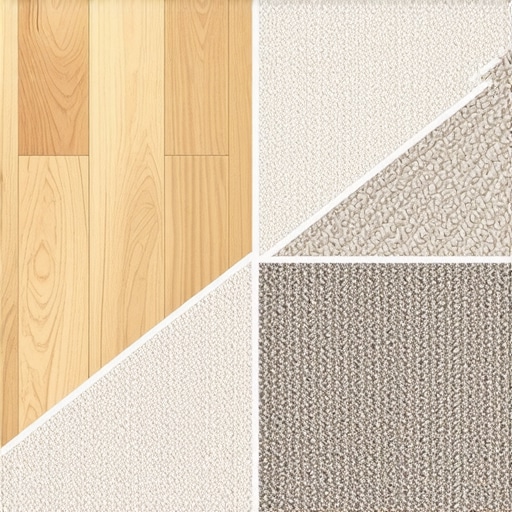
Most guys skip the leveling compound. They think the underlayment will hide the dip. It won’t. I spent three days grinding concrete on a job last month just so the floor wouldn’t click like a castanet. That job was a perfect example of why you cannot cut corners when you are moving from a hard surface to a soft one. The homeowner had picked out this beautiful 12mm laminate that looked like reclaimed white oak, but the subfloor was a nightmare of hills and valleys. If I had just thrown down the planks and tried to bridge that gap to her thick, plush carpet without fixing the foundation, the locking mechanisms would have snapped under the weight of a footfall within a week. I view a floor as a performance surface, not just something pretty to look at. You have to respect the physics of the materials or they will fail you every single time.
The 1/8 inch that ruins everything
Laminate flooring and thick carpet require a reducer transition or a Z-bar to manage height differences effectively. Proper installation ensures the subfloor remains level while the tack strip and carpet padding provide a flush finish against the laminate plank edge without exposing the underlayment or the expansion gap.
When you are dealing with a height differential, you are fighting a battle of millimeters. A standard laminate plank is usually between 8mm and 12mm thick. When you add a 2mm underlayment, you are looking at a total height of maybe half an inch. Now, look at a thick, high pile carpet. You have a 7/16 inch 8lb density pad, plus the primary and secondary backing of the carpet, plus the pile height itself. You could easily be looking at over an inch of total thickness. That half inch difference is a trip hazard and a structural weakness if you do not handle it with a proper transition strip. Unlike hardwood floors that are often nailed directly to a wooden subfloor, laminate is a floating system. It moves. It breathes. If you pin it down too tight at the carpet line, it will buckle in the middle of the room when the humidity hits.
“A floor is only as good as the subfloor beneath it; deflection is the enemy of every joint.” – Master Flooring Axiom
Why your subfloor is lying to you
Subfloor flatness is the most ignored variable in flooring installation, yet it dictates the longevity of the laminate locking system. A concrete slab or plywood subfloor must be flat to within 3/16 of an inch over a 10 foot radius to prevent vertical deflection that causes click-lock flooring to separate at the transition.
I have seen guys try to use extra padding to fill a birdbath in the concrete. That is a recipe for disaster. The padding compresses, the joint flexes, and eventually, the melamine resin core of your laminate snaps. You need to get out the straightedge and the floor patch. If you are working over concrete, you better be checking the moisture levels too. I do not care if the house is fifty years old. Hydrostatic pressure can push moisture through that slab and rot your carpet pad or swell the edges of your laminate. You do not want the smell of mold coming from your transition. It is not like grout in showers where you have a waterproof membrane and a chemical bond to hold things in place. Here, you are relying on mechanical fastness and dry conditions.
The ghost in the expansion gap
An expansion gap of at least 1/4 inch is required for all laminate floors to accommodate changes in temperature and humidity. The carpet transition must hide this gap while allowing the floating floor to move freely underneath the molding or track system without binding or pinching.
If you bury the edge of the laminate under the carpet without a transition piece, you are asking for trouble. The carpet will trap dust and grit in that gap. Over time, that grit acts like sandpaper against the edge of the laminate. Every time someone walks on the carpet, it shifts slightly, grinding away at the decorative wear layer of your floor. This is why a metal track or a hard surface reducer is the only way to go. You secure the track to the subfloor, not the laminate. This allows the floor to slide back and forth as the seasons change. In the winter, the floor shrinks. In the summer, it grows. If you do not give it that 1/4 inch, it will find the space it needs by lifting up in the center of your hallway.
| Transition Type | Material | Best Use Case | Max Height Offset |
|---|---|---|---|
| Z-Bar | Metal | Hidden carpet edge | 3/4 inch |
| Reducer | Composite/Wood | Visible wood look | 1/2 inch |
| Slim Trim | PVC/Metal | Low profile transitions | 1/4 inch |
| End Cap | Aluminum/MDF | Sliding door tracks | 5/8 inch |
The hidden chemistry of carpet tack strips
Carpet tack strips must be installed approximately 1/4 inch away from the transition molding to allow the carpet specialist to tuck the high pile fabric into the gulley. This creates a clean edge that prevents the carpet fibers from fraying or pulling away from the laminate floor over time.
People think a tack strip is just a piece of wood with nails. It is a precision tool. If you put it too close to the laminate, there is no place to tuck the carpet. If you put it too far away, the carpet will look loose and sloppy. For a thick carpet, you might even need architectural strips, which are wider and have more pins to hold the tension of a heavy stretch. You want that carpet tight enough to bounce a quarter off it. If it is loose, it will bunch up at the transition and look like a speed bump. This is especially true in high traffic areas where the transition takes the most abuse from foot traffic and vacuum cleaners.
Why heavy furniture kills floating floors
Heavy furniture placed near a carpet transition can effectively lock a floating laminate floor in place, preventing thermal expansion. This localized pressure causes the laminate planks to peak or gap at the weakest point, which is usually the transition joint between the hard surface and the subfloor.
I have walked into so many homes where the owner complains about their floors buckling. I look over and see a 400 pound oak armoire sitting right on the edge of the laminate near the carpet. You have essentially nailed the floor to the subfloor with gravity. If you are going to have heavy furniture near a transition, you need to ensure the transition itself is not pinched. You need a little extra room in that expansion gap. Think of it like a bridge. If the bridge cannot move on its expansion joints, it collapses. Your floor is no different. It is a structural system that needs to breathe.
“Moisture vapor emission rate must not exceed three pounds per one thousand square feet in twenty-four hours.” – NWFA Technical Guidelines
The mistake of using standard T-molding
T-molding is designed for two floors of equal height and should never be used to bridge the gap between laminate and thick carpet. Instead, a 4-in-1 transition kit or a specific carpet reducer provides the necessary sloped profile to eliminate trip hazards and protect the exposed edges of the flooring material.
A T-molding looks like a capital T. It sits on top of both floors. If the carpet is higher than the laminate, the T-molding will sit at an angle. It will look terrible, and you will eventually kick it loose. A reducer is different. It has a rounded or sloped edge that transitions the height down. For a thick carpet, you often want the carpet to be slightly higher than the transition so you can tuck it down into a Z-bar. This creates that high-end look where the carpet seems to just disappear into the wood. It is a much cleaner look than a bulky piece of plastic sitting on top of your rug. It takes more work to install, but the result is worth the effort.
- Inspect the subfloor for any dips exceeding 1/8 inch.
- Install a moisture barrier if working over concrete.
- Leave a 1/4 inch expansion gap between the laminate and the track.
- Secure the transition track using 1-inch screws or construction adhesive.
- Tuck the carpet tightly into the gulley using a stair tool.
- Ensure the transition molding does not pinch the laminate plank.
Tools the pros use for a clean edge
Professional flooring tools like a power stretcher, stair tool, and knee kicker are essential for achieving a tight carpet transition. Using a carbide-tipped saw blade for the laminate cuts ensures a burr-free edge that allows the transition strip to sit flush against the subfloor without interference.
If you try to stretch a thick carpet by hand, you are going to fail. You need a power stretcher to get the wrinkles out and ensure the carpet stays put once it is tucked. For the laminate side, I always use a fine-tooth blade. You do not want jagged edges. Even if the edge is hidden under the molding, those burrs can hold moisture or cause the molding to sit unevenly. I also keep a shop vac running while I cut. Dust is the enemy of a good bond if you are using any adhesive on your tracks. You want a clean, dry surface for everything to grab onto. It is the difference between a floor that lasts thirty years and one that needs to be replaced in five. Pay attention to the details. The subfloor does not lie, and neither does the transition.