
The walnut heartbreak and the $15,000 mistake
I once walked into a house where a $15,000 wide-plank walnut floor was cupping so bad it looked like a potato chip because the installer didn’t check the crawlspace humidity. The homeowner was devastated. They had just moved their furniture back in, dragging a heavy Victorian sideboard across the boards without protection. Not only was the floor buckling from the moisture below, but it was also gouged from the movement above. It was a total loss. I spent twenty-five years on my knees with a moisture meter and a level. I have seen every way a person can ruin a floor. Most people think of their hardwood as a finished product once the last nail is driven or the last coat of poly is dry. That is a dangerous lie. A floor is a living, breathing structural element. It is a performance surface that reacts to the physics of friction and the chemistry of the environment. If you treat it like a cheap rug, it will fail you. Moving furniture is the most dangerous moment in the life of a new floor. One mistake ruins a decade of savings. You need to understand the mechanics of the surface before you slide a single chair leg. I smell like oak dust and WD-40 most days, and I can tell you that the most humble tool in your kitchen is often the best defense against a $5,000 repair bill. That tool is the paper plate.
The physics of the plate and the friction of the finish
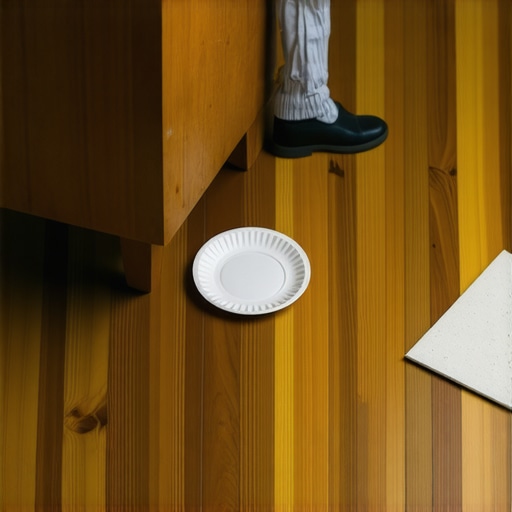
Paper plates act as high-density buffers that reduce the coefficient of friction between a heavy furniture leg and the polyurethane finish of your hardwood. By distributing the weight over a wider surface area, the plate prevents the concentrated point load from crushing the wood fibers. It is a mechanical advantage that saves your finish from burnishing or deep gouges. You must use the right kind of plate. The cheap, uncoated paper plates are the gold standard here. Avoid the fancy plastic-coated or waxed plates. The wax can transfer to your floor under the heat of friction, leaving a hazy residue that is a nightmare to remove without damaging the sheen. The physics are simple. You are creating a sled. The fibrous texture of the paper grips the furniture leg while the smooth bottom slides across the floor. This only works if your floor is pristine. If there is one grain of sand, one tiny piece of grit, or a single metal shaving under that plate, you have just created a high-grit sandpaper block. You will sand a permanent circular scar into your floor. You must vacuum and microfiber the entire path before you move an inch. It will save you. Hardwood floors are not invincible. They are actually quite soft relative to the metal or plastic feet found on most heavy dressers. Even a high Janka rating cannot protect against a dragging load.
“A floor is only as good as the subfloor beneath it; deflection is the enemy of every joint.” – Master Flooring Axiom
Why your subfloor is lying to you
A subfloor that looks flat to the naked eye often contains dips and swells that will cause your new hardwood or laminate to flex under the weight of furniture. If you move a heavy china cabinet over a hidden low spot, the tongue and groove joint will undergo extreme vertical stress. This leads to the dreaded clicking sound or, worse, a snapped locking mechanism. I spent three days grinding concrete on a job last month just so the floor wouldn’t click like a castanet. Most guys skip the leveling compound. They think the underlayment will hide the dip. It won’t. When you use the paper plate hack, you are also gaining a sensory tool. You can feel the dips through the plate. If the plate suddenly becomes harder to push, you have hit a high spot or a deflection zone. You must be careful. If the subfloor is not within 1/8 inch of level over a 10-foot radius, no amount of paper plates will save your joints from the pressure of a 300-pound wardrobe. You are fighting gravity and the structural integrity of the wood. Solid 3/4 inch oak is more forgiving of these dips than the thin engineered floors sold at big-box retailers. Those thin floors have no structural mass. They are just a thin veneer glued to a plywood or HDF core. If you put too much weight on them while moving, you can actually delaminate the top layer. It is a structural engineering challenge every time you rearrange the room.
The 1/8 inch that ruins everything
Expansion gaps are the most misunderstood part of any flooring installation, yet they are the primary reason floors buckle when furniture is moved poorly. You need a minimum of 1/4 to 1/2 inch of space around the entire perimeter of the room to allow for seasonal movement. When you place a massive, heavy object like a pool table or a heavy kitchen island directly onto the floor, you are essentially pinning it down. Homeowners always ask why their waterproof vinyl is buckling. Usually, it’s because they locked it under a heavy kitchen island, killing the floor’s ability to breathe. The floor wants to expand as humidity rises. If the furniture is too heavy, the floor cannot slide under it. Instead, it will peak at the seams. When moving furniture with paper plates, you must ensure you aren’t shoving the boards toward the wall and closing that gap. Use a gentle, steady pressure. Never kick or shove the furniture. The momentum can cause the floor boards to shift if they aren’t properly acclimated or fastened. I have seen entire floors shift two inches because someone tried to move a piano without help. The paper plate is a slider, not a license to be reckless.
| Material Type | Janka Rating (LBF) | Friction Resistance | Acclimation Time |
|---|---|---|---|
| White Oak | 1360 | High | 7-10 Days |
| Brazilian Cherry | 2350 | Very High | 14 Days |
| Laminate Core | N/A | Medium | 48 Hours |
| Engineered Maple | 1450 | High | 5-7 Days |
Protecting the grout and the tile transitions
Tile floors and grout lines present a different hazard where the paper plate hack must be used with extreme caution to avoid chipping the edge of the ceramic. When you move from hardwood to a tiled kitchen, you usually encounter a transition strip or a T-molding. These are the weakest points of the floor. If you slide a heavy appliance over a grout line using a paper plate, the weight is concentrated on the edge of the tile. This can cause the grout to crumble or the tile to crack if there is a void in the thin-set mortar underneath. I hate bulky T-moldings, but they serve a purpose. They protect the expansion gap. When crossing these thresholds, you should use a piece of 1/8 inch hardboard or Masonite as a bridge. Place the paper plates on top of the Masonite. This creates a smooth, continuous surface that bypasses the grout lines entirely. Showers and bathroom tile are even more sensitive. If you are moving a heavy vanity, remember that the waterproofing membrane under the tile can be compromised by extreme point loads. One crack in the grout is all it takes for moisture to seep into the subfloor and start the rot. I have seen subfloors turned to mush because of a single cracked tile under a heavy toilet or vanity. Precision is everything. Chemistry matters. The bond of modified thin-set is strong, but it is not flexible.
“Wood is a hygroscopic material, meaning it constantly gains or loses moisture to reach equilibrium with its environment.” – National Wood Flooring Association
A checklist for a safe furniture move
- Vacuum the floor three times to remove every microscopic bit of grit.
- Check the bottom of the furniture legs for hidden staples or nails.
- Select uncoated, heavy-duty paper plates for the best slide.
- Ensure the room humidity is between 30 and 50 percent to prevent wood brittleness.
- Measure the expansion gap at the baseboards to ensure the floor hasn’t already shifted.
- Use a helper to lift the furniture onto the plates to avoid initial drag marks.
- Move slowly to prevent heat build-up on the polyurethane finish.
The chemistry of the finish and heat friction
Modern water-based polyurethanes reach their full chemical hardness after 14 to 30 days, making them extremely vulnerable to scuffing during the initial move-in. While the floor might be dry to the touch in four hours, the molecules are still cross-linking. If you drag a heavy couch across a floor that was finished three days ago, you will leave a permanent mark in the finish. The paper plate hack helps, but it doesn’t solve the problem of a soft finish. You can actually melt the finish slightly if you move a heavy object too fast. The friction generates heat. That heat softens the poly, and the paper fibers can actually become embedded in the floor. This is why I tell people to wait. If you smell floor wax or that sharp chemical scent of fresh poly, the floor is not ready for a heavy move. Wait at least a week. Use the paper plate hack only after the floor has had time to breathe. Also, be aware of the mil-thickness of your wear layer. A cheap laminate might only have a 6-mil wear layer, which is thinner than a piece of paper. A high-end LVP will have a 20-mil layer. The thinner the layer, the more vital the paper plate becomes. You are not just moving furniture. You are managing the structural integrity of a multi-layer system. Don’t let a simple task turn into a structural failure. Follow the standards. Respect the wood. Use the plates.