
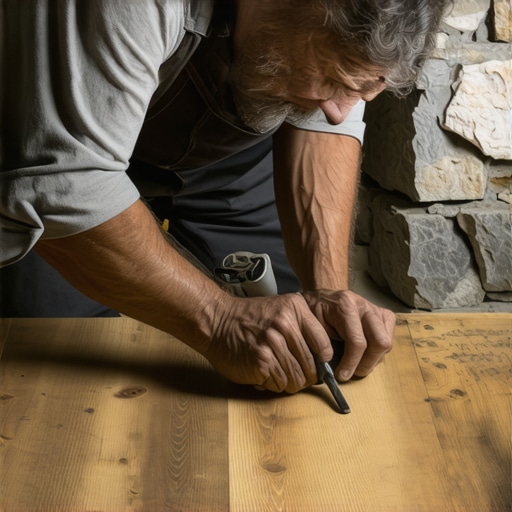
Most guys skip the leveling compound. They think the underlayment will hide the dip. It won’t. I spent three days grinding concrete on a job last month just so the floor wouldn’t click like a castanet. That job was a nightmare of a stone hearth that looked like a jagged mountain range. The homeowner wanted a zero-threshold transition between their new white oak hardwood floors and a 19th-century fieldstone fireplace. Most installers would have just slapped a bulky T-molding or a piece of quarter-round against the stone and called it a day. That is the mark of an amateur. A real floor is a structural performance surface. When you are dealing with stone, you are dealing with the physics of moisture and the brutal reality of irregular geometry. If you do not understand how a stone hearth acts as a thermal sink or how it holds onto ambient humidity, your beautiful hardwood floors will be cupping before the first season changes.
The hidden physics of the scribe line
Scribing hardwood floors to a stone fireplace requires a precise transfer of irregular contours onto a rigid plank using a compass or a profile gauge. This process ensures a tight fit that accounts for the natural expansion and contraction of the wood while maintaining the aesthetic integrity of the masonry. You must calculate the exact moisture content of the subfloor and the stone before the first cut is made. Stone is porous. It breathes differently than your subfloor. If you are installing hardwood floors, you are essentially marrying two different geological speeds. The stone remains static while the wood moves based on the vapor pressure in the room. I have seen guys treat this like they are installing laminate in a dry basement. They forget that stone can pull moisture from the earth and transfer it directly into the end grain of your planks.
“A floor is only as good as the subfloor beneath it; deflection is the enemy of every joint.” – Master Flooring Axiom
The chemistry of the wood itself matters. Red oak and white oak react differently to the heat of a fireplace. White oak has tyloses in its cellular structure which makes it more resistant to rot but also more stubborn when you are trying to execute a complex scribe. When the fireplace is active, the wood near the hearth will dry out faster than the wood in the center of the room. This creates a localized micro-climate. If your scribe is too tight, the wood will have nowhere to go when it expands in the humid summer months. If it is too loose, you will see a gap that looks like a canyon by February. You need that perfect 1/16th of an inch gap, hidden by an undercut or a very fine bead of color-matched sealant that mimics the look of grout.
Why your subfloor is lying to you
Subfloor flatness is the single most important factor when attempting to scribe flooring to a stone fireplace because any vertical movement will ruin the scribe. If the subfloor has a dip of even 1/8 of an inch, the plank will flex when walked upon. This flex causes the scribed edge to rub against the stone, eventually splintering the wood or chipping the mortar. I have walked into too many homes where the laminate was clicking and popping because the installer thought a foam underlayment would compensate for a bad slab. It never does. You need to get the grinder out. You need to level the playing field. In some cases, you might even be looking at the same prep work required for showers, where the substrate must be perfectly pitched or level before the finish material is applied.
| Material Type | Janka Hardness | Expansion Rate | Scribe Difficulty |
|---|---|---|---|
| White Oak | 1360 | Medium-High | Expert |
| Hickory | 1820 | High | Extreme |
| Engineered Oak | 1360 | Low | Moderate |
| Laminate | N/A | Very Low | Easy |
While most people want the thickest underlayment, too much cushion actually causes the locking mechanisms on LVP or engineered hardwood floors to snap under pressure. You want a high-density underlayment with a high compression strength. This is especially true near a heavy stone fireplace. The weight of the stone is not the issue, it is the lack of movement in the stone versus the required movement in the floor. If you are working in a region with high humidity, like the coastal areas of the Carolinas, you need to be even more careful. The moisture in the air will penetrate the stone and sit at the interface of the wood. This is where the battle is won or lost.
The ghost in the expansion gap
The expansion gap is a non-negotiable structural requirement that allows hardwood floors to move without buckling or crowning. When scribing to stone, the gap is often hidden by undercutting the stone itself. This is a dusty, miserable job that requires a diamond blade and a steady hand. You are essentially creating a pocket for the wood to slide under. This allows the floor to expand and contract while the visible edge remains perfectly clean. If you cannot undercut the stone, you must scribe the wood to the face of the stone with a hair-thin gap. This is where your skills with a jigsaw or a coping saw come into play. You are not just cutting wood, you are following the history of the stone’s formation.
- Always use a moisture meter to check the stone and the subfloor before starting.
- Use a sharp, high-tooth-count blade to prevent splintering the wood fibers during the scribe.
- Template the stone using a piece of cardboard or inexpensive lath before cutting your expensive hardwood.
- Account for the thickness of the wear layer on engineered floors to ensure the core is not exposed.
- Vacuum the expansion gap thoroughly to ensure no debris or grout chips restrict movement.
The complexity of this task is why most installers fail. They do not understand the molecular level of what is happening. Wood is essentially a series of straws bundled together. When you cut those straws to fit the jagged edge of a stone fireplace, you are exposing the end grain. This makes the wood more susceptible to moisture changes. I always seal the cut edges of my scribes with a bit of poly or wax to slow down that moisture exchange. It is a small step that takes ten minutes but adds ten years to the life of the floor. This is the difference between a floor that looks good in a photo and a floor that survives a decade of seasons.
“Hardness is not just a measure of dent resistance but of the structural resistance to the saw’s teeth during intricate profile matching.” – Hardwood Engineering Guide
The 1/8 inch that ruins everything
Precision measurement in scribing is the difference between a professional finish and a structural failure that requires a complete tear-out. If you miss your scribe line by 1/8 of an inch, the gap will be visible from the front door. You cannot fix it with wood filler. Wood filler is for nail holes, not for poor craftsmanship. If the gap is too tight, the floor will bind. When wood binds, it has to go somewhere. Usually, it goes up. This results in crowning, where the center of the floor lifts off the subfloor. I have seen entire rooms ruined because one installer didn’t leave enough room at the fireplace. They treated the hardwood floors like they were static, like the tile in showers, but wood is alive. It moves. It breathes. It demands respect. You must treat every plank like a component in a high-performance machine. The stone fireplace is the anchor, and the floor is the engine. If the clearance is wrong, the engine will seize.