
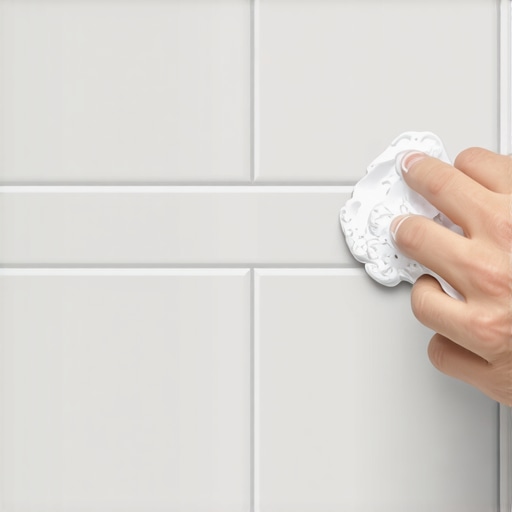
I spent three days grinding concrete on a job last month just so the floor would not click like a castanet, and that is the same level of obsession you need when you look at your shower. Most people see a dirty grout line and think it is just a cosmetic failure. It is not. It is a biological and chemical invasion of a porous structural component. I have seen guys try to clean grout with everything from toothpaste to industrial acid, but the shaving cream trick works for reasons most internet influencers do not even understand. It is about the surfactants. When you are kneeling on a hard subfloor every day like I am, you learn that if you do not respect the chemistry of the materials, the materials will fail you.
“A floor is only as good as the subfloor beneath it; deflection is the enemy of every joint.” – Master Flooring Axiom
The myth of the magic foam
Shaving cream cleans shower grout through the action of surfactants like triethanolamine and stearic acid. These chemicals break down the surface tension of water, allowing the foam to lift oils and soap scum from the porous cementitious surface of the grout joint before it dries. It is not magic. It is a matter of lowering the interfacial tension between the liquid and the solid grout particles. Most shaving creams are essentially aerated soaps with a high concentration of glycerin. The glycerin acts as a humectant, keeping the cleaning agents in contact with the grout longer than a standard liquid spray would. This prevents the moisture from evaporating too quickly, which is the primary reason most grout cleaners fail to penetrate the microscopic pores of the cement. If the cleaner dries on the surface, the dirt stays trapped in the capillaries. You need that foam to sit and work its way into the 1/8 inch gap where the mold likes to hide.
The molecular anatomy of a grout joint
Grout is a porous mixture of Portland cement and sand that functions as a structural bridge between tiles. At a microscopic level, it contains millions of tiny voids or capillaries that trap moisture and organic matter, which eventually leads to the discoloration commonly mistaken for permanent damage. When you look at a grout joint under a magnifying glass, it looks like a sponge. When you use a high-foaming agent like shaving cream, the tiny bubbles expand into these voids. This is the structural zooming that professionals use to understand why some cleaners work and others just sit on top. A standard liquid cleaner has a high surface tension, meaning it beads up. Shaving cream has almost zero surface tension once the foam begins to break down. It flows into the microscopic valleys of the grout. This is why white foam works best, because it contains no artificial dyes that could potentially stain the very grout you are trying to whiten. If you use the blue gel stuff, you are just asking for a permanent tint job that you will never get out.
| Cleaner Type | Surface Tension | Dwell Time | Porosity Penetration |
|---|---|---|---|
| Liquid Spray | High | Low | Minimal |
| Shaving Foam | Low | High | Deep |
| Bleach Pen | Moderate | Medium | Surface Only |
The 1/8 inch that ruins everything
Maintaining the integrity of the grout joint prevents moisture from reaching the subfloor and causing structural rot. If you let your grout degrade, you are not just looking at ugly lines, you are looking at a future where your floor joists turn into mush. I have pulled up enough water-damaged laminate to know that a leak starts small. The grout is your first line of defense. When you clean it with shaving cream, you are removing the acidic soap scum that can slowly eat away at the lime in the cement. Cement is alkaline. Soap scum is often acidic. When they meet, a slow-motion chemical war happens. This is why your grout gets soft over time. By using a neutral or slightly alkaline foam, you neutralize those acids without damaging the integrity of the bond. It is the same reason we do not use solid hardwood in a wet bathroom environment. The physics of expansion and the chemistry of moisture do not mix. You want a stable environment. A clean grout line is a sealed grout line, and a sealed grout line protects the entire assembly from the tile down to the plywood.
- Apply only white, non-gel shaving cream to dry grout lines
- Let the foam dwell for at least twenty minutes to allow capillary action
- Scrub with a stiff nylon brush using circular motions
- Rinse with distilled water to prevent mineral redeposit
- Wipe the tile surfaces immediately to prevent film buildup
Why your subfloor is lying to you
A subfloor that appears level may still have micro-deflections that cause grout to crack regardless of how clean it is kept. Many homeowners blame their cleaning habits for cracked grout when the real culprit is a lack of floor stiffness. If your subfloor flexes even a fraction of an inch when you step on it, the grout will fail. No amount of shaving cream or specialized bleach will fix a structural crack. You have to understand that the grout is the weakest link in the flooring system. It is rigid. If the wood underneath moves, the grout snaps. This is why I always check the joist spacing before I even think about the tile. While most people want the thickest underlayment, too much cushion actually causes the locking mechanisms on LVP to snap under pressure. The same logic applies to tile. You want a rock-solid base. If your grout keeps getting dirty in the same spot, check for a dip in the floor. That dip is catching water, and that water is breeding the mold that turns your white grout black. It is a cycle of physics and biology that starts under your feet.
“Tile installations fail not because of the ceramic, but because of the movement in the substrate.” – TCNA Handbook Commentary
The ghost in the expansion gap
Expansion gaps at the perimeter of a room allow the floor to breathe and prevent the grout from crushing itself. If you have hardwood floors or laminate meeting your shower tile, you must leave a gap. Wood is a living material. It expands and contracts with the humidity of your bathroom. If you grout right up against a wood transition, that wood will expand and crush the grout into powder. I see this mistake on every third job. People want a seamless look, but seamless is a lie in the world of flooring. You need movement joints. Use a color-matched caulk instead of grout at the transitions. Caulk is flexible. Grout is brittle. Shaving cream will not help you if the joint has already turned to dust because of thermal expansion. You have to respect the 1/4 inch gap. It is the difference between a floor that lasts thirty years and one that buckles in three. I have seen wide-plank walnut floors look like potato chips because the installer did not check the crawlspace humidity and choked the expansion gaps. Do not let that happen to your shower. Clean the grout, but respect the physics of the space. It is all one system, from the shaving cream on the wall to the joists in the basement.