
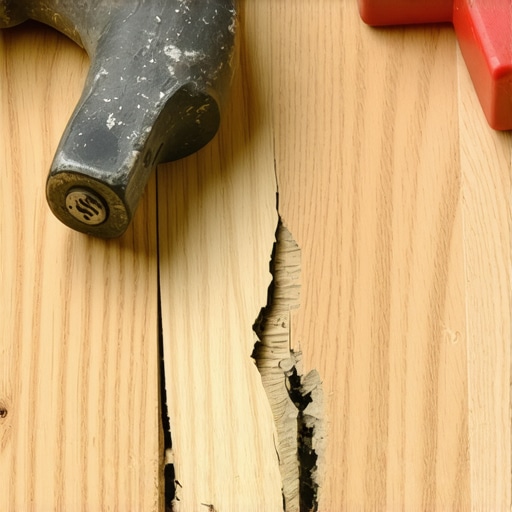
The Tapping Block Mistake That Ruins Laminate Edges
I smell like oak dust and WD-40 most days. It is the scent of a career spent on my knees, wrestling with subfloors that refuse to be flat. Most guys skip the leveling compound. They think the underlayment will hide the dip. It won’t. I spent three days grinding concrete on a job last month just so the floor wouldn’t click like a castanet. That job reminds me why most laminate failures happen before the first person even walks on the planks. It starts with a tool that every homeowner thinks they know how to use. The tapping block is a simple piece of plastic or wood. Yet, in the wrong hands, it is a surgical instrument for destruction. When you strike that block against a laminate edge, you are sending a wave of kinetic energy through a brittle locking mechanism. If your angle is off by even a few degrees, you are not seating the floor. You are shearing the tongue.
The hidden physics of the tongue and groove
Laminate flooring relies on a precision-engineered click-lock system where a protruding tongue fits into a recessed groove to create a stable, floating surface. This joint is often made of high-density fiberboard. It is strong under compression but incredibly weak under shear force. When an installer strikes a tapping block too hard or at an upward angle, the force concentrates on the top lip of the groove. This creates micro-fractures. You might not see them today. You might not see them tomorrow. But three months from now, when the humidity shifts and the floor tries to expand, those fractured edges will lift. The floor begins to peak. This is why your expensive floor looks like a topographical map after the first season change. Professional installers understand that the tapping block is for guidance, not for brute force.
Why your subfloor is lying to you
A subfloor may look flat to the naked eye, but a ten-foot straightedge usually reveals a landscape of valleys and peaks that will snap laminate joints. I have walked onto countless jobs where the homeowner is frustrated because their ‘waterproof’ laminate is separating. I always look at the floor. Then I look at the subfloor. If there is a dip of more than 3/16 of an inch over a ten-foot span, the floor is doomed. As you walk across the room, the laminate bridges that gap. Every step pushes the tongue deeper into the groove, eventually snapping the lock. No amount of tapping or hammering will fix a floor that is hovering over a hole. You must use self-leveling underlayment. You must grind the high spots of the concrete. It is dirty, loud, and miserable work, but it is the only way to ensure the edges stay together.
“A floor is only as good as the subfloor beneath it; deflection is the enemy of every joint.” – Master Flooring Axiom
The impact of kinetic energy on brittle plastic
Applying excessive force with a heavy mallet against a tapping block causes the high-density fiberboard core to compress and shatter at the locking point. Most people think they need to hear a loud ‘thwack’ to know the plank is set. That sound is actually the sound of the core material failing. I tell my apprentices to use a dead-blow hammer. A dead-blow is filled with sand or lead shot. It doesn’t bounce. It delivers a controlled, muffled thud. When you use a standard framing hammer on a tapping block, the vibration alone can vibrate the previous three rows out of alignment. Laminate is essentially compressed sawdust and resin. It is a miracle of engineering, but it has zero elasticity. Once you crush the fibers in that tongue, they never grow back. The joint is dead.
The 1/8 inch that ruins everything
Expansion gaps are the lungs of a laminate floor, and failing to provide a consistent 1/4 to 3/8 inch space at the perimeter causes the edges to crush themselves. I see this mistake in every DIY install. People want the floor to look tight against the baseboards. They shove the planks right up to the drywall. Then summer hits. The humidity rises. The floor expands. Because it has nowhere to go, the planks push against each other with thousands of pounds of pressure. This is when the edges you carefully tapped together start to buckle. This pressure is the primary cause of ‘edge checking,’ where the decorative wear layer begins to flake off at the seams. You must use spacers. You must respect the gap. If you don’t, the floor will eventually find its own space by destroying its own joints.
Technical specifications of modern laminate cores
| Feature | HDF Core (Premium) | MDF Core (Budget) | Stone Plastic (SPC) |
|---|---|---|---|
| Density | 850+ kg/m3 | 600-750 kg/m3 | 2000+ kg/m3 |
| Edge Strength | High | Low | Very High |
| Expansion Rate | Low | Moderate | Minimal |
| Tool Sensitivity | Moderate | Extreme | Low |
The myth of the waterproof label
While many laminate products are marketed as waterproof, this rating typically applies only to the surface and not the vulnerable core material at the joints. Do not get confused by the marketing. If water sits on a seam where the locking mechanism has been damaged by a tapping block, that water will seep into the HDF core. Once HDF gets wet, it swells. It looks like a sponge that has been left in a bucket. This is why you never see laminate in showers. For areas with high moisture, you need to look at tile and grout or LVP. Even then, the grout must be sealed. In a bathroom, the moisture doesn’t just come from the top. It comes from the humidity in the air. A damaged laminate edge is an open door for that moisture. Once the edge swells, it can never be flattened again. The floor is a total loss.
Hardwood floors and the ghost of humidity
Unlike laminate, solid hardwood floors are organic materials that react violently to changes in the ambient moisture of a home. If you are used to installing hardwood floors, you might be tempted to use the same force on laminate. That is a mistake. Hardwood is forgiving. You can nail it. You can plane it. Laminate is a finished product the moment it leaves the box. Hardwood requires acclimation for at least two weeks in the room where it will be installed. Laminate also needs acclimation, usually 48 hours, but people skip it. They take the cold planks from a garage and install them in a heated house. The planks grow as they warm up. If you tapped them tight while they were cold, they will be peaking by dinner time.
A checklist for a floor that lasts decades
- Verify subfloor flatness using a 10-foot straightedge to within 3/16 inch.
- Maintain indoor humidity between 35 and 55 percent at all times.
- Use a 2-pound dead-blow mallet and a professional-grade tapping block.
- Check every fifth row for ‘gapping’ or ‘peaking’ before proceeding.
- Leave a 3/8 inch expansion gap around all vertical obstructions.
- Acclimate the flooring in the installation room for 48 hours.
Why grout fails in the wrong places
Grout is a rigid cementitious product that will crack if there is any movement in the subfloor or the transition between different flooring types. People often ask me if they can grout the gap between laminate and a tile entryway. The answer is always no. Laminate moves. Grout does not. If you put grout against a laminate edge, the laminate will eventually crush the grout into dust or the grout will prevent the laminate from expanding, leading to a buckled floor. You need a transition strip. A T-molding or a Reducer is designed to hide that expansion gap while allowing the floor to breathe. It might not look as ‘seamless’ as some designers want, but it is the only way to prevent a structural failure. I have replaced miles of flooring because someone wanted to avoid a 2-inch wide piece of trim.
“A floor is only as good as the subfloor beneath it; deflection is the enemy of every joint.” – Master Flooring Axiom
The chemistry of the wear layer
The AC rating of a laminate floor determines its resistance to abrasion, but even an AC5 rating cannot protect a joint that has been structurally compromised. The wear layer is made of aluminum oxide. It is incredibly hard. It can withstand dog claws and dragging furniture. However, that hardness makes it brittle. When you use a tapping block incorrectly and ‘mushroom’ the edge of the plank, you are cracking that aluminum oxide layer. You have just created a microscopic entry point for dirt and moisture. Over time, as you mop the floor, the water enters those cracks. The core swells. The wear layer flakes. It looks like the floor is ‘wearing out,’ but the reality is that the installer killed it on day one. High-quality flooring is a system. You cannot break one part of the system and expect the rest to perform. It is a structural engineering challenge, not a weekend craft project. Take your time. Check your subfloor. Use the right tools. If you don’t, you’ll be calling someone like me to tear it all out and start over.