
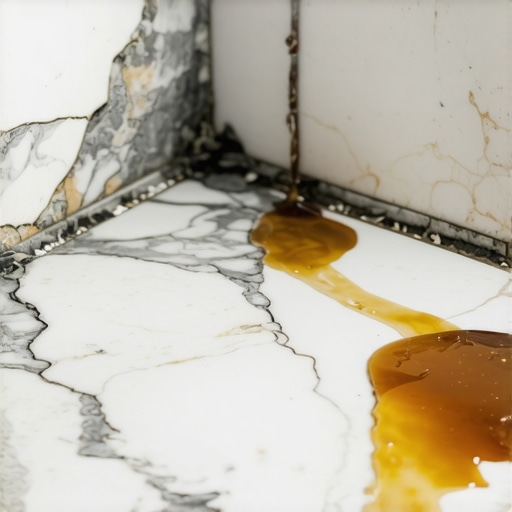
I once walked into a house where a $15,000 wide-plank walnut floor was cupping so bad it looked like a potato chip because the installer didn’t check the crawlspace humidity. The homeowner was crying, the contractor was ghosting them, and the wood was literally screaming as it pulled away from the subfloor. That is what happens when you treat physics like a suggestion. It is the same story with marble. People spend a fortune on stone and then listen to a blog post that tells them to clean it with salad dressing. My knees have the scars of thirty years in this trade, and I have seen the same error destroy more showers than I can count. When you pour vinegar on marble, you are not cleaning. You are performing a chemical demolition of your investment.
The acid bath in your master bathroom
Marble tile grout and natural stone surfaces are composed of calcium carbonate, which reacts violently to acetic acid found in vinegar. This chemical reaction, known as etching, dissolves the calcite crystals on contact, leading to permanent surface dulling and the structural breakdown of cementitious grout joints in high-moisture areas like showers.
The science is simple, even if it is devastating. Marble is a metamorphic rock. It is basically compressed limestone. The main ingredient is calcium carbonate. If you remember your middle school science projects, you know what happens when you mix vinegar and calcium. It bubbles. That bubbling is the acid eating the stone. When you spray a diluted vinegar solution on your marble floor, you are creating a million tiny pits on the surface. You cannot buff those out with a rag. You have to grind the stone down to find a new layer. Most people do not realize this is happening until the floor looks cloudy and grey. They think it is soap scum, so they add more vinegar. It is a death spiral for the stone. The smell of floor wax and sawdust is my life, but the smell of vinegar in a bathroom is the smell of a checkbook about to catch fire.
“A floor is only as good as the subfloor beneath it; deflection is the enemy of every joint.” – Master Flooring Axiom
The molecular war between vinegar and calcite
Grout joints are porous structures made of Portland cement and sand aggregates that act as a capillary system for liquids. When vinegar penetrates these pores, it weakens the chemical bonds of the cement, leading to grout erosion, color fading, and the eventual delamination of the tile from the thin-set mortar bed.
Think about the grout. It is the bridge between your tiles. In a shower, that grout has a hard job. It has to handle thermal expansion, water pressure, and the weight of anyone standing on it. When you use an acidic cleaner, you are thinning that bridge. The acid moves through the pores of the grout like a termite through wood. It eats the binder. Eventually, the grout becomes sandy and soft. You will notice it starts to wash away when you rinse the floor. Once the grout is compromised, water gets behind the tile. That is where the real nightmare starts. Water behind tile leads to mold, rotted studs, and a subfloor that turns into mush. I have torn out showers where the plywood was so rotten I could put my finger through it, all because the grout failed. All because of a bottle of vinegar.
The structural failure of wet subfloors
Subfloor deflection refers to the vertical movement of a floor system under a load, measured by the L/360 standard for ceramic and L/720 for natural stone. If the subfloor is not rigid, the grout will crack regardless of the cleaner used, as marble tile lacks the tensile strength to bridge gaps in the structural decking.
I tell every apprentice the same thing. You do not build a floor from the top down. You build it from the joists up. If those joists are bouncy, your marble is doomed. Marble is heavy and brittle. It does not bend. If the subfloor flexes even a fraction of an inch, the tile will snap or the grout will pop out. Most guys skip the leveling compound. They think the underlayment will hide the dip. It won’t. I spent three days grinding concrete on a job last month just so the floor wouldn’t click like a castanet. When you add chemical erosion from vinegar to a floor that already has too much deflection, you are asking for a catastrophic failure. The stone will literally start to detach from the floor.
| Material Type | Cleaning Agent pH | Structural Impact | Recovery Method |
|---|---|---|---|
| Marble Tile | 2.5 (Vinegar) | Surface Etching | Professional Refinishing |
| Hardwood Floors | 7.0 (Neutral) | Cellular Stability | None Required |
| Laminate | 11.0 (Bleach) | Edge Swelling | Board Replacement |
| Epoxy Grout | Variable | Chemical Resistance | Deep Scrubbing |
Why hardwood floors die in the bathroom
Hardwood floors are hygroscopic materials that expand and contract based on the moisture content of the surrounding air, measured by relative humidity. Installing solid oak or walnut in a bathroom environment leads to cupping, crowning, and buckling because the vapor pressure exceeds the wood’s dimensional stability limits.
Hardwood is a living thing. Even after it is cut and finished, it breathes. In a bathroom, the humidity swings are wild. You take a hot shower and the air is 90 percent moisture. The wood drinks that up. Then you turn on the fan and the air dries out. The wood tries to shrink. This constant movement kills the finish and breaks the tongues off the planks. I have seen people try to save their hardwood by cleaning it with vinegar and water. That is a double hit. The water swells the fibers and the acid eats the polyurethane finish. If you want the look of wood in a wet room, go with a high-end porcelain tile that mimics the grain. Do not put real timber where you brush your teeth. It will buckle.
“Cementitious grout is a porous structure that requires chemical stability to maintain its compressive strength.” – TCNA Handbook Principles
The laminate trap and the moisture barrier
Laminate flooring consists of a high-density fiberboard (HDF) core that is extremely sensitive to hydrostatic pressure from the subfloor. Without a 6-mil poly vapor barrier and a neutral pH cleaning routine, the click-lock joints will swell, resulting in peaking and the eventual shattering of the wear layer.
Laminate is basically sawdust and glue with a picture of wood on top. It is great for a bedroom, but it is a landmine for a kitchen or a bathroom. The joints are the weak point. If you use too much liquid when you clean, it seeps into those joints. The HDF core acts like a sponge. It expands. Once it expands, it never goes back down. You get these little ridges at every seam. I call it peaking. If you keep using vinegar, the acid breaks down the melamine wear layer, making the floor look dull and scratched. You cannot sand laminate. Once it is ruined, it goes in the dumpster. Always check your moisture levels with a pin-meter before you lay a single plank. If the concrete is putting out more than three pounds of vapor per thousand feet, you are in trouble.
How grout loses its grip
Grout maintenance requires penetrating sealers that occupy the pore space of the cement matrix, preventing contaminants from reaching the pigment particles. Acidic cleaners like vinegar strip these sealers away, exposing the grout to iron stains, mildew, and structural weakening from capillary action.
If you want your grout to last, you have to seal it. And you have to keep the acid away from it. I tell people to use a pH-neutral cleaner. It is boring, but it works. A simple mix of mild soap and water is all you need. If the grout is already stained, you do not reach for the vinegar. You use a oxygen-based cleaner and a soft brush. My hands are stained with years of thin-set and dyes, and I know that once you lose the color in a grout line, you are never getting it back perfectly. It is better to protect the bond from day one. Stop treating your stone like a science experiment and start treating it like the architectural feature it is.
- Test the subfloor for deflection before installing any natural stone.
- Use a 1/2 inch notched trowel to ensure 95 percent mortar coverage in wet areas.
- Apply a high-quality penetrating sealer to marble and grout every six months.
- Maintain indoor humidity between 30 and 50 percent to protect hardwood and laminate.
- Avoid all acidic or bleach-based cleaners on calcium-based stones.