
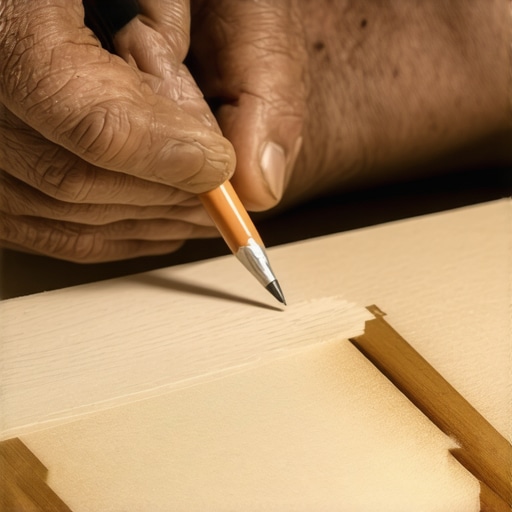
I spent three days grinding concrete on a job last month just so the floor wouldn’t click like a castanet. Most guys skip the leveling compound because it is messy and slow. They think the underlayment will hide the dip. It won’t. When that subfloor is not flat to within 3/16 of an inch over a 10 foot radius, your laminate joints are going to flex. That constant vertical movement eventually shears off the locking profile or creates a gap. Once that gap opens up, you are looking at the ugly brown High-Density Fiberboard core. It is the beginning of the end for that plank unless you act fast. You see, laminate flooring is a sandwich of melamine, photographic paper, and compressed wood fibers. It is not like solid hardwood floors that are wood all the way through. Once you see the core, the protection is gone. If water from a spill or a mop gets into that exposed fiberboard, the floor will swell like a sponge and you can never flatten it out again. This is why the wax pencil method is not just about looks. It is about sealing the breach.
The structural reality of the damaged joint
Laminate flooring relies on a wear layer of aluminum oxide to protect the High-Density Fiberboard core from moisture and impact. When core exposure occurs at the joints, the structural integrity of the click-lock system is compromised, making the floor vulnerable to moisture intrusion and peaking. The core is the heart of the plank. It is made by taking wood fibers and bonding them with resins under immense pressure. In most quality laminates, this core has a density of roughly 800 to 1000 kilograms per cubic meter. While this makes it hard, it also makes it thirsty. Wood fibers have a cellular memory. They want to return to their original tree-like state when they get wet. If you leave a joint open, you are inviting ambient humidity to crawl inside those fibers. This leads to edge swelling. You will feel it under your socks before you see it. It feels like a little ridge. Once that ridge starts, the wear layer on top begins to erode even faster because it is now the highest point on the floor. Every footfall rubs against that raised edge like sandpaper. Repairing this with a wax pencil is a race against the clock.
“A floor is only as good as the subfloor beneath it; deflection is the enemy of every joint.” – Master Flooring Axiom
The ghost in the expansion gap
Expansion gaps are the 1/4 inch to 1/2 inch spaces left around the perimeter of a room to allow for thermal expansion and contraction. Failure to provide these gaps causes buckling, joint separation, and core exposure as the floor hits the walls and forces the planks apart. I have seen guys install laminate tight against the baseboards because they did not want to install shoe molding. That is a rookie move. A floor is a living thing. It expands when the humidity rises and shrinks when it drops. If the floor has nowhere to go, the energy of that expansion has to go somewhere. It usually goes into the weakest point, which is the locking mechanism. When those tongues and grooves are under that kind of pressure, they will eventually snap. Or, if the floor shrinks in the winter, the planks will pull away from each other, revealing the core. People think hardwood floors are the only ones that move, but laminate is just as temperamental. It is basically a big sheet of compressed wood. It follows the laws of physics. If you do not give it room to breathe, it will scream by breaking its joints.
The 1/8 inch that ruins everything
Subfloor flatness is the most overlooked variable in flooring installation, as a 1/8 inch dip will cause plank deflection. This movement stresses the locking system, leading to micro-gaps that expose the fiberboard core to the environment. Think about the chemistry of the bond. When you have a dip in the floor, every time someone walks over it, the plank bends. The melamine top layer is brittle. It does not like to bend. The HDF core is slightly more flexible, but the joint where they meet is a point of extreme stress. Over thousands of footfalls, that stress causes microscopic fractures in the resin. Eventually, a piece of the decorative paper flakes off. Now you are staring at a brown spot in the middle of your grey oak finish. Some people try to use grout to fix this. Never use grout on a floating floor. Grout is rigid. A floating floor moves. The grout will just crumble into dust within a week and act like an abrasive, making the hole even bigger. You need something that stays flexible, which is where the wax comes in.
The chemistry of the wax repair
Wax pencils for flooring are composed of paraffin or beeswax blended with mineral pigments to match specific wood grains. These materials are hydrophobic, meaning they repel water and create a moisture-proof seal over the exposed laminate core. Not all wax sticks are created equal. You have soft waxes and hard waxes. Soft wax is like a heavy-duty crayon. It is great for small scratches. Hard wax requires a heat source to melt it into the hole. For core exposure at a joint, I prefer a medium-hard wax. You want something that is firm enough to withstand being stepped on but soft enough to burnish into the wood fibers. When you rub that wax stick over the gap, the friction of the movement actually generates a small amount of heat. This heat softens the outer layer of the wax, allowing it to flow into the microscopic voids of the HDF core. It creates a mechanical bond. It is not just sitting on top. It is becoming part of the edge. This is vital because you are essentially rebuilding the waterproofing that was lost when the plank was damaged.
| Feature | Wax Pencil | Acrylic Filler | Wood Putty |
|---|---|---|---|
| Flexibility | High | Medium | Low |
| Water Resistance | Excellent | Good | Poor |
| Drying Time | Instant | 4-8 Hours | 24 Hours |
| Shrinkage | None | Moderate | High |
Tools for the precision repair
Repair tools for laminate floors must include a plastic scraper, a lint-free rag, and a color-matched wax kit. Using metal tools will scratch the wear layer, while the wax stick fills the void and protects the HDF core from liquid spills. You also need a bit of denatured alcohol. You have to clean the area first. If there is any dust, skin oils, or floor wax in that gap, the repair wax will not stick. It will just peel out like a scab. I see people try to use wood glue too. Wood glue is for permanent bonds between two porous surfaces. Laminate is only porous on the inside. If you get glue on the melamine surface, it is a nightmare to get off without ruining the finish. The wax pencil is the surgical tool of the flooring world. It is precise. You can blend colors by layering different shades. If the floor has a dark grain line running through a light plank, you use the light wax first, then a quick stroke of the dark wax, then buff them together. It is an art form.
- Clean the damaged area with a damp cloth and dry it immediately.
- Select a wax pencil one shade darker than the floor for deep holes.
- Rub the pencil firmly across the grain of the scratch.
- Level the wax using a plastic straight edge to avoid scratching the laminate.
- Buff the area with a microfiber cloth to remove excess residue.
- Avoid heavy foot traffic on the repair for at least thirty minutes.
The humidity factor in laminate stability
Relative humidity levels should be maintained between 35% and 55% to prevent laminate planks from shrinking and exposing the core. Significant fluctuations in moisture cause the HDF core to expand and contract, which puts immense pressure on the locking joints. I have been in houses in the desert where the floor looks like a jigsaw puzzle that someone pulled apart. The air is so dry it sucks the moisture out of the factory-sealed planks. When the planks shrink, they pull away from each other. Now you have a 1/16 inch gap every three feet. That is a lot of exposed core. If you live in an environment like that, a wax pencil is your best friend, but a humidifier is your savior. You have to treat the cause, not just the symptom. If the joints are opening because the house is too dry, filling them with wax is a temporary fix. The floor will just keep moving. You need to stabilize the environment before you start the cosmetic work.
“Laminate is a floating system; if it cannot move as a single unit, it will fail at the weakest link.” – TCNA Installation Handbook Supplement
Why cheap laminate fails at the joints
Inexpensive laminate often features a low-density core and a thin wear layer, which leads to edge chipping and joint failure. High-quality laminate uses wax-impregnated edges during manufacturing to resist moisture absorption, whereas budget options leave the HDF completely raw and vulnerable. You get what you pay for. The big-box retailers sell stuff that is 6mm or 7mm thick. That is way too thin. It has no structural mass. The locking tongue is so thin you could snap it with your pinky finger. When you install that over a subfloor that is not perfectly flat, those tongues snap off during the first week of use. Then the planks start to slide. Once they slide, the core is exposed. I always tell clients to look for at least 10mm or 12mm thickness. The thicker the board, the more surface area there is for the wax pencil to grab onto if you do have to make a repair. A thin board has no meat. There is nothing to hold the filler in place. It is like trying to patch a hole in a piece of paper versus a piece of cardboard.
The final verdict on the subfloor
At the end of the day, a floor is a mechanical assembly. It is not just a decoration. If you see core exposure, your floor is telling you that something is wrong with the mechanics. Maybe it is the humidity. Maybe it is the subfloor. Or maybe someone tried to install laminate in showers or bathrooms where it does not belong. Laminate is not tile. It does not have waterproof grout. It has a physical joint that relies on tight tolerances. The wax pencil is a fantastic tool for extending the life of your investment. It seals out the moisture and hides the damage from the naked eye. But remember, it is a bandage. If the floor keeps moving, the bandage will fail. You have to respect the physics of the installation. Keep your subfloor flat, keep your humidity stable, and keep your wax pencil handy for those little accidents that are bound to happen in a house that is actually lived in. A well-maintained floor can last twenty years. A neglected one will look like trash in five. Take care of the core, and the floor will take care of you.