
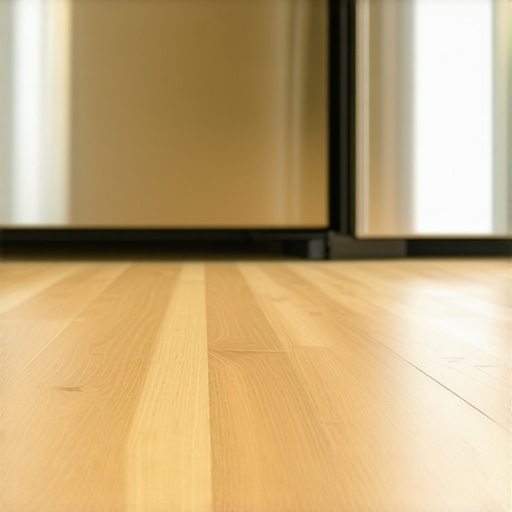
I smell like WD-40 and oak dust most days. My knees tell the story of twenty-five years spent crawling across slabs that were never quite flat enough. People think a floor is just something you walk on. They think it is a color or a texture. To me, it is a structural engineering project that happens to be under your feet. When a homeowner calls me because their floor is making a clicking sound near the refrigerator, I already know the culprit. It is usually a combination of a lazy installer and a subfloor that looks like the rolling hills of Kentucky. Most guys skip the leveling compound. They think the underlayment will hide the dip. It won’t. I spent three days grinding concrete on a job last month just so the floor wouldn’t click like a castanet. That is the reality of the trade. If you do not respect the physics of the subfloor, the floor will eventually humiliate you in front of your guests.
The phantom sound in your kitchen
The clicking sound near your refrigerator is caused by vertical movement in the laminate locking joints as they deflect into a subfloor void. This happens because laminate is a floating floor system that requires a deviation of less than 3/16 of an inch over a 10 foot radius. When you walk near a heavy appliance like a refrigerator, your body weight combined with the static load of the appliance causes the HDF core to bend. This bending forces the tongue and groove connection to rub together, creating a high pitched click or snap. This is not a ghost. It is the sound of your floor slowly destroying itself through friction and poor structural support.
Physics of the floating floor system
Laminate is not attached to the ground. It is a giant wooden raft held together by tension and gravity. The integrity of that raft depends entirely on the friction within the locking mechanism. Cheap laminate often uses a lower density fiberboard core. These cores are soft. When they encounter a dip in the subfloor, the tongue of the plank acts like a lever inside the groove. Under the weight of a refrigerator, which can weigh upwards of 300 pounds, the planks are pinned down. As you walk past, the floor tries to shift but is held fast by the appliance. This creates a pinch point. The click is the release of that mechanical stress. If you ignore it, the locking mechanism will eventually snap. Once the tongue breaks, the gap will open up. You will be left with a hole that collects dirt and moisture, leading to the eventual swelling of the entire plank.
“A floor is only as good as the subfloor beneath it; deflection is the enemy of every joint.” – Master Flooring Axiom
Why your subfloor is lying to you
Subfloors are rarely flat. Whether it is a concrete slab or a plywood deck, there are always humps and valleys. In new construction, builders often rush the process. They throw down the subfloor and cover it before the house has even settled. On concrete, the screed work is often sloppy. A homeowner looks at a floor and thinks it looks fine. I look at it with a 10 foot straightedge. If I see light under that level, I see a future click. You cannot fix a dip with more underlayment. People try to double up the foam thinking it will provide cushion. That is a disaster. Too much cushion allows the floor to bounce. That bounce is what kills the joints. You need a rigid surface. You need self-leveling underlayment or a diamond grinder to take down the high spots. There is no middle ground in floor prep.
Thermal expansion around heavy appliances
Your refrigerator is a heat source. It has a compressor that runs 24 hours a day. This heat warms the laminate planks directly underneath it. Wood and wood based products like laminate expand when they get warm. Because the refrigerator is so heavy, it pins the planks to the subfloor. This prevents the floor from expanding and contracting as a single unit. This is why the clicking is often worse near the kitchen. The floor wants to move but it cannot. This builds up internal tension. When you step on a plank that is under tension, it snaps back into place with a click. I have seen entire floors buckle and peak because someone put a heavy kitchen island on top of a floating floor without leaving proper expansion gaps or using a fixed transition.
| Feature | Cheap Laminate | Premium Laminate | Hardwood Floors |
|---|---|---|---|
| Core Density | 600-700 kg/m3 | 850-950 kg/m3 | Solid Wood |
| Locking Strength | Low Tension | High Tension Uniclic | Nail Down |
| Moisture Resistance | 4-hour topical | 72-hour+ perimeter | Variable |
| Subfloor Tolerance | Extremely Strict | Moderate | Flexible |
The 1/8 inch that ruins everything
In the world of flooring, 1/8 of an inch is a mile. If your subfloor has a 1/8 inch dip and you install a 7mm laminate over it, that floor is going to move. The thinner the laminate, the less structural integrity it has. Cheap laminate is usually very thin. It lacks the mass to bridge small imperfections. This is why I always recommend at least a 12mm product. The added thickness provides a more stable platform. It feels more like solid hardwood floors underfoot. It also resists the deflection that leads to those annoying clicks. When you are standing in the aisle of a big box store, do not just look at the color. Look at the mil thickness of the wear layer and the density of the core. If you can snap the tongue off with your thumb, that floor will not survive five years in a high traffic kitchen.
Moisture dynamics and joint failure
The chemistry of the adhesive used in the HDF core matters. In cheap floors, they use high amounts of urea-formaldehyde resins. These resins are brittle. They do not handle the micro-movements of a clicking floor well. Over time, the constant clicking grinds the resin into a fine dust. This is why you sometimes see white powder coming up from your floor joints. It is the floor literally turning into sawdust. Furthermore, if you are in a high humidity area like Florida or the Gulf Coast, the moisture in the air softens that core even more. A soft core is a noisy core. I always check the calcium chloride levels in a concrete slab before I even open a box of flooring. If the moisture vapor transmission rate is too high, you are essentially installing your floor on a sponge.
“Standard subfloor flatness requirements are 3/16 inch in 10 feet or 1/8 inch in 6 feet. Anything outside this range will lead to mechanical failure of the locking system.” – NWFA Technical Standards
Showers and grout in the adjacent room
It is not just about the kitchen. Often, the moisture that causes laminate failure comes from nearby bathrooms. If you have tile showers with failing grout, water can seep under the transition strips. Laminate acts like a wick. It will draw that moisture in from the edges. Once the edges swell, the tongue and groove no longer fit together perfectly. They start to rub. Now you have a click that is caused by structural swelling. I always tell people to check their grout lines in the bathroom. If you see cracks in the grout, you have water getting under your floor. That water will travel further than you think, following the path of least resistance across the subfloor until it reaches your laminate.
The fix that actually works
If your floor is already clicking, you have a few options, but none of them are as good as doing it right the first time. You can try to inject a floor repair adhesive through a small hole, but that is a temporary fix. It might fill the void and stop the movement for a few months. The real fix is to pull up the planks, level the subfloor, and reinstall. This is why floor prep is the most expensive part of a professional install. It is labor intensive. It is dirty. It involves grinders and vacuums and bags of leveler. But it is the only way to guarantee a silent floor. If your installer says he can just lay the floor over your old linoleum without checking for level, fire him on the spot.
- Remove baseboards to check for proper expansion gaps of at least 3/8 inch.
- Use a 6 foot straightedge to identify dips deeper than 1/8 inch.
- Apply a high quality moisture barrier or 6-mil poly film on concrete.
- Ensure the refrigerator feet are sitting on a solid portion of the plank.
- Avoid using T-molding in doorways if the run is less than 30 feet.
The specific failure of big box laminate
The stuff you buy for ninety-nine cents a square foot is not a long term flooring solution. It is a temporary covering. The locking systems are often designed for ease of installation rather than long term durability. They use a drop-lock system that is prone to vertical separation. Once that vertical lock is compromised, the clicking begins. High end laminate uses a fold-down or angle-angle locking system that creates a much tighter bond. You can feel the difference when you put them together. The premium planks require a tapping block and a hammer to seat. The cheap ones just fall into place. If it is easy to put together, it is easy for it to come apart or move. That is the hard truth of the flooring industry. You get exactly what you pay for.