
I smell like oak dust and the sharp chemical tang of WD-40. My knees have the permanent calluses of a man who has spent twenty-five years crawling across plywood and concrete. I have seen the same mistake repeated from the custom builds in the suburbs to the quick flips in the city. Homeowners walk into a showroom, fall in love with a 12mm wide-plank laminate, and then ask for the thickest, softest underlayment they can find. They want it to feel like carpet. They want it to be quiet. What they are actually doing is buying a ticket to a structural failure that will manifest in less than eighteen months. Most laminate underlayments sold today are a complete waste of money because they focus on the wrong physics. I spent three days grinding concrete on a job last month just so the floor wouldn’t click like a castanet, and that is a lesson most people only learn after their $4,000 floor starts separating at the seams. I once walked into a house where a $15,000 wide-plank walnut floor was cupping so bad it looked like a potato chip because the installer didn’t check the crawlspace humidity, but the same principles of moisture and levelness apply to the cheapest laminate you can buy. You cannot hide a bad foundation with a piece of foam.
The myth of the magic foam roll
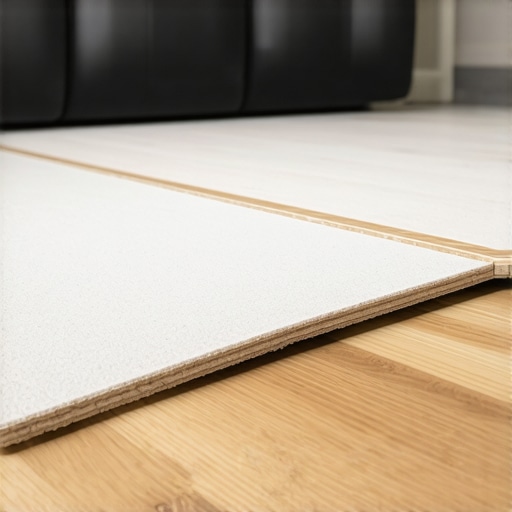
Laminate underlayment is a specialized padding material designed to provide a moisture barrier, sound reduction, and thermal insulation between the subfloor and the floating floor planks. It is not a leveling agent. Many homeowners mistakenly believe that a 6mm or 10mm underlayment will smooth out a bumpy subfloor, but the reality is that the padding will eventually compress into those dips, leaving the floor planks unsupported. When you walk across a floor with unsupported spans, the locking mechanisms flex. They weren’t designed for that. Unlike the rigid grout used in showers or the nailed-down stability of hardwood floors, laminate depends entirely on its locking tongue and groove to stay together. If the subfloor has a dip, the underlayment just follows the curve. You are better off spending your money on a bag of self-leveling compound than a roll of premium foam if your floor isn’t flat.
“A floor is only as good as the subfloor beneath it; deflection is the enemy of every joint.” – Master Flooring Axiom
The 1/8 inch that ruins everything
Subfloor flatness tolerances for floating floors are strictly defined as no more than 1/8 inch of deviation over a 6-foot radius or 3/16 inch over 10 feet. If your floor is outside these parameters, it is technically out of spec. Most installers skip the straight-edge test. They just roll out the blue or green foam and start clicking planks. Within weeks, the homeowner starts hearing a clicking sound. That is the sound of the HDF core rubbing against the neighboring plank. It is the sound of your floor dying. I have seen floors where the homeowner thought the “premium” $1.50 per square foot underlayment would make their floor feel like a luxury hotel. Instead, it felt like a bouncy castle. Every time they took a step, the whole floor moved. This movement stresses the mechanical bond of the click system until the thin lip of the groove snaps off. Once that happens, there is no fix. You are tearing it up and starting over.
The physics of the locking mechanism
The locking mechanism of a laminate floor is a precision-engineered joint that relies on zero vertical movement to maintain its integrity. When you select a thick, squishy underlayment, you are introducing vertical deflection into a system that was designed to be static. Imagine a bridge where the supports are made of sponges. The bridge might stay up for a while, but eventually, the concrete joints will crack. The same thing happens at the microscopic level with your laminate. High-density underlayments, such as those made from recycled felt or high-density rubber, are superior because they offer a high PSI (pounds per square inch) resistance. They don’t compress under the weight of a person or a heavy piece of furniture. If you buy a cheap polyethylene foam roll, you are basically putting a layer of air bubbles under your floor. Those bubbles pop. They flatten out. And then your floor starts to sag.
Why too much cushion is a death sentence
Contrary to popular belief, the thickest underlayment is usually the worst choice for a laminate floor because it allows for excessive vertical movement. While it might feel slightly softer to walk on, that softness is the enemy of the floor’s longevity. A high-quality underlayment should be no more than 2mm to 3mm thick, but it should be dense. Think of it like a mattress. You don’t want a mattress that you sink into until your back hurts; you want one that supports your weight while providing a bit of surface comfort. In the flooring world, we look at the compression set of the material. If you can pinch the underlayment between your thumb and forefinger and it stays flat, it’s garbage. It needs to fight back. This is why I often recommend cork or heavy felt over those shiny gold or silver foam rolls. They don’t quit on you.
| Underlayment Type | Density Rating | Moisture Protection | Best Use Case |
|---|---|---|---|
| Standard Blue Foam | Low | Minimal | Budget rentals only |
| Felt Padding | High | Moderate | Sound dampening |
| Natural Cork | Very High | None (needs film) | Structural integrity |
| Rubberized Pad | High | Excellent | Condos with strict IIC rules |
The ghost in the expansion gap
An expansion gap is a mandatory 1/4 inch to 1/2 inch space left around the perimeter of the room to allow the floor to expand and contract with temperature and humidity changes. If you don’t leave this gap, or if you jam your underlayment up against the drywall and then pinch it with baseboards, the floor cannot move. I once saw a guy who used a double layer of underlayment thinking it would make the floor warmer. All it did was create so much friction and vertical lift that the floor buckled in the center of the room. It looked like a tent. The underlayment is supposed to be a slip sheet. It should allow the entire floor to slide as one giant unit. If your underlayment is too thick or too grippy, it traps the floor. You might as well have glued it down, which would also be a disaster for laminate.
Why your subfloor is lying to you
Subfloors, whether they are concrete or plywood, are rarely as flat or as dry as they appear to the naked eye. You need to use a moisture meter. I don’t care if the house is fifty years old and hasn’t had a leak since the Nixon administration. Concrete is a sponge. It pulls moisture from the soil and releases it as vapor. If you put a laminate floor over concrete without a proper 6-mil poly vapor barrier, that moisture will hit the bottom of your planks and cause the HDF core to swell. This is often why people think their underlayment failed. The underlayment didn’t fail; it just didn’t have a vapor barrier integrated into it. Many “premium” underlayments claim to be 2-in-1 or 3-in-1, but I still prefer a dedicated 6-mil plastic sheet on concrete. It’s cheap insurance. It’s the difference between a floor that lasts twenty years and one that starts smelling like a basement in three months.
“Deflection is the silent killer of the modern floating floor system; if it moves, it breaks.” – Master Flooring Axiom
The chemistry of moisture vapor
Moisture vapor transmission rate (MVTR) is the measurement of how much water vapor passes through a material over a specific period. For a laminate floor, you want an underlayment with a very low MVTR. If you have too much moisture rising, the edges of your laminate will start to peak. Peaking is when the joints push upward because the core of the plank has expanded. This is different from cupping, which is what happens to solid hardwood floors when the bottom of the board is wetter than the top. When laminate peaks, the wear layer at the seam becomes the highest point in the floor. Your feet, your vacuum, and your dog’s paws will hit that edge every time. Eventually, the décor layer chips off, and you are left with a brown line of fiberboard showing through your beautiful gray oak finish. No underlayment can fix peaking once it starts, but a good one can prevent it if it has a properly sealed vapor lip.
Sound ratings and the logarithmic lie
Sound Transmission Class (STC) and Impact Insulation Class (IIC) are ratings used to measure how much sound travels through a floor assembly, but these numbers are often manipulated by manufacturers. They test these materials under laboratory conditions with dropped ceilings and specific floor joist configurations that you don’t have in your house. When a roll of underlayment says it has an IIC of 72, that doesn’t mean your upstairs neighbor’s kids will sound like ghosts. It means in a very specific lab in Michigan, it performed that way. In the real world, the density of the underlayment matters more than the marketing number. A thin, dense rubber mat will always outperform a thick, airy foam roll for actual sound deadening because it has the mass to stop vibration. If you really want a quiet floor, look for high-mass materials, not high-thickness materials.
The truth about cork and rubber
Natural cork and recycled rubber are the gold standards for underlayment because they provide high compressive strength and excellent acoustic properties without the vertical flex of foam. Cork is particularly interesting at a molecular level. It is made of millions of tiny air-filled cells that are naturally resistant to compression. When you walk on cork, it compresses slightly and then bounces back immediately. It doesn’t stay squashed like cheap polyethylene. Rubber is similar but offers even better moisture resistance. The downside is the cost. These materials can cost more per square foot than the laminate itself. But if you are installing a high-end laminate in a condo or a second-story bedroom, this is where you should put your money. Skip the “designer” foam with the fancy foil backing. Go with the heavy stuff.
Pre-installation subfloor audit
- Check for flatness using a 10-foot straight edge and mark all dips deeper than 3/16 inch.
- Use a concrete moisture meter to ensure the slab is below 4.5 percent moisture content or 75 percent relative humidity.
- Scrape off all drywall mud, paint drips, and old adhesive residues that could create high spots.
- Ensure the subfloor is structurally sound with no squeaks or loose plywood sheets.
- Vacuum the entire surface twice; a single grain of sand under a laminate plank can cause a clicking sound.
- Check that the door casings are undercut to allow the floor and underlayment to slide underneath.
In the end, you have to treat your floor like an engineering project. If you are worried about the comfort of the floor, wear slippers. Don’t ask your underlayment to be a pillow. Its job is to provide a flat, stable, dry surface for your floor to float on. If you buy a cheap, thick foam, you are essentially building your house on sand. It might look good the day you finish, but when the seasons change and the house settles, those joints are going to start screaming. I’ve spent enough time tearing out ruined floors to know that the guy who tries to save fifty cents a square foot on the right underlayment usually ends up paying for the whole floor twice. Do it right the first time. Get the subfloor flat, use a high-density pad, and leave your expansion gaps. Your knees and your wallet will thank you later.