
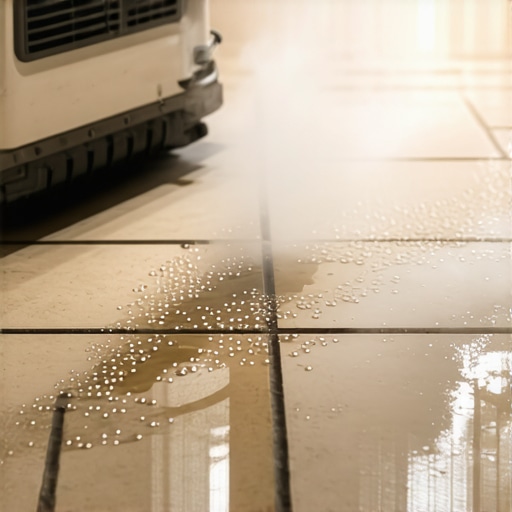
I spent three days grinding concrete on a job last month just so the floor wouldn’t click like a castanet. Most guys skip the leveling compound and they think the underlayment will hide the dip. It won’t. I have seen it a thousand times where a homeowner tries to do the right thing by cleaning but ends up destroying the very bond that keeps their home together. You stand there with a steam mop in your hand thinking you are sanitizing your life when in reality you are injecting a high-pressure thermal wedge into the microscopic pores of your floor. I smell like WD-40 and oak dust most days and I can tell you that physics does not care about your cleaning habits. When you blast grout with steam you are triggering a sequence of structural failures that start at the molecular level and end with a tile popping off in your hand. This is not a cosmetic issue. This is a structural engineering challenge that most people fail before they even start.
The microscopic war between steam and cement
Steam cleaning grout causes thermal expansion and vapor pressure to build up within the cementitious matrix of the tile bond which eventually leads to delamination of the thin-set mortar from the subfloor substrate. Grout is a porous material. It is essentially a collection of sand and cement with tiny capillaries running through it. When you introduce steam at two hundred and twelve degrees Fahrenheit you are forcing moisture into those capillaries. That moisture turns into gas and expands. The pressure inside those tiny channels can exceed the internal strength of the grout. It starts with micro-fissures that you cannot see with the naked eye. Over time these cracks grow. They allow more water to penetrate deeper. Eventually that water hits the thin-set. Once the thin-set is compromised the tile is no longer bonded to the floor. It becomes a floating island. You might not notice it today or tomorrow but one day you will walk across that floor and hear a hollow click. That is the sound of a failed installation.
“A floor is only as good as the subfloor beneath it; deflection is the enemy of every joint.” – Master Flooring Axiom
Why your subfloor is lying to you
Concrete slabs and plywood subfloors always contain a moisture vapor emission rate that must stay balanced to prevent adhesive failure in laminate or hardwood floors. You think the slab is dry because it looks gray and hard. It is not. It is a breathing organism that moves water from the ground up into your house. When you use a steam cleaner you are adding to that moisture load. The heat from the steam lowers the viscosity of the water and allows it to travel faster through the slab. If you have a crawlspace the humidity is already working against you. I once saw a job where the vapor drive was so high that it literally pushed the grout out of the joints. Steam cleaning accelerates this process. It creates a localized high-pressure zone that forces water into the substrate. If that substrate is wood it will swell. If it is concrete it will hold that moisture and slowly release it over weeks, attacking the alkaline balance of your mortar.
The chemical reality of modified thin-set
Polymer-modified thin-set relies on a chemical bond that is susceptible to hydrostatic pressure and thermal shock which can occur when steam cleaning is used on ceramic tile or porcelain tile. Modern mortars are not just sand and cement. They are packed with polymers that provide flexibility and strength. These polymers are tough but they are not invincible. High heat can soften certain types of polymer chains. When you combine that heat with the physical pressure of a steam jet you are essentially power-washing the glue out of your floor. The bond between the tile and the mortar is a physical lock. The mortar reaches into the pores of the tile and grabs hold. Steam acts like a lubricant and a solvent at the same time. It weakens the grip. You are left with a tile that is held in place only by gravity and the friction of the surrounding grout. It is a disaster waiting to happen.
| Flooring Type | Moisture Tolerance | Heat Sensitivity | Standard Maintenance |
|---|---|---|---|
| Solid Hardwood | Very Low | High | Dry Dust Mop |
| Engineered Wood | Moderate | Medium | Damp Microfiber |
| Laminate | Low | Very High | Vacuum Only |
| Porcelain Tile | High | Low | Neutral pH Cleaner |
| LVP Vinyl | High | Very High | Cool Water Mop |
The 1/8 inch that ruins everything
Expansion gaps around the perimeter of the room are essential components for hardwood floors and laminate to prevent buckling or cupping when ambient humidity changes. Most people think grout is just a filler but it is actually a sacrificial joint. It is supposed to handle the movement of the house. When you steam clean you are making that grout brittle. Brittle grout cannot handle the expansion and contraction of the subfloor. It cracks. Once it cracks it lets in even more moisture. This is especially dangerous near showers. In a bathroom the humidity is already high. Adding steam to the floor is like putting your tiles in a pressure cooker. The water seeps under the tile and gets trapped. It has nowhere to go. It sits there and rots the subfloor or causes the thin-set to undergo a process called leaching where the minerals are pulled out of the cement, leaving it soft and chalky.
“Tile installations shall be designed to allow for movement caused by moisture and temperature changes.” – TCNA Handbook Principle
Hardwood floors and the danger of ambient steam
Hardwood floors will experience dimensional instability and finish peeling if they are exposed to the overspray or high humidity generated by steam cleaning nearby grout lines. I have seen beautiful white oak floors ruined because someone was overzealous with a steam mop in the kitchen. The steam doesn’t just stay on the tile. It drifts. It gets under the baseboards. It hits the end-grain of the wood. Wood is a sponge. It will suck that moisture up and it will not let go. The fibers expand. The finish stays rigid. The result is a floor that looks like a topographical map. You cannot sand your way out of a moisture problem. You have to replace the wood. Even laminate is at risk. Laminate is just compressed sawdust with a picture of wood on top. One hit of steam and the edges will bloom. They will puff up and never go back down. You are effectively killing your floor to get it clean.
Better ways to keep your surfaces intact
Proper maintenance for showers and tiled floors involves non-acidic cleaners and manual agitation rather than high-heat steam to preserve the sealant and grout integrity. You do not need to blast your floor with the power of a locomotive to get it clean. You need chemistry and a bit of elbow grease. Use a cleaner that is specifically designed for stone or tile. Let it sit. Let the chemicals do the work of breaking down the oils and the dirt. Then use a soft brush. It takes longer but it doesn’t destroy the bond. You also need to ensure your grout is sealed. A good sealer fills those capillaries I talked about. It keeps the water out. Steam cleaning actually strips the sealer off. So every time you steam you are making your grout more vulnerable to the next round of dirt. It is a vicious cycle that ends with a phone call to a guy like me to come and tear the whole thing out.
- Vacuum the floor thoroughly to remove abrasive grit before any liquid cleaning.
- Use a pH-neutral cleaner to avoid etching the surface of natural stone or weakening grout.
- Apply a high-quality penetrating sealer to grout lines every year to maintain water resistance.
- Mop with cool or lukewarm water only to prevent thermal shock to the adhesive.
- Ensure all transitions between tile and hardwood are caulked with a flexible sealant.
- Wipe up spills immediately to prevent the moisture from reaching the subfloor.
The ghost in the expansion gap
Vertical deflection in the joist system can be exacerbated by moisture absorption in the subfloor which is often caused by excessive water used during grout cleaning. If your floor feels bouncy it is because the subfloor is not rigid enough. Adding water makes it worse. A wet subfloor is a weak subfloor. When you walk across a wet, weak subfloor you are flexing the tile. The grout cannot flex. It is rigid. So it breaks. You see those tiny cracks in your grout and you think you need to clean them more. So you get out the steam mop again. You are literally feeding the monster. You are making the subfloor wetter and weaker while making the grout more brittle. This is how you end up with a floor that needs to be completely replaced. It is a structural failure disguised as a cleaning routine. Stop using steam. Protect your investment. A floor should last a lifetime if you treat the chemistry and the physics with the respect they deserve. Every 1/8 inch of movement matters. Every percentage of moisture matters. Do not let a cleaning tool be the reason your home’s foundation fails. Use the right tools. Keep it dry. Keep it stable. Your knees and your wallet will thank you in twenty years.