
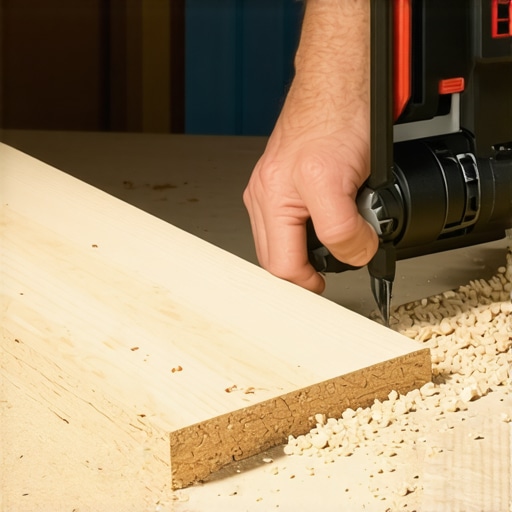
The precision of the flush cut in modern flooring
The oscillating tool allows for a perfectly level undercut of door jambs by using the actual flooring material as a height guide. This ensures that hardwood floors or laminate can slide underneath the trim with zero vertical gap. It creates a professional finish that eliminates the need for messy caulking or unsightly quarter-round moldings at the doorway.
I spent three days grinding concrete on a job last month just so the floor wouldn’t click like a castanet. Most guys skip the leveling compound. They think the underlayment will hide the dip. It won’t. After that back breaking labor, I wasn’t about to ruin the job with a sloppy door jamb. I’ve seen it a thousand times. An installer gets lazy with a handsaw and ends up with a jagged gap that you could fit a nickel through. They try to hide it with grout or wood filler. It looks like garbage. My hands are stained with walnut dust and my knees have the permanent indentations of a lifetime on the subfloor. I know that the difference between a master and a hack is the 1/8 inch of space under a casing. If you don’t undercut your jambs with an oscillating multi-tool, you are just a guy throwing planks on a floor, not an architect of the home.
The physics of high frequency vibration
Oscillating tools operate at roughly 20,000 strokes per minute with a tiny arc of motion. This high frequency allows for surgical precision when cutting through oak or pine casings without damaging the surrounding drywall. The tool does not pull or kick back like a circular saw because the movement is side to side within a three degree arc. This is the only way to get a flush cut against a floor surface.
When you trigger that motor, the blade moves so fast it becomes a blur. This isn’t just about speed. It is about the chemistry of the cut. A standard handsaw creates friction that can tear the wood fibers of expensive door trim. An oscillating blade, specifically a titanium coated bi-metal blade, slices through the lignin and cellulose with minimal heat buildup. Heat is the enemy. If you get the wood too hot, the sap caramelizes and creates a blackened edge that won’t take stain or paint. I always tell the apprentices to let the tool do the work. If you push too hard, you’re just dulling the teeth and smoking the motor. You want a clean, vibration controlled pass that mirrors the exact plane of the subfloor.
“A floor is only as good as the subfloor beneath it; deflection is the enemy of every joint.” – Master Flooring Axiom
The ghost in the expansion gap
Laminate and hardwood floors require a perimeter expansion gap of at least 1/4 inch to account for humidity changes. Undercutting the door jamb allows the floor to expand and contract freely underneath the trim. This prevents the floor from buckling or peaking when the summer humidity hits and the wood fibers swell. Without this hidden space, the floor will bind against the jamb and eventually fail.
The expansion gap is a living thing. In the winter, the wood shrinks. In the summer, near showers or humid kitchens, it grows. If you trap that plank against a door casing, something has to give. Usually, it’s the locking mechanism. I’ve walked into homes where the laminate was peaking three inches off the ground because the installer didn’t undercut the jambs. They just cut the board around the trim. It’s a death sentence for the floor. By using a scrap piece of your actual flooring and an underlayment sample as a shim, you create a guide for your oscillating tool. This ensures the cut is at the exact molecular height needed. You aren’t guessing. You are engineering a void that allows the floor to breathe while remaining invisible to the eye.
The 1/8 inch that ruins everything
A gap larger than 1/8 inch between the flooring and the door jamb is a structural and aesthetic failure. Using an oscillating tool ensures that the transition is tight enough to prevent dust and debris from collecting in the void. This precision is especially vital in areas near grout lines or tile transitions where height variances are common. A flush cut keeps the architectural lines of the home intact.
| Cutting Method | Precision Level | Risk of Wood Splitting | Time Efficiency |
|---|---|---|---|
| Handsaw | Low | High | Very Slow |
| Reciprocating Saw | Zero | Extreme | Fast but Messy |
| Oscillating Tool | Highest | Minimal | Fast and Controlled |
The mechanical advantage of the oscillating tool lies in its offset blade design. This allows the blade to lay flat against the floor. If you try this with a Japanese pull saw, you’re going to be fighting the handle the whole time. You’ll end up angled. An angled cut means the flooring won’t slide under, or worse, you’ll see a dark shadow of a gap at the top. I’ve seen guys try to use a chisel to clean up a bad cut. They usually end up splitting the casing. Then you’re looking at a trim replacement job on top of the flooring. That’s how you lose money. Professionalism is about the right tool for the specific physics of the task. The oscillating tool is the only answer here.
The checklist for a perfect undercut
- Clear all debris from the base of the jamb to ensure the guide piece sits flat.
- Place a scrap piece of flooring and underlayment upside down against the jamb.
- Hold the oscillating tool blade flat against the scrap wood.
- Start the tool before making contact to avoid jumping or scarring the wood.
- Cut horizontally through the entire depth of the casing and the underlying door frame.
- Vacuum the sawdust out of the void immediately to prevent it from clogging the expansion gap.
“Wood floors are a hygroscopic material; they never stop moving in response to their environment.” – NWFA Technical Guide
Why your subfloor is lying to you
Subfloors are rarely perfectly level, which means your door jamb cuts must adapt to local high spots. An oscillating tool allows you to scribe the cut relative to the floor’s actual topography rather than a theoretical level line. This prevents the flooring from getting stuck on a subfloor hump during the final installation phase. It accounts for the reality of the slab or plywood beneath.
While most people want the thickest underlayment, too much cushion actually causes the locking mechanisms on LVP or laminate to snap under pressure. When you are undercutting your jambs, you have to account for this. If you have a spongey underlayment, the floor will deflect when someone walks through the door. If your undercut is too tight, the floor will hit the bottom of the jamb every time it’s stepped on. This creates a clicking sound. It’s annoying. It’s avoidable. I use a 1.5 mil moisture barrier even under engineered hardwood floors to ensure a stable base. When I’m cutting, I’m thinking about the PSI of the foot traffic. I’m thinking about the way the moisture from the showers down the hall might migrate through the subfloor. Every cut is a calculated decision based on the chemical and physical properties of the materials in that specific room.