
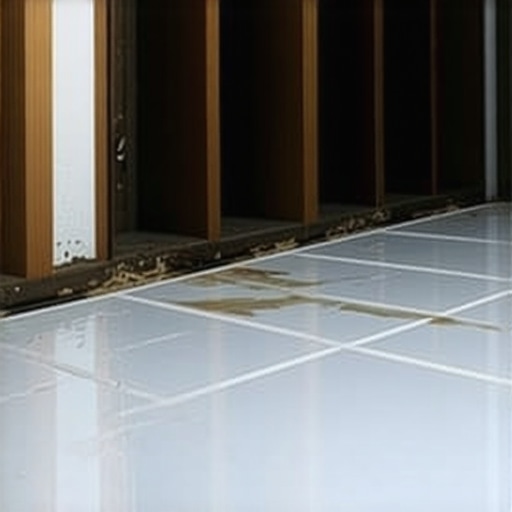
The hidden catastrophe under your feet
Bouncy bathroom floors usually indicate subfloor delamination or joist decay caused by persistent water intrusion. When moisture penetrates the grout lines or laminate seams, it saturates the plywood or OSB, breaking down the structural adhesives and causing the layers to separate, which leads to vertical deflection and a spongy sensation underfoot. This isn’t just a soft spot. It is a sign that the structural integrity of your home is actively failing because water has transitioned from a liquid state into a biological agent of decay.
Most guys skip the leveling compound. They think the underlayment will hide the dip. It won’t. I spent three days grinding concrete on a job last month just so the floor wouldn’t click like a castanet. That experience taught me one thing. If you ignore the physics of the subfloor, the finish floor will always punish you. I have seen fifteen thousand dollar hardwood floors turn into potato chips because a simple moisture barrier was forgotten. In a bathroom, that bounce you feel is the death rattle of your subfloor. It means the wood fibers have lost their ability to resist shear force. When you step down, those fibers are sliding past each other instead of holding firm.
The mechanics of plywood delamination
Plywood delamination occurs when liquid water or high humidity dissolves the phenol-formaldehyde resins that bond the wood veneers together. Once these adhesive bonds fail, the structural rigidity of the panel drops by over 70 percent. This creates inter-layer friction which produces the classic bouncy floor feeling often accompanied by a dull, wet thud. It is a chemical failure as much as a structural one. Wood is essentially a collection of cellulose straws. When those straws get wet, they swell. In a bathroom environment, this swelling happens unevenly. The top layer of the plywood gets soaked while the bottom stays dry. This differential pressure creates a curl. Once that curl starts, the glue line snaps.
“A floor is only as good as the subfloor beneath it; deflection is the enemy of every joint.” – Master Flooring Axiom
The standard for floor stiffness in a bathroom, especially for tile, is L/360. That means the floor should not deflect more than the length of the span divided by 360. When water gets in, you are lucky to hit L/120. You are walking on a trampoline made of wet sawdust. If you have showers that are not properly tanked, that water migrates through the grout. Grout is not waterproof. It is a mineral sponge. It sucks up the water and dumps it directly onto the thin-set. If you used a cheap, modified thin-set with poor water resistance, the bond breaks. Now the tile is floating. When you step on a floating tile, it pushes down into the wet subfloor, and that is where the bounce starts.
Why grout is not a waterproof barrier
Tile grout is a porous cementitious material that allows moisture migration through capillary action even when it appears dry. Standard sanded grout has a water absorption rate that can reach up to 10 percent, meaning it acts as a conduit for leaks rather than a shield. Without a liquid-applied waterproofing membrane like Kerdi or RedGard, the subfloor is constantly exposed to micro-leaks. Most homeowners think their tile is the waterproof layer. That is a dangerous lie. The tile is the wear layer. The grout is the aesthetic filler. Neither of them stops water. If your installer did not put down a waterproof membrane over the cement board, every time you mop or splash, you are feeding the rot in the joists.
| Material | Janka Hardness | Moisture Resistance | Typical Deflection Rating |
|---|---|---|---|
| Solid White Oak | 1360 | Low | L/360 |
| Engineered Maple | 1450 | Medium | L/480 |
| Marine Grade Plywood | N/A | High | L/720 |
| OSB (Standard) | N/A | Very Low | L/240 |
The problem is exacerbated by the use of OSB, or oriented strand board. OSB is made of wood chips and wax. Once water gets past the wax coating on the edges, the chips swell like popcorn. Unlike plywood, which might dry out and keep some of its shape, OSB stays swollen. It becomes a mushy mess that has the structural integrity of a wet cardboard box. If your bathroom was built with builder-grade OSB and you have a leak around the toilet or the shower curb, the bounce is the chips literally falling apart under your weight. The fasteners, whether they are screws or nails, lose their grip because the wood around them has turned to pulp.
The failure of laminate in wet environments
Laminate floors in bathrooms are prone to edge swelling and core voiding because the High-Density Fiberboard (HDF) core is extremely hydrophilic. Even if the product is marketed as waterproof, the click-lock joints are vulnerable points where standing water can bypass the wear layer. This leads to peaking and soft spots that mimic a bouncy subfloor. I have seen so many people buy into the waterproof laminate hype. They think they can douse it in water. But if that water sits in the expansion gap at the perimeter, it travels under the floor. Once it is under there, it is trapped. The plastic underlayment that was supposed to protect the floor now keeps the water from evaporating. It creates a terrarium for mold and rot.
While most people want the thickest underlayment, too much cushion actually causes the locking mechanisms on LVP or laminate to snap under pressure. This is a common mistake. You buy a 5mm foam pad thinking it will be soft on your feet. But that softness allows the joint to flex every time you walk. Over six months, that plastic tongue and groove will fatigue and break. Now you have a floor that feels bouncy not because of a leak, but because you over-cushioned it. When you add a real leak to that equation, the HDF core drinks the water and expands. The floor has nowhere to go because it is locked against the walls. It buckles. It heaves. It feels like you are walking on a bubble.
Structural deflection and joist health
Floor joists provide the primary structural support for the bathroom, and their load-bearing capacity is severely compromised by fungal decay known as brown rot. Brown rot fungi break down cellulose and hemicellulose, leaving the wood brittle and prone to compression failure. If your joists are notched or drilled for plumbing, their bending moment is already reduced, making them the first point of structural failure during a leak. You have to look at the plumbing. Often, a plumber will cut a huge hole in a 2×10 joist to fit a 3-inch drain pipe. That joist is now effectively a 2×4 in that spot. If that spot gets wet, the wood loses its stiffness. The bounce is the joist literally bending under your weight because it no longer has the fiber density to stay rigid.
“Deflection is not just a cosmetic issue; it is the physical manifestation of structural fatigue within the timber substrate.” – Structural Engineering Guideline
The bounce often starts at the toilet flange. The wax ring fails, and water slowly seeps into the subfloor over five years. You don’t see it because it stays under the vinyl or tile. But the wood is drinking. By the time you feel the bounce, the plywood is black and the joist is furry with mold. This is why I always use a moisture meter. If I walk into a bathroom and the air smells like a damp basement, I know the meter is going to scream. You should see 6 to 9 percent moisture content in a healthy floor. If I see 20 percent, that floor is a goner. You can’t just dry it out and hope for the best. The lignin is gone. The wood is a ghost of its former self.
Diagnostic checklist for a bouncy bathroom floor
- Check the toilet base for any hairline cracks in the caulk or grout.
- Inspect the shower curb for water marks or soft spots on the adjacent drywall.
- Use a flashlight to look at the joists from the crawlspace or basement while someone walks above.
- Measure the vertical movement of the floor near the leak source with a laser level.
- Check the moisture levels of the subfloor using a pin-style meter at the perimeter.
- Verify if the flooring was installed with the required 1/4 inch expansion gap.
The fix is rarely easy. You can’t just pour some floor leveler over a bouncy spot and call it a day. That is like putting a band-aid on a broken leg. You have to pull the finish floor. You have to cut out the rot. I have had to sister joists many times because the original wood was so soft I could poke a screwdriver through it. Sistering involves bolting a new, pressure-treated joist alongside the old one to take the load. If you don’t do this, the new floor you put down will crack within a year. The movement will kill the grout lines and the cycle of leaking will start all over again. It is about building a rigid, dry box that can handle the humidity of a bathroom.
The path to a rigid floor
Subfloor remediation requires the removal of saturated materials and the reinforcement of the floor system with exterior-grade plywood or cementitious backer units. Ensuring proper fastener spacing every 6 inches on the edges and 12 inches in the field is essential to minimize micro-movements. Using a high-quality subfloor adhesive that meets ASTM D3498 standards will create a monolithic structure that resists bouncing and squeaking. If you are in a high-humidity area like Florida or Louisiana, you need to be even more careful. The air itself is trying to rot your floor. You need a vapor barrier on the bottom of the joists in the crawlspace to stop the moisture from coming up, and a waterproof membrane on top to stop the shower water from coming down. You are essentially creating a wood sandwich that needs to stay dry to stay strong.
Final verification of a floor’s health comes down to the tap test. I take a heavy screwdriver and bounce the handle off the subfloor. A healthy floor has a high-pitched, solid ring. A bouncy, rotted floor has a dull thud. It sounds like you are hitting a bag of flour. If you hear that thud, stop what you are doing. Don’t let a contractor tell you a little bit of water damage is fine. It is never fine. Wood rot is a cancer that spreads. It attracts termites and carpenter ants. It compromises your home’s value. Fix the source of the leak, replace the wood, and use the right materials. Your feet will thank you, and your house will stand another fifty years. Floor work is 90 percent preparation and 10 percent installation. If you get the 90 percent right, the 10 percent is easy. If you mess up the prep, the finish will never save you.