
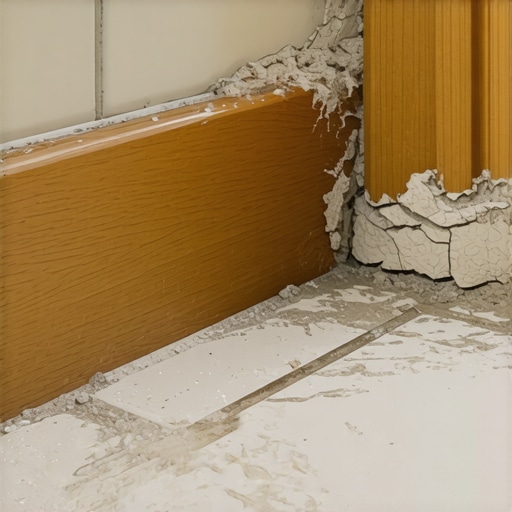
I spent three days grinding concrete on a job last month just so the floor wouldn’t click like a castanet. Most guys skip the leveling compound. They think the underlayment will hide the dip. It won’t. I have seen every shortcut in the book, and the result is always the same. You walk into a bathroom and see that ugly, jagged line of broken cement running right where the tile meets the wall. It is a sign of a fundamental misunderstanding of structural physics. A floor is not a static object. It is a living, breathing assembly of disparate materials that are constantly at war with one another. When your grout cracks along the bathroom baseboard, you are witnessing the point where the battle was lost.
The structural myth of the static home
Bathroom grout failure occurs because houses are dynamic structures that expand and contract due to thermal changes and humidity. Grout is a rigid crystalline material with zero flexibility. When the floor joists deflect or the wall studs shift, the brittle grout cannot accommodate the movement and inevitably fractures at the change of plane. This movement is often invisible to the naked eye, but at a microscopic level, it is violent. Your bathroom is a high moisture environment where the hardwood floors or laminate in adjacent rooms are pulling and pushing against the subfloor. Even if you have a concrete slab, the house is settling. The junction between a horizontal surface like your tile floor and a vertical surface like your baseboard is known as a change of plane. In the world of professional tile setting, filling this gap with rigid grout is a cardinal sin. It ignores the reality of building movement. Professional standards dictate that these joints must be treated as expansion gaps. If you fill a gap that wants to move with a material that refuses to bend, the material will break.
“A floor is only as good as the subfloor beneath it; deflection is the enemy of every joint.” – Master Flooring Axiom
The chemistry of a brittle bond
Portland cement based grout is a mixture of hydraulic cement and sand that forms a rigid matrix once cured. This material possesses a high compressive strength but almost no tensile strength or elasticity. It cannot stretch. Consequently, any minor vibration or settlement causes the bond to fail immediately. To understand why this happens, you have to look at the molecules. Portland cement creates a lattice of calcium silicate hydrate crystals. These crystals are incredibly strong when you push on them, which is why tile can handle heavy foot traffic. However, they have the flexibility of a glass rod. When the subfloor beneath your laminate or tile bends by even a fraction of a millimeter, it creates a shearing force. The baseboard is usually nailed to the wall studs, while the tile is bonded to the floor. These two surfaces move independently. If you bridge them with a cementitious material, you are asking the grout to hold the entire weight of the house together. It will lose that fight every time. This is why you see the grout turning into dust or popping out in long, needle-like shards along the perimeter of the room.
Why wood and water are eternal enemies
Wood based materials like hardwood floors or plywood subfloors are hygroscopic, meaning they absorb and release moisture from the air. This causes them to swell and shrink across the grain. In a bathroom, the humidity from showers forces the wood to expand, putting immense pressure on the grout. If you have hardwood floors leading into a bathroom, the transition is a war zone. Wood can expand up to ten percent of its width depending on the species and the moisture content. Even engineered cores and laminate products have a degree of movement. When that expansion hits the tile floor, it creates lateral pressure. If the installer did not leave a proper expansion gap under the baseboard, that pressure has nowhere to go. It travels through the tile and into the grout joints. The joint at the baseboard is the weakest link. Furthermore, water from the shower can seep into these cracks, reaching the subfloor. Once the subfloor absorbs that moisture, it swells further, creating a feedback loop of destruction that can rot your floor from the bottom up.
| Material Type | Flexibility Rating | Best Use Case | Durability |
|---|---|---|---|
| Sanded Grout | Zero | Field tiles on stable floors | High Compressive |
| Unsanded Grout | Zero | Wall tiles with thin joints | Low Shrinkage |
| Siliconized Acrylic | Medium | Interior trim gaps | Moderate |
| 100% Silicone | Maximum | Change of plane joints | High Chemical Resistance |
The mechanics of the change of plane
A change of plane refers to any corner where two different surfaces meet at an angle, such as where the floor meets the wall. These areas require a movement joint rather than a rigid grout joint. Failure to use flexible sealant in these locations is the primary cause of cracking. The Tile Council of North America (TCNA) provides clear guidelines on this. Detail EJ171 explicitly states that movement joints are required where tile work abuts restraining surfaces. When an installer runs tile right up to the wall and then grouts that gap, they are