
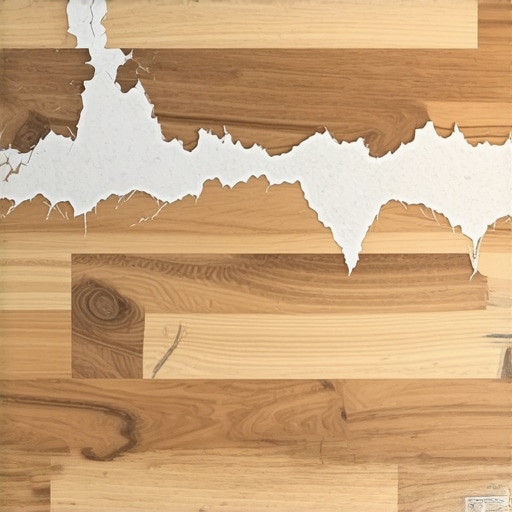
The lie of the waterproof sticker
Laminate floors peel at the edges because moisture penetrates the decorative paper layer and the high-density fiberboard (HDF) core. This often happens when the top melamine wear layer fails or when excessive humidity causes the core to swell beyond its structural limits. It is rarely a defect in the material and almost always a failure of installation technique or improper maintenance routines. I have spent twenty five years on my knees with a moisture meter and a level, and I can tell you that the marketing term waterproof is the most dangerous word in the flooring industry. Homeowners always ask why their laminate is buckling or peeling. Usually, it is because they locked it under a heavy kitchen island or a massive bookshelf, killing the floor’s ability to breathe. I saw a case last winter where a guy installed 1,200 square feet of beautiful laminate without a single transition strip. He thought it looked better. Three months later, the whole floor was walking away from itself and the edges were shredding because the floor had no room to breathe. It was a $4,000 mistake that could have been avoided with a $20 T-molding. Laminate is a composite of paper and wood fibers bonded with resin. When you understand the physics of how these layers interact, you understand why the edges are the first point of failure. Unlike hardwood floors which are a single piece of organic material, laminate is a sandwich of conflicting densities. The top layer is a melamine resin reinforced with aluminum oxide. Beneath that is the decorative print film. Then comes the HDF core, which is essentially sawdust and glue compressed at high pressure. The problem is that the edges of the plank, where the click-lock tongue and groove are milled, are often the most vulnerable because they lack the thick protective coating found on the surface.
The molecular anatomy of a laminate plank
Laminate flooring is a precision engineered product that relies on a balanced construction to remain flat and stable. The high-density fiberboard core usually has a density of 800 to 900 kg/m3. This density is what gives the floor its impact resistance. However, HDF is hygroscopic. This means it naturally absorbs moisture from the air. When the humidity in your home jumps from 30 percent in the winter to 60 percent in the summer, those fibers swell. If the edges of the planks are not properly sealed or if the locking mechanism is under too much tension, the decorative layer starts to lift. This lifting is what you see as peeling. It is a mechanical failure of the bond between the melamine and the HDF. If you look at the floor under a microscope, you would see the wood fibers in the core expanding like tiny sponges. This expansion puts upward pressure on the thin wear layer. Because the wear layer is brittle, it cannot stretch. Instead, it cracks or delaminates from the edge of the plank. This is why acclimation is not just a suggestion, it is a structural requirement. You cannot take planks from a cold warehouse and install them in a humid living room immediately. The material needs at least 48 hours to reach an equilibrium with the local environment. If you skip this, the internal stresses will tear the edges apart before you even move your furniture back in.
“A floor is only as good as the subfloor beneath it, deflection is the enemy of every joint.” – Master Flooring Axiom
The friction war at the perimeter
Expansion gaps are the most misunderstood part of flooring. Every floating floor must have at least a 1/4 inch or 3/8 inch gap around the entire perimeter. If the floor hits a wall or a door frame, it has nowhere to go. The energy of that expansion has to be released somewhere, and it usually manifests at the joints. When the planks are pushed together with nowhere to expand, the edges rub against each other. This friction wears down the protective coating. Once that coating is gone, any small amount of liquid, even a damp mop, will soak into the HDF core. While most people want the thickest underlayment, too much cushion actually causes the locking mechanisms on laminate to snap under pressure. A soft, squishy underlayment allows the floor to bounce. Every time you walk across it, the tongue and groove move vertically. This movement creates a shearing force at the edge of the plank. Over time, this shear stress breaks the bond of the laminate film. You might think you are making the floor softer for your feet, but you are actually killing the joints. A high quality underlayment should be firm and have a high compressive strength. It should be designed to support the locking system, not provide a cloud-like feel. If your floor feels like a trampoline, your edges will be peeling within two years. This is a common issue when people try to install laminate over old carpet padding, which is a massive mistake. Carpet padding is designed for carpet, it has no place under a floating floor system. You need something with a high density that will not compress more than 2 or 3 millimeters under load.
| Feature | AC3 Rating (Residential) | AC4 Rating (Commercial) | AC5 Rating (Heavy Traffic) |
|---|---|---|---|
| Wear Layer Thickness | 0.2mm to 0.3mm | 0.4mm to 0.5mm | 0.6mm+ |
| Core Density | 800 kg/m3 | 850 kg/m3 | 900 kg/m3 |
| Edge Style | Square Edge | Micro-Bevel | Deep Pressed Bevel |
| Best Use | Bedrooms | Living Rooms | Retail Spaces |
Steam mops are the enemy of your warranty
Nothing kills a laminate floor faster than a steam mop. You see the commercials showing how easy it is to clean, but they never show you what the floor looks like six months later. Steam is water in its most invasive state. It is a gas that is forced under high pressure into the micro-cracks of your floor. When you run a steam mop over a laminate joint, you are injecting boiling water directly into the HDF core. The heat softens the resins and the moisture causes the wood fibers to explode in size. This is why the edges of your planks look like they are rising. Once the moisture is inside, it cannot get out. The wear layer traps it there, causing a permanent bubble or peel. If you use a steam mop on your laminate, you have effectively voided your warranty. Manufacturers can tell immediately if a floor has been steam cleaned because the damage is localized to the joints and shows signs of heat degradation. Use a microfiber mop and a pH neutral cleaner instead. You want the floor to be dry within 30 seconds of cleaning. If you see standing water, you are doing it wrong. This is the same reason why laminate is a risky choice for bathrooms. While modern laminate has improved, the high humidity from showers can still penetrate the perimeter. If you must use it in a wet area, you need to use a 100 percent silicone sealant in the expansion gaps before you install the baseboards. This creates a gasket that prevents water from getting under the floor and attacking the planks from the bottom up.
- Check subfloor levelness to within 3/16 inch over a 10 foot radius.
- Always use a 6-mil poly vapor barrier over concrete slabs.
- Maintain indoor humidity between 35 and 55 percent year-round.
- Leave a minimum 3/8 inch expansion gap at all vertical obstructions.
- Never use a steam mop or excessive water for cleaning.
- Use transition strips for any run longer than 30 feet.
The subfloor truth that installers ignore
Most guys skip the leveling compound. They think the underlayment will hide the dip. It will not. I spent three days grinding concrete on a job last month just so the floor would not click like a castanet. If your subfloor is not flat, your laminate edges will fail. When a plank spans a dip in the subfloor, it creates a bridge. When you step on that bridge, the plank flexes. This vertical movement is called deflection. Every time the plank deflects, the tongue and groove rub against each other. This mechanical wear eventually strips the laminate film right off the edge of the plank. This is particularly common in older homes with plywood subfloors that have settled over time. If you do not spend the time to fill the low spots and sand down the high spots, no amount of expensive flooring will save you. You are building on a shaky foundation. In regions with high humidity, like the coastal south, the subfloor can also hold moisture that migrates upward. This is why a vapor barrier is not optional. Even if the floor feels dry, the concrete slab is constantly releasing moisture vapor. If that vapor gets trapped between the slab and the laminate core, the core will swell and the edges will peel. It is a slow, invisible process that destroys the floor from the underside. Always perform a calcium chloride test or use a pinless moisture meter before you start laying planks. If the moisture levels are too high, you need to address the drainage or use a specialized moisture mitigation primer. Skipping this step is the fastest way to turn a beautiful floor into a pile of garbage within a single season.
“Moisture vapor emission from a concrete slab must not exceed 3 lbs per 1000 square feet over 24 hours for most fiber-core installations.” – NWFA Technical Guidelines
The bottom line on edge failure
Peeling edges are a symptom of a deeper problem. Whether it is environmental moisture, mechanical stress from an uneven subfloor, or chemical damage from improper cleaning, the result is the same. The bond between the protective surface and the structural core has been compromised. If you catch it early, you might be able to replace individual planks, but usually, once the peeling starts, it is a sign that the entire installation is at risk. Protect your investment by following the basics. Use the right AC rating for your traffic level. Spend more time on the subfloor than the actual floor. And for the love of everything, throw away the steam mop. If you treat laminate like the technical, moisture-sensitive product it is, it will last for decades. If you treat it like plastic that can handle anything, you will be calling me for a rip-out and replacement sooner than you think. Real flooring professionals know that the beauty of the surface is irrelevant if the engineering beneath it is flawed. Focus on the chemistry of the bond and the physics of the expansion, and the aesthetics will take care of themselves. That is the only way to ensure a floor stays flat, tight, and beautiful for the long haul.