
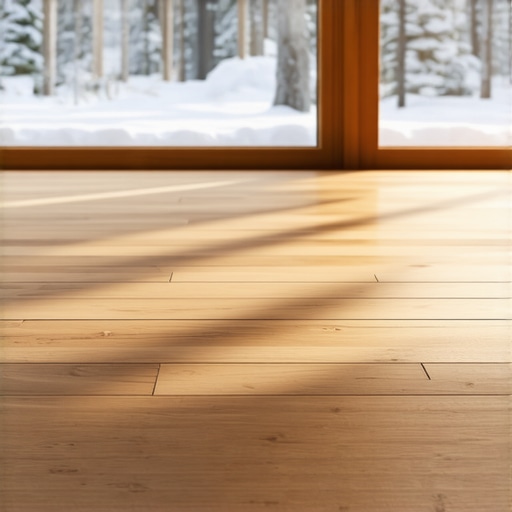
The winter air is a thief. It crawls into your home and steals the moisture right out of the HDF core of your laminate planks. When that moisture leaves, the wood fibers shrink. It is basic physics. If your floor was not installed with a floating mindset, it will pull apart at the weakest point, usually the short end joints. I have spent decades on my knees with a moisture meter and a level, and I can tell you that a floor is a performance surface, not a decoration. Most guys skip the leveling compound. They think the underlayment will hide the dip. It won’t. I spent three days grinding concrete on a job last month just so the floor wouldn’t click like a castanet. That is the reality of the trade. If you want a floor that stays together when the furnace kicks on, you have to respect the chemistry and the physics of the material. Laminate is not plastic. It is mostly wood, and wood moves.
The seasonal physics of wood fiber
Laminate flooring separation in winter occurs because the high-density fiberboard (HDF) core is hygroscopic, meaning it absorbs and releases ambient moisture. When indoor relative humidity drops below 35 percent, the wood fibers contract at a cellular level, causing the locking mechanisms to pull away from one another. This movement is inevitable in climates where heating systems strip the air of its natural water content. The HDF core is composed of refined wood fibers mixed with wax and a synthetic resin binder, typically urea-formaldehyde. While the resin provides some stability, the wood fibers remain reactive to the atmosphere. When the air dries out, the water molecules bonded to the cellulose fibers evaporate. This causes the internal structure of the plank to physically narrow and shorten. Even a tiny fraction of a millimeter per plank adds up across a twenty foot room. If the floor is pinned by heavy cabinetry or lacks proper expansion gaps, the cumulative force of this contraction will snap the locking tongues or pull the grooves apart. This is not a defect in the product. It is a failure to account for the laws of thermodynamics in your living room. You are dealing with a material that wants to breathe, and if you do not give it the space to do so, it will make its own space by opening gaps at the joints.
The 1/8 inch that ruins everything
Subfloor flatness is the single most important factor in preventing laminate joint separation during the winter months. According to NWFA standards, a subfloor must be flat within 1/8 inch over a 6 foot radius or 3/16 inch over 10 feet to prevent vertical deflection. When a plank sits over a dip, every step causes it to flex downward. This mechanical stress weakens the click-lock joint over time, making it much easier for the planks to slide apart when they shrink in the cold. Most installers are lazy. They see a small hollow in the plywood or concrete and assume the underlayment will cushion it. Underlayment is for sound and moisture, not for structural leveling. If the subfloor is not dead flat, the floor is doomed before the first box is even opened. I have seen million dollar homes with floors that feel like trampolines because the builder did not want to spend the money on self-leveling compound. Concrete grinding is a dusty, miserable job, but it is the difference between a floor that lasts thirty years and one that fails in three. When the floor is flat, the friction between the tongue and the groove is maximized. When the floor is uneven, that friction is lost, and the winter contraction pulls the planks apart like a zipper.
“A floor is only as good as the subfloor beneath it; deflection is the enemy of every joint.” – Master Flooring Axiom
The humidity range for floor stability
Indoor relative humidity levels must be maintained between 35 percent and 55 percent to ensure laminate floor integrity and prevent gapping. If your home drops into the 20 percent range during a cold snap, no amount of quality installation will save your end joints from separating. This is a matter of environmental control. You cannot expect a wood-based product to remain dimensionally stable in an environment that is as dry as a desert. Most modern HVAC systems include a humidifier for a reason. It is not just for your skin and sinuses. It is for your woodwork and your flooring. If you see gaps appearing, the first thing you should reach for is a hygrometer, not a hammer. Measuring the air is just as important as measuring the subfloor. If you find that your air is too dry, you need to introduce moisture back into the space. However, you must be careful. Rapid changes in humidity can be just as damaging as sustained dry air. A sudden spike in moisture can cause the planks to expand too quickly, leading to peaking or buckling at the edges. Consistency is the key to a happy floor. I always tell my clients that if they are comfortable, their floor is probably comfortable. If their skin is cracking and they are getting static shocks every time they touch a doorknob, their laminate is suffering too.
Acclimation mistakes you cannot fix later
Laminate acclimation requires the flooring to sit in the installation environment for at least 48 to 72 hours to reach moisture equilibrium. Many installers rush this process by leaving the boxes in a cold garage or bringing them in the same day they start the job. If the planks are cold and contracted when they are installed, they will expand as they warm up, then shrink again when the winter air hits, leading to structural instability. You have to open the boxes or at least cross-stack them to allow for airflow. I have seen guys stack twenty boxes in a solid block and wonder why the planks in the middle are still cold three days later. Air needs to circulate around every box. This allows the internal moisture content of the HDF core to match the average humidity of the room. This is not a suggestion. It is a requirement. If you install a floor that is wetter than the room it is in, it will shrink. If you install a floor that is drier than the room, it will grow. You are looking for a baseline. Using a pinless moisture meter to check the planks against the subfloor is the only way to be sure. If you are within a couple of percentage points, you are usually safe to proceed. Skipping this step is like trying to bake a cake without preheating the oven. You might get lucky, but you probably will not.
“Wood flooring will perform best when the environment is controlled to stay within a relative humidity range of 30 to 50 percent.” – NWFA Technical Guidelines
Locking mechanisms and structural failure
Click-lock flooring systems rely on mechanical friction and milled tolerances to hold planks together without the need for adhesive. In the winter, if these tolerances are exceeded by material shrinkage, the locking tongue can actually shear off or slide out of the groove entirely. Not all locking systems are created equal. You have the Uniclic system, the Valinge 2G or 5G, and various drop-lock designs. Some are better than others at resisting tension. The 5G systems use a plastic insert to create a stronger vertical lock, which can be very effective at preventing end-joint separation. However, even the best system has a breaking point. When the HDF core shrinks, the physical dimensions of the tongue and groove change. The gap that was once microscopic becomes visible. If dirt or grit gets into that gap, it acts like sandpaper, wearing down the profile every time you walk on it. Eventually, the lock fails. This is why keeping a clean floor is a structural necessity, not just a cosmetic one. If you have gaps, you should vacuum them out before trying to tap the planks back together. If you trap a piece of sand in the joint and then force it closed, you will break the lock. I have seen homeowners ruin an entire room of flooring by being too aggressive with a pull bar when the joints were full of winter grit.
| Material Type | Expansion Potential | Typical Core | Winter Stability |
|---|---|---|---|
| Laminate | Medium | HDF / Wood Fiber | Low |
| Engineered Wood | Low | Plywood / SPC | High |
| Solid Hardwood | High | Natural Lumber | Very Low |
| LVP (Vinyl) | Very Low | PVC / Stone Core | Very High |
The heavy furniture anchor trap
Floating floor installations must be able to move as a single continuous unit, but placing heavy kitchen islands or massive bookshelves on the planks will anchor the floor and prevent it from shrinking uniformly. This creates localized tension, forcing the gaps to open up in the areas where the floor is not pinned down. This is one of the most common mistakes I see. People treat laminate like it is glued down. It is not. It is a giant wooden raft floating on an underlayment. If you put a three hundred pound piano on one end and a heavy China cabinet on the other, you have effectively nailed the floor to the subfloor. When winter comes and the floor tries to shrink toward the center, it cannot. Something has to give, and that something is usually the joint in the middle of the room. You have to install heavy objects first and floor around them, or use specialized transition strips to break the floor into smaller, independent sections. This allows each section to expand and contract without pulling against a fixed point. T-moldings are ugly, I get it. But they are a necessary evil in large rooms or at doorways. If you run a continuous floor through three rooms without a break, you are asking for trouble. The cumulative movement of sixty feet of laminate is more than any locking system can handle.
The ghost in the expansion gap
Perimeter expansion gaps of at least 1/4 inch to 3/8 inch must be maintained around all fixed vertical surfaces to allow the laminate field to shift during seasonal changes. If the floor hits a wall or a door casing during the summer, it can cause the boards to bind. When winter arrives and the floor tries to contract, the internal tension from being previously jammed against a wall can cause the joints to snap open violently. Most people cover these gaps with baseboards or quarter-round molding, which is fine, but you have to make sure the molding is nailed to the wall, not the floor. If you nail your baseboard into the laminate, you have just created a thousand tiny anchors that will prevent the floor from moving. It is a common DIY mistake. You also need to look at door jambs. You should be undercutting the wood so the floor can slide underneath. If you cut the laminate to fit around the jamb, you are likely leaving no room for movement. I spend a lot of time with an oscillating saw making sure those jambs are clear. It is the small details that keep a floor together when the temperature drops. If the floor cannot move at the edges, it will move at the seams. It is a simple equation of force and resistance.
Winter Floor Maintenance Checklist
- Monitor indoor humidity and keep it above 35 percent using a whole-home or room humidifier.
- Check for any heavy furniture that might be anchoring the floor in place.
- Inspect the perimeter to ensure the floor has at least a 1/4 inch gap behind the baseboards.
- Vacuum gaps regularly to prevent debris from damaging the locking mechanisms.
- Use a specialized laminate floor gap fixer tool if joints begin to open, but only after cleaning the groove.
- Avoid using wet mops, as moisture can seep into open winter joints and swell the HDF core.
The final verdict on seasonal gaps
Laminate flooring is a marvel of modern engineering, but it is not immune to the laws of nature. The separation you see in the winter is a symptom of a dry environment and a material that is doing exactly what it was designed to do: react to its surroundings. To fix it, you have to address the root cause. Close the gaps with a glass suction cup and a tapping block, but only after you have stabilized the humidity in the room. If you try to force a floor back together while the air is still bone-dry, you are fighting a losing battle. You might even break the delicate tongues that hold the whole system together. Respect the material, maintain your subfloor, and keep an eye on the moisture levels in your home. If you do those three things, you will have a floor that stays tight from January through December. If you ignore the physics, you will be looking at gaps every time the snow starts to fall. It is as simple as that. Flooring is not just about what looks good in a showroom; it is about how it handles the reality of a changing climate inside your four walls. Take care of the subfloor and the air, and the floor will take care of itself.