
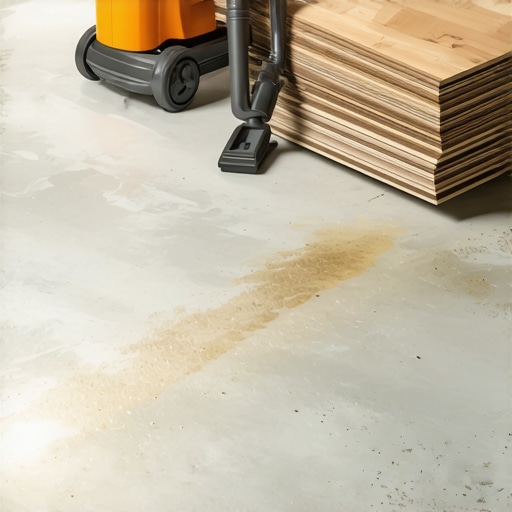
I spent three days grinding concrete on a job last month just so the floor wouldn’t click like a castanet. Most guys skip the leveling compound and the deep clean. They think the underlayment will hide the dip or the debris. It won’t. I remember a job in a high-rise where the previous crew left drywall screws and chunks of plaster under a floating floor. Six months later, every step sounded like a firecracker. The homeowner lost their mind and the installer lost their shirt. I had to rip the whole thing out. You could see where the grit had actually punctured the vapor barrier and started a small colony of mold in the sawdust. It smelled like a damp basement in a five-million-dollar penthouse. That is what happens when you treat the subfloor like a dumpster instead of a foundation.
The microscopic debris that snaps locking systems
Subfloor cleanliness is the primary factor in maintaining the structural integrity of laminate click-lock joints. Even small particles like sand, sawdust, or drywall dust create point-load stress, which leads to mechanical failure, audible squeaking, and the eventual separation of planks during thermal expansion.
When you look at a subfloor, you might see a flat surface. I see a battlefield of physics. Laminate flooring is a floating system. It is not nailed or glued. It relies on the balance between gravity and the friction of the underlayment. If you leave a single pebble or a glob of dried joint compound on that plywood or concrete, you have created a fulcrum. Every time a person walks over that spot, the plank flexes over that debris. Laminate is made of High-Density Fiberboard or HDF. While it is tough, it is brittle at the tongue and groove. Constant flexing over a piece of grit will eventually fatigue the wood fibers. The locking mechanism will snap. Once that happens, the floor is dead. You cannot glue it back together. You are looking at a full replacement because you were too lazy to use a shop vac.
Why your subfloor is lying to you
Latent contaminants such as paint overspray, wax, or old adhesive residues can interfere with underlayment performance and vapor barrier seals. A subfloor must be level within 3/16 of an inch over a ten-foot radius to prevent deflection and air pockets that cause plank bounce.
I have seen homeowners spend five thousand dollars on high-end laminate just to lay it over a floor covered in old carpet adhesive. They think the underlayment will just sit on top of it. What they do not realize is that old adhesives can be chemically active. Some old black cutback adhesives contain asbestos, while others use plasticizers that can migrate into your new underlayment. This can cause the foam to break down or create a sticky mess that prevents the floor from expanding and contracting. A floating floor needs to move. If it gets stuck to a patch of old glue, it will buckle when the humidity hits sixty percent. You need to scrape that floor until it is as clean as a dinner plate. If you do not, you are just building a house on sand.
“A floor is only as good as the subfloor beneath it; deflection is the enemy of every joint.” – Master Flooring Axiom
The ghost in the expansion gap
Expansion gaps are the perimeter zones required for laminate flooring to fluctuate in size based on ambient humidity and temperature changes. Debris trapped in these gaps, such as drywall chunks or baseboard splinters, creates a physical bridge that causes the floor to peak or gap.
The physics of wood-based products are non-negotiable. Even though laminate is a composite, its HDF core reacts to moisture. In the summer, those planks are going to grow. If you have left piles of sawdust or construction debris at the edges of the room, that floor has nowhere to go. It will hit that debris, stop, and then the pressure has to go somewhere. That somewhere is up. You will get a peak in the middle of your hallway that looks like a mountain range. I always tell my apprentices that the most important tool for a flooring job is not the saw or the tapping block. It is the vacuum. You vacuum before you lay the underlayment. You vacuum the underlayment before you lay the planks. You vacuum the gaps before you put down the baseboards. If I see a single grain of sand, the job is not ready.
The microscopic ball bearings of drywall dust
Drywall dust acts as a lubricant or ball-bearing layer between the subfloor and the underlayment, which causes unwanted shifting and noise. This fine particulate matter is alkaline and can also corrode certain types of adhesives or vapor retarders over time.
| Contaminant Type | Mechanical Impact | Warranty Risk |
|---|---|---|
| Drywall Dust | Joint Friction/Noise | High |
| Paint Drips | Uneven Surface/Crowning | Medium |
| Grit/Sand | Puncture/Point Loading | Extreme |
| Old Adhesive | Chemical Migration | High |
Drywallers are the natural enemies of floorers. They leave a fine white powder everywhere. To the naked eye, it just looks like a messy floor. To a flooring professional, that dust is a disaster. It is so fine that it gets into the pores of the wood or concrete. When the floating floor moves, it grinds that dust into the underlayment. It creates a rasping sound every time you walk. You can’t just sweep it. You need a HEPA vacuum. If you don’t get that dust up, you are basically installing your floor on a layer of tiny marbles. This leads to the planks shifting more than they should, which puts even more stress on those delicate clicking joints.
The 1/8 inch that ruins everything
Subfloor flatness is often confused with subfloor levelness, but for laminate installations, a flat surface is more critical than a level one. Any protrusion greater than 1/8 of an inch will cause a hollow spot, leading to vertical movement and fatigue of the HDF core.
I have walked away from jobs where the builder refused to let me grind the high spots. I won’t put my name on a floor that I know is going to fail. If you have a high spot, the laminate will teeter-totter on it. If you have a low spot, the floor will dip and feel like a sponge. Both scenarios are death for laminate. People think the foam underlayment is there to level the floor. That is a lie. The foam is for sound dampening and minor cushion. It will not bridge a valley or hide a mountain. You need to be surgical. Use a ten-foot straight edge. If you can slide a nickel under it, you have work to do. Clean the area, patch the lows, grind the highs. It is dirty, loud, and miserable work, but it is the difference between a floor that lasts thirty years and one that lasts thirty days.
“Subfloor preparation is 75 percent of the labor; the actual installation is merely the victory lap.” – NWFA Professional Manual
Moisture and the organic buffet under your feet
Organic debris trapped under non-breathable underlayments provides a nutrient source for mold and mildew when moisture vapor emits from a concrete slab. Maintaining a clean subfloor ensures that the vapor barrier can lay flush against the substrate without air pockets.
Concrete is never truly dry. It is always breathing moisture vapor. When you lay a vapor barrier down, you are trapping that moisture. If you left sawdust, food crumbs, or even old paper under there, you have just created a greenhouse for mold. I have pulled up floors where the underside was completely black because the installer didn’t sweep. It is disgusting. Beyond the smell, that mold can eventually rot the bottom of your door casings and baseboards. Cleaning the floor is about hygiene as much as it is about mechanics. You want that subfloor sterile. I use a TSP solution on concrete if it is particularly nasty, just to make sure I am starting with a blank slate.
The subfloor preparation checklist
- Remove all existing flooring and staples or tack strips completely.
- Scrape every square inch of the surface to remove paint drips and drywall mud.
- Vacuum the entire perimeter twice using a high-suction shop vac.
- Check for moisture levels using a calcium chloride test for concrete or a pin meter for wood.
- Sand down plywood seams that have swollen due to construction moisture.
- Ensure no protruding nail heads or screws exist across the entire field.
The physics of the clicking plank
Acoustic performance in laminate flooring is directly tied to the contact quality between the underlayment and a clean substrate. Debris creates voids that act as echo chambers, amplifying the impact noise of footsteps and reducing the IIC rating of the assembly.
If you want a quiet home, you need a clean subfloor. When there is grit between the floor and the subfloor, the sound of your footstep vibrates through the plank, hits the grit, and bounces back. It creates a hollow, cheap sound. A clean, flat floor sounds solid. It sounds like real hardwood. I take pride in the thud of a well-installed floor. That thud comes from total contact. No air gaps. No debris. No shortcuts. It takes an extra four hours to prep a large room correctly. Most people want to rush into the pretty part where the planks go down. I tell them to go get a coffee and let me finish the prep. The prep is the floor. Everything else is just the wear layer. You have to respect the chemistry of the adhesives and the physics of the HDF. If you do not, the house always wins, and by the house, I mean the repair costs.