
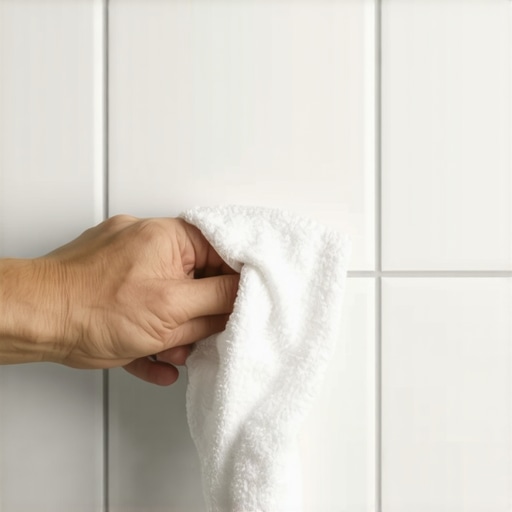
The invisible film that ruins a tile job
Grout haze is the microscopic residue of Portland cement and polymer additives that remains on the surface of tile after the installation process is complete. Most homeowners and amateur flippers think they can just wipe it away with a damp rag. They are wrong. I spent three days grinding concrete on a job last month just so the floor wouldn’t click like a castanet, and that same level of obsessive prep applies to your tile finish. If you leave that haze for more than twenty four hours, it undergoes a chemical hydration process that bonds it to the face of the porcelain or ceramic. It becomes a part of the stone. It attracts dirt, hair, and grease. Within a week, your brand new shower looks like a gas station bathroom. I have seen guys spend hundreds of dollars on caustic chemicals that eat their lungs just to remove a film that could have been handled for the price of a cup of coffee. You have to understand the chemistry of what you are fighting. This is not just dust. This is a lattice of minerals and hardened polymers that require a specific pH shift to release their grip on the substrate.
The physics of grout hydration and surface tension
Grout haze forms when the water used during the clean up process evaporates and leaves behind the solids from the grout mixture. When you are floating grout into the joints of a shower wall, you are essentially pushing a slurry of sand, cement, and pigments into a void. The surface of the tile acts as a shelf for the excess. Even after the initial sponge wipe, a thin layer of liquid remains. As the ambient air in the room pulls moisture out of that liquid, the concentration of minerals increases until they precipitate out of solution. This is where the bond begins. In a high humidity environment like a bathroom, this process can be unpredictable. I have walked into jobs where a $15,000 wide plank walnut floor was cupping because the installer didn’t check the crawlspace humidity, and I have seen $20,000 tile jobs ruined because the installer used a dirty sponge. Every single molecule of cement left on the surface is a magnet for future stains. You are dealing with a material that is designed to be permanent. If you do not break the bond within the first forty eight hours, you are no longer cleaning; you are performing a chemical extraction.
“A floor is only as good as the subfloor beneath it; deflection is the enemy of every joint.” – Master Flooring Axiom
The magic of a two dollar gallon of white vinegar
The most effective tool for removing standard cementitious grout haze is a simple solution of distilled white vinegar and warm water mixed at a specific ratio. I know the big box stores want to sell you a thirty dollar bottle of proprietary haze remover with a fancy label. They want you to think it is a complex industrial secret. It is not. Most grout haze is alkaline. Vinegar is acidic. When the acetic acid in the vinegar hits the calcium carbonate in the cement residue, a chemical reaction occurs that breaks the ionic bond. You are essentially melting the microscopic anchors that hold the haze to the tile. However, you cannot just pour it on. You need a five gallon bucket, a professional grade microfiber cloth, and a specific technique. Do not use this on natural stone like marble or travertine. The acid will etch the stone and leave permanent dull spots. For porcelain and ceramic, it is the gold standard. I keep a gallon in my truck next to my WD-40 and my spacers. It is the cheapest and most reliable tool in my kit. You mix one part vinegar to four parts water. This creates a mild acidic wash that is strong enough to eat the haze but weak enough to leave your grout joints intact.
Why your hardwood and laminate care is different
While tile requires acidic intervention, using the same logic on laminate or hardwood floors will result in a total structural failure of the finish. I see people try to clean their luxury vinyl plank or their engineered oak with vinegar all the time because they read a blog post from someone who has never held a tape measure. Acid eats the wear layer of a laminate floor. It turns the clear coat cloudy and brittle. On a hardwood floor, vinegar will eventually penetrate the grain and cause the wood fibers to swell. If you are dealing with a haze on a wood floor, it is likely a wax buildup or a construction adhesive residue, not cement. Those require a neutral pH cleaner or a mineral spirit. You have to match the solvent to the solute. If you treat your hardwood like a shower floor, you will be calling me in six months to rip it all out and start over. I have seen million dollar homes with ruined white oak because someone thought ‘natural’ meant ‘safe for everything’. It does not. Chemistry does not care about your intentions. It only cares about the reaction between the liquid and the solid.
| Material Type | Recommended Solvent | Dwell Time | Risk Level |
|---|---|---|---|
| Porcelain Tile | White Vinegar Solution | 2 Minutes | Low |
| Ceramic Tile | White Vinegar Solution | 3 Minutes | Low |
| Polished Marble | Neutral pH Cleaner | 0 Minutes | Extreme |
| Laminate Flooring | Isopropyl Alcohol Mix | 30 Seconds | High |
| Solid Hardwood | Hardwood Specific Soap | 0 Minutes | High |
Tools that professional installers keep in the truck
Achieving a haze free finish requires more than just the right chemical; it requires a mechanical process that prevents redeposition of the solids. Most people fail because they use the same bucket of water for the whole room. By the time they get to the third wall of the shower, they are just wiping liquid grout back onto the tile. You need a dual bucket system. One bucket for the cleaning solution and one bucket for the rinse. You need to switch your water out every fifty square feet. If the water looks cloudy, it is useless. I use a specific type of sponge that has a high density cell structure. Cheap sponges from the grocery store have big holes that trap too much water. You want a sponge that is barely damp. If you see water running down the wall, you are using too much. You are washing the pigment out of the joints and creating more haze. It is a delicate balance of moisture and friction. I also swear by white nylon scrub pads. They have enough bite to break the surface tension of the haze but they are not abrasive enough to scratch the glaze of a high quality ceramic tile.
- Distilled white vinegar for acidic neutralization
- Two five gallon buckets for the clean and rinse cycle
- Microfiber towels that have been washed without fabric softener
- White nylon non abrasive scrub pads
- A pair of heavy duty nitrile gloves to protect your skin from the acid
- A high quality squeegee to remove excess liquid instantly
The chemistry of the hazy residue
At a molecular level, grout haze is composed of silica sand, calcium oxide, and various polymer binding agents that create a crystalline structure upon drying. When you look at tile under a microscope, even the smoothest porcelain has peaks and valleys. The haze settles into these valleys. The polymers are the hardest part to deal with. Modern grouts are ‘high performance’, which means they have added latex or acrylic to make them flexible and water resistant. This is great for the longevity of your shower but it is a nightmare for cleanup. These polymers create a plastic film that vinegar alone might struggle with if left too long. In those cases, you might need to bump up the temperature of your water. Heat increases the kinetic energy of the molecules and helps soften the polymer chains. I always use the hottest water the tap will provide. It thins the viscosity of the solution and allows the acetic acid to penetrate deeper into the microscopic pores of the tile surface. This is the difference between a floor that looks clean and a floor that is structurally clean.
“Grout is the dress that hides the nakedness of the tile; if the dress is dirty, the whole room is a failure.” – Master Flooring Axiom
The ghost in the expansion gap
One of the most common mistakes I see involves people ignoring the perimeter of the room where the tile meets the wall. They focus so much on the center of the floor that they let grout and haze accumulate in the expansion gaps. These gaps are there for a reason. Buildings move. Slabs shift. If you fill that gap with hardened grout haze, you are creating a bridge that will cause the tile to tent or crack when the house settles. I spent years learning that the small details are what separate a pro from a handyman. When you are cleaning the haze, make sure you are clearing the edges. Use a small nylon brush to detail the corners. Do not let the vinegar solution sit in the corners where it can soak into the drywall or the baseboards. Use a dry cloth to buff the edges immediately. This prevents the moisture from wicking into the wall studs and causing mold growth behind the tile. A floor is a system, and every part of that system must be treated with respect. If you ignore the edges, the center will eventually fail.
The forty eight hour window of opportunity
The timeframe for haze removal is the single most important factor in determining the success of your installation. During the first four hours, the grout is in its initial set phase. You should only be using clean water and a sponge. Between four and twenty four hours, the grout enters its secondary set. This is the sweet spot for the vinegar solution. The bond is firm enough that you won’t wash out the joints, but the haze hasn’t fully carbonated yet. Once you hit the forty eight hour mark, the chemical reaction is largely complete. At that point, you are no longer dealing with a film; you are dealing with a rock. I have had to use diamond polishing pads to save floors that were left for a week without cleaning. It is a grueling, expensive process that can be avoided with two dollars and a little bit of elbow grease on day two. Always check your work with a high powered work light. Ambient room light is deceptive. It will hide the haze until the sun hits it at a specific angle the next morning, and by then, you are already behind the clock.
The regional reality of water mineral content
The effectiveness of your cleaning solution is heavily influenced by the mineral content of your local water supply. If you live in an area with hard water, like the limestone heavy regions of the Midwest or the desert Southwest, your tap water is already saturated with calcium and magnesium. Adding vinegar to hard water is like trying to put out a fire with gasoline. The vinegar reacts with the minerals in the water before it ever touches the tile. In these regions, you must use distilled water for your final haze wash. It is an extra dollar, but it ensures that the acid remains available to react with the grout haze. I have seen guys in Phoenix wonder why their floors are still streaky after ten cleanings. It is because they are just moving desert minerals around the room. Use pure water, pure vinegar, and a clean cloth. This is the only way to achieve a surgical level of cleanliness that will last for decades. This is the professional standard that keeps my clients calling me back for thirty years.