
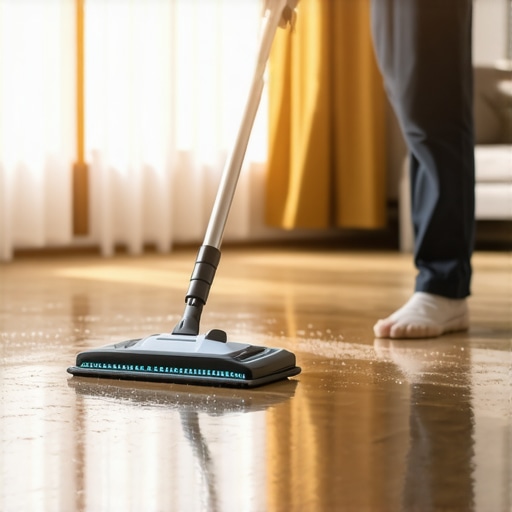
I once walked into a house where a $15,000 wide-plank walnut floor was cupping so bad it looked like a potato chip because the installer didn’t check the crawlspace humidity, and the homeowner decided a steam mop was the best way to clean up after their golden retriever. The wood was literally groaning under the tension. You could hear it pop in the middle of the night like a ghost was walking through the hallway. It was a tragedy of engineering. People treat their hardwood floors like they are ceramic tile, but wood is a living, breathing structural material that reacts to every change in its environment. When you introduce pressurized water vapor into that equation, you are essentially asking for a total floor failure. This isn’t about being picky. It is about the fundamental laws of physics and chemistry that govern how timber behaves inside a residential structure.
The hydrothermal destruction of the wood cell
Wood is a hygroscopic material, which means it has the natural ability to absorb and release moisture to stay in equilibrium with the surrounding atmosphere. When you use a steam mop, you are forcing high-pressure water vapor into the microscopic pores of the wood grain, causing the fibers to expand rapidly beyond their natural elastic limit, leading to permanent cellular collapse and cupping. This expansion is not uniform. The top of the board gets hit with the heat and moisture first, while the bottom remains dry. This creates a massive moisture gradient across the thickness of the 3/4 inch oak or maple. The board has nowhere to go but up. Even the best site-finished polyurethane cannot withstand the vapor pressure. Water vapor is much smaller than a liquid water droplet. It can penetrate the tiniest cracks in your finish, including the micro-bevels and the expansion gaps between planks. Once that moisture is pushed into the wood, it gets trapped. It does not just evaporate back out. It sits there, rotting the wood from the inside out and turning your expensive investment into a warped mess.
The thermal shock effect on modern finishes
Modern hardwood floor finishes such as aluminum oxide or oil-based polyurethanes are designed to be flexible but durable barriers against liquid spills. However, thermal shock occurs when the 212-degree steam hits a room-temperature floor, causing the finish to delaminate from the wood surface and creating a cloudy, milky appearance that cannot be cleaned off. This heat breaks the chemical bond between the wood and the protective coating. You might not see it the first time you use the mop. You might not even see it the tenth time. But eventually, the finish will start to flake. It looks like a bad sunburn. Once that finish is compromised, the wood is defenseless. If you have engineered floors, the problem is even worse. The heat from the steam can melt the adhesives used to bond the wear layer to the core layers. I have seen floors where the top veneer simply peeled off because the steam turned the glue back into a liquid. It is a total loss situation. No amount of sanding and refinishing can fix a delaminated engineered floor.
“A floor is only as good as the subfloor beneath it; deflection is the enemy of every joint.” – Master Flooring Axiom
The ghost in the expansion gap
Moisture trapped in expansion gaps is the primary cause of long-term structural failure in hardwood installations because it allows fungal growth and mold to thrive in the dark space between the wood and the subfloor. When you blast steam at your baseboards and transitions, that vapor finds its way down into the subfloor. Most people use plywood or OSB as a subfloor. These materials are like sponges for moisture. Once the subfloor gets wet, it stays wet. This causes the fasteners, whether they are staples or cleats, to lose their grip. You start getting squeaks. Then you get the smell. That musty, earthy odor is the smell of your subfloor rotting because you wanted a deep clean. In humid regions like the Gulf Coast or the Pacific Northwest, this is a death sentence for a floor. The moisture stays trapped there forever because the wood planks on top act as a lid. You are basically creating a terrarium under your feet.
| Wood Species | Janka Hardness Rating | Moisture Sensitivity Level | Stability Index |
|---|---|---|---|
| Brazilian Cherry | 2350 | High | Moderate |
| White Oak | 1360 | Medium | High |
| Black Walnut | 1010 | High | Low |
| Yellow Pine | 690 | Extreme | Very Low |
Why your warranty is already dead
Hardwood floor warranties almost universally contain clauses that void all coverage if a steam mop is used on the surface because manufacturers know that pressurized vapor is the leading cause of non-warrantable finish failure and structural instability. I have had to tell dozens of homeowners that their $20,000 claim was denied because the inspector found evidence of steam cleaning. Inspectors look for specific signs. They look for white spotting in the grain. They look for edge-blackening where the moisture has wicked up the ends of the boards. They check the moisture content with a pin-meter. If the wood is at 12 percent moisture and the rest of the house is at 6 percent, they know exactly what you did. You are on your own at that point. No manufacturer is going to pay for a new floor because you ignored the care instructions. They spend millions on testing to prove that steam kills wood. Listen to them.
The 1/8 inch that ruins everything
Vertical movement in floorboards is often caused by the localized swelling of the tongue and groove joints when they are exposed to the concentrated heat of a steam mop, leading to a permanent clicking sound as the floor is walked upon. Even a tiny 1/8 inch shift in the wood’s dimensions can break the integrity of the installation. In many modern homes, we use T-moldings and transitions to manage expansion. Steam causes the wood to expand so fast it slams into these transitions. It can actually pop the trim right off the wall. I have seen baseboards pushed out by a quarter inch because the floor expanded so much from a single deep cleaning session. It is a violent reaction on a microscopic scale. You are forcing a solid material to change its physical size in a matter of seconds. Wood needs days or weeks to acclimate to humidity changes. Steam forces that change in an instant. The wood fibers literally tear themselves apart trying to make room for the water.
“Wood flooring is a natural product that responds to its environment; controlling moisture is the only way to ensure longevity.” – Master Flooring Axiom
The proper maintenance protocol for long term success
Safe hardwood floor maintenance requires a pH-neutral cleaner and a lightly dampened microfiber pad to remove surface debris without introducing excessive moisture into the wood fibers or the subfloor system. Stop thinking about cleaning as a way to sanitize the floor with heat. If you want a sterile environment, install a hospital-grade epoxy or a sheet vinyl with heat-welded seams. Wood is for warmth and character. To keep it that way, follow this checklist.
- Use a dry dust mop or vacuum with the beater bar turned off to remove grit that scratches the finish.
- Apply a mist of approved hardwood cleaner directly to a microfiber pad, never to the floor itself.
- Ensure the pad is only damp to the touch, not dripping or saturated.
- Clean in the direction of the wood grain to avoid streaks and trapped debris.
- Wipe up any liquid spills immediately with a dry cloth.
- Maintain indoor relative humidity between 35 and 55 percent year-round to minimize natural expansion.
- Avoid all oil soaps and waxes that leave a residue and prevent future refinishing.
The goal is to keep the moisture content of the wood stable. In dry climates like Arizona, you might actually need a humidifier to keep the wood from shrinking and cracking. In swampy areas like Florida, you need a high-quality HVAC system and potentially a de-humidifier in the crawlspace. Introducing steam into any of these environments is just adding fuel to the fire. It is an aggressive, unnecessary tactic that destroys more than it cleans. If you want your floors to last fifty years, throw the steam mop in the trash. Your subfloor will thank you. Your wallet will thank you. And you won’t have to call a guy like me to come out and tell you that your beautiful walnut floor is now just expensive firewood.