
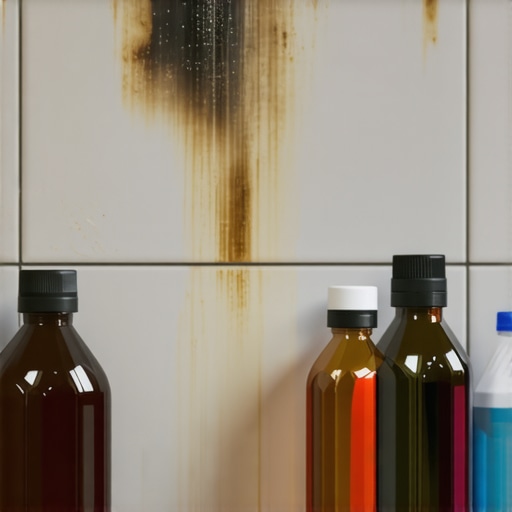
Most guys skip the leveling compound. They think the underlayment will hide the dip. It won’t. I spent three days grinding concrete on a job last month just so the floor wouldn’t click like a castanet because the previous installer thought a thick pad would mask a sloppy substrate. That kind of shortcut is exactly why your shower is failing. You think you are being clean by using vinegar, but you are actually performing a slow motion demolition of your home’s structural integrity. I have seen thousand dollar tile jobs turn into mushy, moldy disasters because of a bottle of salad dressing. Cleaning with acid is a death sentence for Portland cement. [IMAGE_PLACEHOLDER]
The acid trap in your morning routine
Vinegar contains acetic acid which reacts chemically with the calcium carbonate in cementitious grout to create a soluble salt called calcium acetate. This chemical reaction strips the binding agents from the grout, increasing its porosity and allowing water to penetrate the subfloor. Once the grout becomes porous, it no longer acts as a water shedding surface, but as a sponge that pulls moisture into the thin-set and backer board below.
Why vinegar acts as a solvent on Portland cement
The high acidity of vinegar, typically sitting at a pH of two point five, dissolves the alkaline bonds of cement based products on contact. Grout is essentially a mixture of sand and cement. The cement acts as the glue. When you introduce an acid, you are dissolving the glue that holds the sand particles together. Over time, this leads to sanding, which is when the grout starts to crumble out of the joints in a gritty powder. This is not just an aesthetic issue. It is a failure of the assembly.
The chemistry of grout disintegration
The molecular breakdown of grout occurs when the hydrogen ions in the acetic acid displace the calcium ions in the cement paste. This leads to a loss of structural density. As the density drops, the grout loses its compressive strength. In a shower environment, this means every time you step on a tile, the grout is less able to resist the micro-movements of the floor. Eventually, the bond between the tile and the grout snaps.
“A floor is only as good as the subfloor beneath it; deflection is the enemy of every joint.” – Master Flooring Axiom
Hardwood floors in the splash zone
Hardwood floors located near a failing shower will experience cupping and crowning as the moisture from the leaking grout migrates through the wall studs and subfloor. Wood is a hygroscopic material, meaning it absorbs water from its environment. If your shower grout is compromised by vinegar use, the water behind the tile will find the easiest path of travel. Often, that path leads directly to the plywood subfloor of the adjacent hallway or bedroom, where your expensive oak planks will begin to warp.
The laminate moisture lie
Laminate flooring marketed as waterproof is often only resistant to top down spills, not the systemic moisture vapor transmission caused by a failing shower pan. When grout fails due to acid erosion, the water saturates the substrate. This moisture then moves laterally under the transitions. Laminate cores are typically made of high density fiberboard which acts like a wick. Once the edges of those boards absorb acidic moisture, the melamine wear layer will begin to peel and the joints will peak.
The 1/8 inch that ruins everything
A gap of just one eighth of an inch in your grout or a hairline crack caused by acid erosion is enough to allow gallons of water into your floor joists over a year. Most people ignore the small cracks. They think a little extra vinegar will kill the mold growing in them. In reality, the vinegar is making the crack wider. I have seen floor joists rotted through because a homeowner spent five years cleaning their shower with a vinegar and water mix, thinking they were being eco friendly.
How to save your shower floor from a slow death
To preserve your grout you must use pH neutral cleaners specifically formulated for stone and tile to maintain the integrity of the cementitious bond. Stop using household acids immediately. If your grout is already chalky or soft, the only real fix is to rake it out and replace it with a high performance epoxy or pre mixed resin grout that is resistant to chemical attack.
“The presence of moisture in the subfloor is the primary cause of flooring failure, accounting for over 75 percent of all claims.” – NWFA Technical Publication
| Material Type | pH Sensitivity | Recommended Cleaner | | :— | :— | :— | | Portland Grout | High | pH Neutral Soap | | Epoxy Grout | Low | Alkaline Detergent | | Ceramic Tile | Low | Neutral Cleaner | | Natural Stone | Extreme | Stone Soap |
The technical reality of moisture vapor
Moisture vapor transmission rates increase significantly when the surface tension of the grout is destroyed by acidic etching. In the humid climates of the Southeast, this is a nightmare. The humidity already keeps the subfloor at a high moisture content. Adding a steady leak from an etched shower floor will push the wood past its fiber saturation point. This leads to dry rot and structural failure that insurance often will not cover because it is considered a maintenance issue.
- Inspect grout for pinholes or sandy texture every six months.
- Test your cleaner with a pH strip to ensure it is between seven and eight.
- Apply a high quality penetrating sealer annually to reduce porosity.
- Never mix vinegar with bleach as it creates toxic chlorine gas.
- Switch to a squeegee to remove bulk water after every shower.
The ghost in the expansion gap
Movement joints at the perimeter of the shower must be filled with one hundred percent silicone rather than grout to allow for the natural expansion of the house. If you have grout in the corners where the walls meet the floor, the vinegar will eat that grout even faster because those joints are already under stress. Silicone is unaffected by vinegar, but the grout right next to it will fail, creating a ghost leak that you won’t see until the ceiling below starts to sag.