
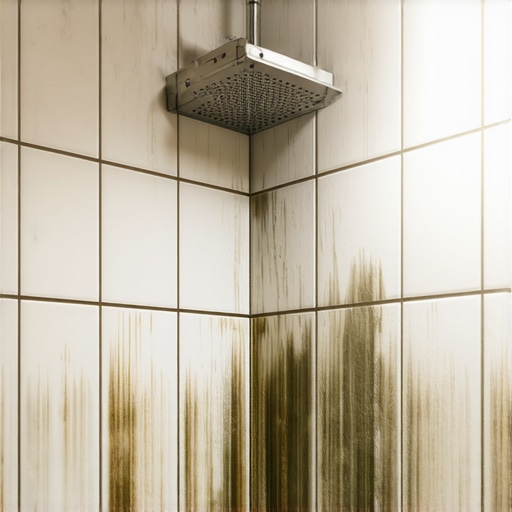
I spent three days grinding concrete on a job last month just so the floor wouldn’t click like a castanet. Most guys skip the leveling compound. They think the underlayment will hide the dip. It won’t. I have seen it all. I have walked into bathrooms where the homeowner spent a fortune on marble tile only to find black mold blooming like a dark garden in every corner within six months. They always point at the ceiling. They say the exhaust fan is running. They say they paid for the high CFM model that sounds like a jet engine. It does not matter. The fan is a secondary defense. The real battle is happening in the microscopic pores of your subfloor and the chemical composition of the grout you chose. If your grout is moldy, the problem is not the air. The problem is the physics of moisture trapped beneath the surface. I have spent 25 years with a moisture meter in my hand. I know that a floor is more than a surface. It is a structural assembly that either breathes or rots.
The false security of exhaust ventilation
Exhaust fans only manage atmospheric humidity and cannot extract liquid water trapped within porous cementitious grout or saturated backer boards. Mold thrives in stagnant zones where evaporation is blocked. When you shower, water enters the grout through capillary action. The fan clears the steam from the mirror, but it does not reach the moisture tucked behind the tile. This is why grout stays damp for hours. If your installer used a standard cement grout without a high performance sealer, you have essentially installed a hard sponge on your walls. The water sits there. It breeds. The exhaust fan is effectively trying to dry a wet basement by opening a window on the second floor. It is the wrong tool for the job. You need to understand the moisture vapor transmission rate of your wall assembly.
The chemistry of cement grout and fungal growth
Standard grout is a calcium carbonate based material that possesses a high porosity level which provides the perfect anchor for fungal spores. At a molecular level, cement grout is a forest of crystalline structures. These crystals have gaps between them. These gaps are measured in microns. Mold spores are also measured in microns. When water carries organic matter like skin cells or soap scum into these gaps, you have a self sustaining ecosystem. Even if you scrub the surface, the roots of the mold remain deep inside the grout line. This is why the mold returns a week after you clean it. You are only trimming the grass while the roots stay fed. To stop this, you have to change the chemistry of the grout or the permeability of the surface. You must move away from basic cement products and toward epoxy or high performance polymers that do not absorb water.
“A floor is only as good as the subfloor beneath it, deflection is the enemy of every joint.” – Master Flooring Axiom
The physics of capillary suction in shower stalls
Water moves through grout lines via capillary action which pulls liquid deep into the substrate even against the force of gravity. Think of a paper towel dipped in water. The liquid climbs up. This is exactly what happens in your shower. If the waterproofing membrane behind the tile is not perfect, that water reaches the subfloor. Once the subfloor is wet, the grout will never stay dry. The exhaust fan can run for 24 hours a day and it will never pull that moisture back through the tile. This is the structural reality that most homeowners ignore. They focus on the color of the tile. I focus on the hydrostatic pressure and the vapor drive. If your subfloor is plywood or an improperly sealed concrete slab, you are fighting a losing war against biology.
How moisture migration affects laminate and hardwood floors
Adjacent flooring like laminate and hardwood floors will eventually fail if the shower moisture is allowed to migrate through the subfloor or wall cavity. I once walked into a house where a walnut floor was cupping so bad it looked like a potato chip. The homeowner thought it was a leak. It was not a leak. It was vapor drive from a poorly sealed shower in the next room. The humidity in the bathroom was so high that the wood absorbed the moisture through the drywall. Hardwood has a cellular structure. It is composed of tracheids and parenchyma cells that act like straws. When those cells get wet, they expand. Laminate is even worse because the core is often compressed sawdust. One drop of water from a moldy shower transition can make a laminate plank swell until the wear layer snaps. You cannot separate the shower from the rest of the house. It is all one interconnected thermal and moisture envelope.
| Material Type | Porosity Level | Mold Resistance | Acclimation Needs |
|---|---|---|---|
| Standard Cement Grout | High | Low | None |
| Epoxy Grout | Near Zero | High | Temperature Sensitive |
| Solid Hardwood | Variable | Moderate | 7 to 14 Days |
| Laminate Flooring | Low Surface | Low Core | 48 Hours |
The myth of the waterproof grout sealer
Most retail grade grout sealers are breathable membranes that allow vapor to pass through while only repelling liquid droplets on the immediate surface. Do not trust a bottle that costs ten dollars at a big box store. Those sealers wear off. They are temporary. If you want a mold proof shower, you need to use a penetrating sealer that chemically bonds with the silicate in the cement. Better yet, you should use epoxy grout. Epoxy is a plastic. It does not have pores. It does not have a pH that mold likes. It is harder to install. It is sticky. It requires a fast hand and a lot of water for cleanup. But it is the only way to ensure the grout stays as clean as the day it was installed. I have seen guys try to paint over moldy grout. It never works. The gas produced by the mold will just bubble the paint. You have to remove the source of the moisture.
“Moisture migration from wet areas into adjacent wood flooring zones is a primary cause of cupping and adhesive failure in residential installations.” – Master Flooring Axiom
The five point grout integrity audit
- Check for hairline cracks in the corner joints which indicate structural deflection.
- Use a moisture meter to test the drywall on the opposite side of the shower wall.
- Inspect the transition between the tile and the laminate or hardwood for swelling.
- Perform a water bead test to see if your sealer is still functioning.
- Verify that the weep holes in your shower drain are not clogged with thin set.
The structural danger of the 1/8 inch gap
A gap as small as 1/8 inch in your caulking or grout can allow several gallons of water to enter the subfloor over a single month of showering. This is the 1/8 inch that ruins everything. Once that water is under the tile, it cannot escape. It sits on the waterproofing membrane. If that membrane has a single pinhole, the water goes into the wood. Then the mold starts. Not just on the grout, but inside the wall. You will smell it before you see it. It smells like wet earth and old socks. That is the smell of your house being eaten. You can turn on the exhaust fan all you want, but it will not stop the rot inside the framing. You have to be a stickler for the details. You have to use the right materials. You have to respect the physics of water. Flooring is not a decoration. It is a performance surface. If you treat it like a rug, you will be calling me in three years to tear it all out and start over. Build it right the first time and you will never have to worry about what is growing in your grout.