
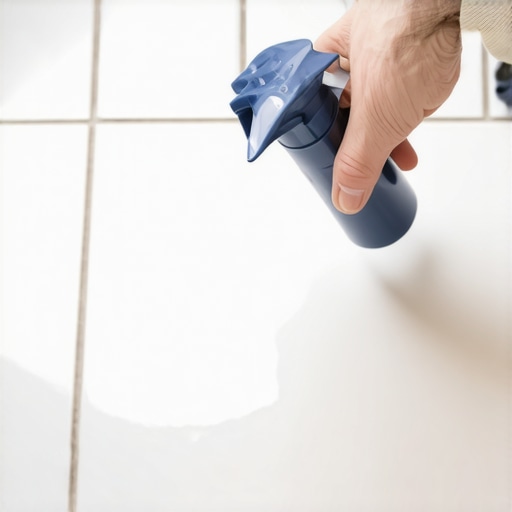
Most guys skip the leveling compound. They think the underlayment will hide the dip. It won’t. I spent three days grinding concrete on a job last month just so the floor wouldn’t click like a castanet. That job was for a high-end client who had already seen two previous installers walk away because they couldn’t get the subfloor within the 1/8 inch tolerance required for large format tile. If the foundation is a lie, every layer you put on top of it is just a more expensive lie. I have spent 25 years on my knees with a moisture meter and a level, and if there is one thing I have learned, it is that the cheapest tool in your bucket might be the one that saves the entire project. This brings me to the spray bottle sitting in the bargain bin of your local hardware store. For a single dollar, you can solve the most frustrating part of a tile installation, which is the uneven application of grout sealer that leaves behind those ugly, dark blotches.
The ghost in the expansion gap
Grout sealer application requires a uniform distribution of liquid polymers to penetrate the microscopic pores of Portland cement. A common mistake involves using those tiny roller-ball applicators that come on the bottles. They are garbage. They clog, they skip, and they apply too much pressure in one spot while leaving the adjacent area bone dry. When you use a simple spray bottle, you create a pressurized mist that settles into the grout line with surgical precision. This is not about being cheap, it is about controlling the physics of the liquid. Grout is a porous matrix of sand and cement. When it is dry, it acts like a sponge. If you apply sealer unevenly, the cement absorbs different amounts of the chemical, leading to a splotchy finish that looks like the floor is perpetually damp. The spray hack ensures that every square millimeter of that grout joint receives the same volume of product at the same velocity. You are basically industrializing a process that most people try to do with a toy.
“A floor is only as good as the subfloor beneath it; deflection is the enemy of every joint.” – Master Flooring Axiom
Why your subfloor is lying to you
Subfloor deflection and moisture vapor transmission rates are the primary causes of grout failure and sealer rejection. Before you even think about that spray bottle, you need to understand what is happening under the tile. If your subfloor has too much flex, also known as deflection, the grout will crack regardless of how well you seal it. The industry standard for ceramic tile is L/360, which means the floor should not bend more than the length of the span divided by 360 when under a full load. For natural stone, it is L/720. I have seen guys try to install heavy marble on a bouncy plywood subfloor and then wonder why the grout is turning to powder. It is because the floor is moving and the grout is not. Once that grout cracks, your sealer is useless. Moisture will find its way into the thin-set, the bond will break, and your beautiful shower or kitchen floor will start to sound like a bowl of cereal when you walk on it. You need to check for moisture too. A concrete slab might look dry, but it could be pumping out pounds of water vapor every day. If you seal grout over a wet slab, you are just trapping that moisture, which leads to efflorescence, that white, salty crust that ruins the look of your grout lines.
The one dollar hardware store solution
The spray bottle method utilizes a fine mist setting to achieve a saturated grout joint without the mechanical friction of a roller. To do this right, you fill a clean spray bottle with a high-quality solvent-based sealer. I prefer solvent over water-based for deep penetration, especially in showers where the water exposure is constant. You set the nozzle to a medium-fine mist. You do not want a stream that splashes, and you do not want a fog that floats away. You want a controlled spray that is about three inches wide. You walk backward, spraying the grout lines in a steady motion. The sealer will pool slightly on the tile surface, but that is fine. After about ten minutes, you come back with a microfiber mop and wipe the excess off the tile faces. Because you sprayed it, the sealer has already dived deep into the cement pores. You are not pushing it around with a sponge; you are letting gravity and capillary action do the heavy lifting.
| Sealer Type | Longevity | VOC Level | Best Use Case |
|---|---|---|---|
| Penetrating (Solvent) | 5-10 Years | High | Natural Stone and Showers |
| Penetrating (Water) | 2-3 Years | Low | Interior Ceramic Tile |
| Film-Forming (Topical) | 1-2 Years | Medium | Decorative Slate |
The physics of capillary action
Capillary action is the movement of a liquid through a porous material due to the forces of adhesion, cohesion, and surface tension. When you mist a sealer over a grout line, the tiny droplets are pulled into the interstitial spaces between the sand grains. This is where the chemistry of the sealer matters. Most high-end sealers use fluoropolymers or silanes. These molecules are incredibly small, smaller than a water molecule. They line the walls of the grout pores and change the surface tension. Instead of the grout being “thirsty” for water, it becomes hydrophobic. It repels water. But the grout can still “breathe” air. This is the difference between a professional sealer and a cheap hardware store