
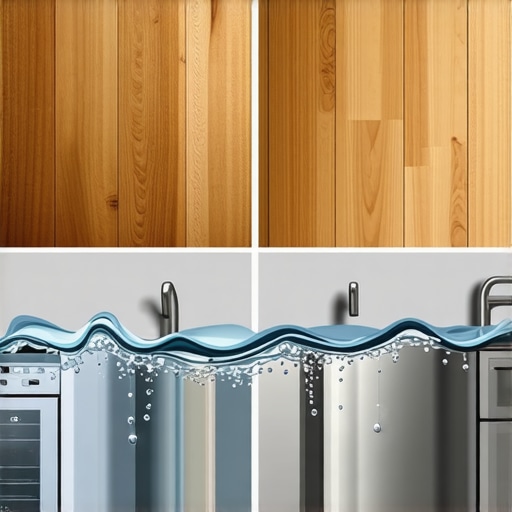
I still remember the smell of the Henderson job back in 2014. It was a mix of expensive French roast coffee and the sickly sweet scent of rotting particle board. They had a dishwasher line snap at three in the morning. By the time I arrived at eight, the entire kitchen floor looked like a series of miniature mountain ranges. A fifteen thousand dollar hardwood floor was cupping so severely that the planks were literally pulling the nails out of the plywood subfloor. The homeowner looked at me and asked if we could just sand it down once it dried. I had to be the one to tell them that the physics of wood cell expansion doesn’t work that way. Once the lignin in those oak fibers saturates and the cells rupture, you are not looking at a floor anymore. You are looking at expensive kindling. This is the reality of the kitchen floor battle. We are told that modern finishes make these surfaces invincible, but water is the ultimate solvent. It finds the path of least resistance. It travels through the microscopic pores of the grain and the tongue and groove joints. Whether you choose laminate or hardwood, you are essentially gambling against the plumbing in your walls. In this breakdown, we are going to look at why these materials fail and which one gives you a fighting chance when the pipes give out.
The lie of the waterproof label
The term waterproof in the flooring industry is often a marketing fabrication rather than a structural reality for most laminate products. When a manufacturer claims a laminate is waterproof, they are usually referring to the top wear layer and the tightness of the locking mechanism, not the core material itself. Most laminate is constructed from High-Density Fiberboard which is essentially compressed sawdust held together by urea formaldehyde resins. If water bypasses the surface tension and reaches that core, the fibers will swell like a sponge and they never return to their original dimensions. Hardwood is different because it is a single organic entity, but it possesses a cellular memory that causes it to warp in specific, predictable patterns when moisture levels exceed the fiber saturation point. You cannot ignore the hydrostatic pressure that builds up when water gets trapped between the flooring and the subfloor. This pressure pushes moisture upward through the material, attacking the finish from the underside where there is no protection. It is a slow motion disaster that usually starts in the expansion gaps tucked under your baseboards.
The biology of a buckling board
Hardwood is a living material even after it is milled into planks. At a molecular level, wood is composed of cellulose, hemicellulose, and lignin. These components are hygroscopic. They naturally want to reach an equilibrium with the humidity of the surrounding environment. When a kitchen floods, the bottom of the plank absorbs water faster than the top. This creates a moisture gradient. The bottom cells expand significantly while the top cells, protected by a polyurethane or oil finish, remain relatively stable. This imbalance is what causes cupping. The edges of the board rise higher than the center. If the flood is severe enough, the wood reaches its elastic limit and the internal structure collapses. Even if you bring in industrial dehumidifiers, the wood will likely crown as it dries, which means the center will now be higher than the edges. It is a permanent deformation. Solid hardwood is particularly vulnerable because it lacks the cross-grain stability of engineered products. You are dealing with a material that wants to move, and when you add several gallons of water to the equation, that movement becomes violent enough to shear fasteners or buckle subflooring.
“A floor is only as good as the subfloor beneath it; deflection is the enemy of every joint.” – Master Flooring Axiom
The chemistry of the laminate core
Laminate flooring is a marvel of engineering until it meets a puddle. The top layer is a melamine resin over a photographic paper, which is incredibly durable against scratches but offers no structural integrity. The High-Density Fiberboard core is the weak point. In many cheap laminates, this core is not sufficiently treated with water repellent chemicals. When water hits the seam, it enters through capillary action. The wood fibers inside the HDF core absorb the liquid and the resin bonds begin to fail. This leads to edge swelling, also known as peaking. Unlike hardwood, which you can sometimes salvage with professional drying equipment, laminate is a total loss once the core swells. There is no sanding it down. There is no flattening it out. The decorative paper layer will delaminate from the core as the bond breaks. If you are choosing laminate for a kitchen, you must look for products with a wax-infused locking system. This wax acts as a temporary barrier, giving you maybe twenty-four to forty-eight hours to clean up a spill before the water penetrates the core. But in a full-scale flood, the wax is useless. The water will simply go under the baseboards and attack the HDF from the perimeter where there is no wax at all.
The ghost in the expansion gap
Every professional installer knows that the expansion gap is the most important part of the job. For a kitchen floor, we usually leave a quarter to a half inch of space around the entire perimeter. This is hidden by your baseboards and shoe molding. This gap allows the floor to breathe as seasons change. However, during a flood, this gap becomes a funnel. Water flows off the surface and straight into this perimeter channel. It then gets trapped between the flooring and the moisture barrier or the subfloor. This is where the real damage happens. In many modern homes, the kitchen is adjacent to a bathroom or laundry room. If you have tile in those areas, the water will travel across the subfloor and begin to affect the grout and thinset of the neighboring rooms. I have seen kitchen floods cause grout to crack in a bathroom fifteen feet away because the plywood subfloor swelled and shifted the entire plane of the house. You have to think of your floor as a single interconnected system. When one part moves, the rest feels the stress.
| Material Property | Solid Hardwood | Engineered Hardwood | Standard Laminate | Waterproof Laminate |
|---|---|---|---|---|
| Core Composition | Solid Timber | Plywood Layers | HDF / Wood Flour | Treated HDF / PVC |
| Water Absorption Rate | Medium | Low-Medium | Very High | Low |
| Expansion Style | Cupping / Crowning | Minimal Warping | Edge Peaking | Joint Swelling |
| Salvage Potential | 30% to 50% | 10% to 20% | 0% | 5% |
| Drying Time | 7 to 14 Days | 5 to 10 Days | Never Dries Correctly | 3 to 5 Days |
Why your subfloor is lying to you
When you look at a dry floor after a flood, you might think you escaped the worst. But the subfloor is likely holding onto moisture like a reservoir. Whether you have an OSB (Oriented Strand Board) or plywood subfloor, these materials are even more susceptible to water damage than the finished floor. OSB is particularly notorious. The edges of OSB will swell and never return to their original thickness, creating a permanent hump in your floor. If you install new flooring over a subfloor that hasn’t been dried to within 2 percent of the flooring’s moisture content, you are guaranteeing a failure. I always use a pin-style moisture meter to check the subfloor in at least twenty different spots. If I see a reading above 12 percent, I am not laying a single plank. You have to run air movers and commercial grade dehumidifiers. If the water was sitting for more than twenty-four hours, the subfloor might have already started to grow mold. This is why a kitchen flood is often an insurance nightmare. It is not just about the boards you see. It is about the structure you don’t see.
“Wood flooring will perform best when the environment is controlled; moisture is the primary cause of all structural flooring failures.” – NWFA Technical Guidelines
The kitchen island as an anchor of destruction
One mistake I see homeowners make constantly is installing a heavy kitchen island on top of a floating laminate floor. This is a recipe for disaster during a flood. A floating floor needs to be able to move as a single unit. When you bolt an island through the laminate and into the subfloor, you are pinning that floor down. If a flood occurs and the floor tries to expand, it can’t move outward. Instead, it will buckle upward at the weakest point, usually in the middle of a walkway. This creates a trip hazard and snaps the locking mechanisms. Hardwood is usually nailed down, so it doesn’t have this specific floating issue, but the pressure of the expanding wood against a fixed island can actually shift the island or crack the cabinetry. If you are going with laminate, the island must be installed first, and the floor should be cut around it with an expansion gap. Never pin a floating floor. It will buckle. It is a mathematical certainty.
The 1/8 inch that ruins everything
In the flooring world, we live and die by the 1/8 inch rule. Over a ten-foot span, a subfloor cannot have a deviation of more than 1/8 of an inch. Most people think this is just about how the floor feels underfoot. It isn’t. It is about the integrity of the joints. If there is a dip in the subfloor and you have a flood, the water will pool in that low spot. Long after you have mopped up the surface, that pool of water is sitting under your laminate or hardwood, slowly rotting the core or the underside of the plank. This is why I spend more time on subfloor prep than on the actual installation. I use self-leveling compounds and grinders to ensure that the plane is perfectly flat. If the subfloor is flat, the flooring joints stay tight. If the joints are tight, water has a harder time getting in. It is your first line of defense. Most guys skip the leveling compound. They think the underlayment will hide the dip. It won’t. It will only compress and cause the floor to bounce, which eventually breaks the tongue and groove, opening a doorway for moisture.
- Shut off the main water valve immediately to stop the flow.
- Remove all baseboards and shoe moldings to allow the perimeter to breathe.
- Use a wet-vac to extract every drop of standing water from the surface.
- Set up high-velocity air movers to blow air across and under the floor if possible.
- Check the moisture content of the subfloor using a professional meter.
- Consult with a flooring professional before assuming the floor can be saved.
- Document everything with photos for insurance purposes.
The regional climate factor
Where you live changes how your floor reacts to a flood. In a high humidity environment like New Orleans or Houston, a flooded hardwood floor is almost impossible to save because the ambient air is already saturated. The wood has nowhere to release its moisture. In a dry climate like Phoenix or Denver, you might have a better chance of drying out a solid hardwood floor, but you run the risk of drying it too fast, which causes the wood to check and crack. Regional building codes often dictate the type of moisture barrier required. In many coastal areas, a 6-mil poly film is mandatory under any floating floor. This film can actually save your subfloor from a minor spill, but in a flood, it can also trap water against the bottom of your laminate, ensuring its destruction. You have to understand the local physics of your home. A basement kitchen in a damp climate faces different risks than a second-story kitchen in a dry climate. Always adapt your materials to your geography.
The final reality of the kitchen floor
Choosing between laminate and hardwood for a kitchen comes down to your risk tolerance. Hardwood offers a path to restoration through professional drying and refinishing, provided the damage isn’t catastrophic. It is a long-term investment that can survive decades if treated with respect. Laminate is a sacrificial floor. It is cheaper to install and more resistant to daily scratches, but it is a single-use product when it comes to water. Once it is saturated, it is trash. If you want a floor that survives a flood, you should probably be looking at luxury vinyl plank with a stone polymer core or traditional porcelain tile. But if you insist on the look and feel of real wood or the cost-effectiveness of laminate, you must accept the structural vulnerability. Keep your plumbing in check, watch your dishwasher for leaks, and never trust a salesperson who tells you that wood and water are friends. They are not. They are in a constant state of war, and water usually wins the long game. Take care of your subfloor, respect the expansion gaps, and always keep a moisture meter in your toolbox. Your floor depends on it.