
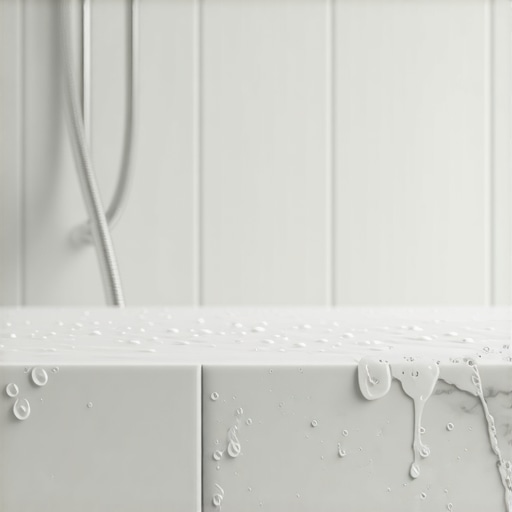
Most guys skip the leveling compound. They think the underlayment will hide the dip. It won’t. I spent three days grinding concrete on a job last month just so the floor wouldn’t click like a castanet. That same philosophy of precision applies to the vertical surfaces of your bathroom. If you think a shower niche is just a hole in the wall to hold your shampoo, you are already inviting mold to live in your wall. A shower niche must have a slight downward pitch on the bottom shelf to ensure that gravity pulls every drop of water back toward the drain. Without that 1/8 inch slope, water sits. It stagnates. It eats through your grout and eventually finds a microscopic path into your wall cavity.
The physics of standing water in wet areas
Standing water in a shower niche occurs when the bottom shelf is perfectly level or tilted backward. This creates a pool that saturates the grout joints and increases the hydrostatic pressure on the waterproofing membrane. Gravity is the only constant in a shower environment. If the surface does not provide a path for evacuation, surface tension will keep water trapped against the corners where the wall meets the shelf. This is where most failures begin. When water sits, it carries soap scum and skin cells into the pores of the grout. Over time, this organic matter decays. You see it as pink mold or black spots that no amount of scrubbing can truly remove because the rot is happening from the bottom up. A positive pitch of approximately 1/8 inch to 1/4 inch across the depth of the niche shelf is enough to break that surface tension and keep the area dry between uses.
“A floor is only as good as the subfloor beneath it; deflection is the enemy of every joint.” – Master Flooring Axiom
The chemistry of grout and moisture absorption
Grout is inherently porous and acts like a hard sponge that pulls moisture into the assembly through capillary action. Even high performance epoxy grouts can have microscopic voids where water can linger if the shelf is not pitched correctly. In a standard cementitious grout, the mineral structure contains thousands of tiny tunnels. When water sits on a flat niche shelf, it does not just stay on top. It migrates downward. If the waterproofing behind the tile was done poorly, that moisture reaches the wall studs. This is why I always use a liquid applied membrane or a bonded fleece membrane over a sloped mortar bed. You cannot rely on the tile alone to be waterproof. The tile is merely the aesthetic skin. The pitch of the shelf ensures that the bulk of the water leaves the skin quickly, reducing the workload on the underlying membrane.
Why your subfloor is lying to you
The stability of your shower niche is directly tied to the structural integrity of the wall studs and the subfloor beneath the shower pan. If your subfloor has too much deflection, the entire wall assembly can shift. This movement creates hairline cracks in the grout of your niche. I have seen beautiful custom niches ruined because the installer did not check the joist spacing or the plywood thickness. You can have the perfect pitch on your shelf, but if the house settles or the floor flexes, that pitch can disappear. When I prep a bathroom, I am looking at the L/360 rating of the floor. This is a measurement of how much the floor bends under a load. For natural stone in a niche, you actually want L/720, which is twice as stiff. If you do not have that rigidity, your pitched shelf becomes a flat shelf, and your flat shelf becomes a reservoir for leaks.
| Surface Type | Required Pitch Per Foot | Recommended Material | Drying Time |
|---|---|---|---|
| Shower Floor | 1/4 Inch | Sloped Mortar Bed | 24 to 48 Hours |
| Niche Bottom Shelf | 1/8 to 1/4 Inch | Solid Stone or Quartz | 12 to 24 Hours |
| Thresholds | 1/8 Inch | Marble or Granite | 24 Hours |
| Bench Seats | 1/4 Inch | Cement Board with Membrane | 24 Hours |
The ghost in the expansion gap
Expansion gaps are required where different planes of tile meet, such as the corners of a shower niche or where the wall meets the floor. These gaps must be filled with 100 percent silicone sealant, not hard grout. Hard grout will crack at these change of plane locations. If your niche shelf is not pitched, water will sit directly on this silicone bead. While silicone is waterproof, it is not invincible. Constant submersion or standing water can lead to seal failure or the growth of mildew behind the silicone. By pitching the shelf, you ensure that the joint where the shelf meets the back wall remains dry. This extends the life of your sealant by years. It also prevents water from wicking behind the tile through the inevitable hairline cracks that form in cement grout over time.
Materials that fail in wet environments
Using the wrong materials for a niche shelf is a recipe for a catastrophic failure within five years. I see people try to use laminate remnants or porous wood look tiles for niche shelves without proper sealing. Laminate has no place in a shower. Even waterproof laminate floors are only rated for surface spills, not the constant humidity and direct spray of a shower. For a niche shelf, I always recommend a solid piece of quartz or marble. A solid surface has no grout lines on the horizontal plane. This removes the most common point of failure. When you install a solid piece, you can easily grind the underside to create a drip edge. This prevents water from running down the wall tile underneath the niche, further protecting the integrity of the shower wall.
- Always use a solid surface for the bottom shelf to eliminate horizontal grout lines.
- Verify the pitch with a small torpedo level before the thin-set hardens.
- Ensure the waterproofing membrane extends at least six inches beyond the niche opening.
- Use 100 percent silicone in all corners and change of plane joints.
- Check the manufacturer instructions for thin-set to ensure it is rated for submerged or wet environments.
“The Tile Council of North America requires a slope on all horizontal surfaces in wet areas to ensure proper drainage and prevent water accumulation.” – TCNA Handbook Standards
The 1/8 inch that ruins everything
A shelf that is off by just a fraction of an inch can lead to thousands of dollars in structural rot. I once worked on a remediation job in a high rise where the installer had tilted the niche shelf backward toward the wall. The water had been running into the wall for three years. By the time I got there, the metal studs were corroded and the drywall in the bedroom next door was soft to the touch. This is the danger of the aesthetic approach. The installer wanted the niche to look square to the eye, but the eye is a terrible judge of drainage. You have to use a level. You have to plan for the thickness of the thin-set. If your tile is thick, like a handmade subway tile, the variations in the clay can hide a back pitch. You must compensate for this during the setting process.
Regional climate impacts on shower longevity
The humidity levels in your specific region dictate how quickly a shower can dry out between uses. In a place like New Orleans or Houston, the air is often saturated. If your niche shelf is flat, the water will never evaporate. It just stays there, keeping the grout in a state of constant saturation. In a dry climate like Phoenix, you might get away with a minor error for longer, but the principle remains the same. High humidity environments require even more aggressive pitching and better ventilation. I tell my clients that their shower is a machine. If you do not maintain the parts and ensure the drainage is perfect, the machine will break down. This is why I am so obsessed with the subfloor and the structural prep. If the bones of the house are moving because of seasonal humidity shifts, your tile work will suffer. Hardwood floors in the rest of the house can tell you a lot about the moisture levels in a home. If you see wide gaps in the oak floors in the hallway, you know that the house is drying out too much, which can lead to shrinking and cracking in the bathroom tile assemblies as well.
The myth of the waterproof grout
No grout is completely waterproof in the way that a sheet of glass is waterproof. People buy the most expensive grout on the market and assume they can skip the pitch on the niche shelf. This is a lie. Even the best epoxy or urethane grouts are only as good as the bond they form with the tile. If water sits on the grout line for hours, it will eventually find a way through. The chemical bond of thin-set is also affected by constant moisture. Standard thin-set is a cement product. If it stays wet, it can lose its structural bond over a period of decades. This is why we see tiles popping off the walls in old showers. The pitch is your first line of defense. The waterproofing membrane is your second. The grout is just there to look pretty and keep the tiles from rubbing together. If you treat the grout as your primary water barrier, you have already lost the battle.
The correct way to install a sloped niche
To get the pitch right, you must start with the framing. I shim the bottom plate of the niche framing before the backer board ever goes up. This gives me a built in slope that is consistent. Then, when I apply my waterproofing, I make sure there are no puddles of liquid membrane in the corners. When it comes time to set the tile, I use a slightly thicker bed of thin-set at the back of the shelf and a thinner bed at the front. This allows me to fine tune the 1/8 inch slope. I always test it with a spray bottle before I call the job finished. If I see the water bead up and roll out of the niche, I know I can sleep at night. If the water sits there, I pull the tile and start over. It is that simple. There are no shortcuts in waterproofing. You either do it right or you do it twice. And doing it twice is a lot more expensive than taking an extra ten minutes to check your level. Avoid the mistake of thinking that because a shower niche is small, it is not a major part of the plumbing system. It is. It is a catch basin that must be integrated into the overall drainage plan of the room. When you respect the physics of water, your tile work will last a lifetime.