
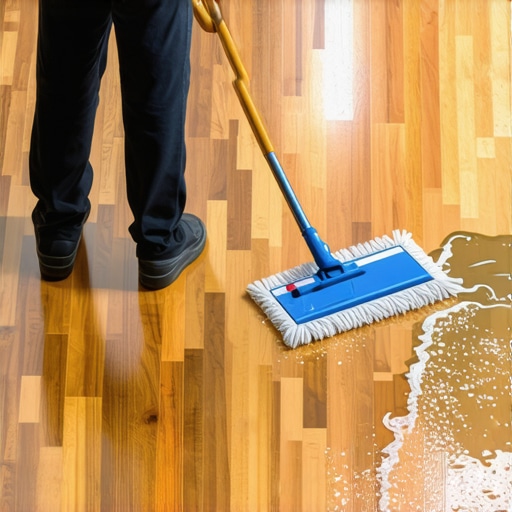
The microscopic reality of moisture absorption in high density fiberboard
Laminate flooring utilizes a High Density Fiberboard core made of compressed cellulose fibers and phenolic resins that react violently to liquid saturation. When you apply excessive water, you trigger a process known as capillary action where moisture is sucked into the joints. This causes the wood fibers to expand at a molecular level beyond their structural capacity. I have seen it a thousand times. Homeowners treat their floors like a bathroom tile, but the reality is much more fragile. Most people think their floors are solid plastic because of the top wear layer. They are wrong. Beneath that thin film of aluminum oxide lies a thirsty heart of sawdust and glue. I once walked into a house where a three thousand dollar laminate installation looked like a rolling mountain range. The owner was proud of how clean she kept it with a soaking wet mop every Saturday. She did not realize she was essentially injecting water into the veins of her floor. The core had swollen so much that the locking mechanisms had snapped under the internal pressure. It was a total loss. You cannot just dry out a floor once the HDF core has expanded. It is a permanent structural change. The fibers lose their bond and the floor loses its integrity. This is why professional installers focus on the chemistry of the materials rather than just the aesthetics. We know that water is the universal solvent and it is patient. It will find every micro gap in your installation. If you are not careful, you are just waiting for a disaster to happen. The way we manufacture these boards involves heat and pressure, but that pressure is a stored energy that water releases in the worst way possible.
Why your locking joints are the weakest link in the system
The tongue and groove locking mechanism represents the most vulnerable entry point for moisture because it lacks the protective wear layer found on the surface. When liquid sits on a seam, it bypasses the melamine shield and hits the raw fiberboard core directly. This results in edge peaking where the edges of the planks rise up. I spent three days grinding concrete on a job last month just so the floor would not click like a castanet, and that taught me that levelness is only half the battle. If your joints are not tight, water enters even faster. Many installers skip the perimeter sealant in kitchens and laundry rooms. That is a mistake that costs thousands. Even if your laminate is marketed as waterproof, that usually only refers to the surface for a limited number of hours. No floor is truly waterproof if it has seams. The chemistry of the bond between the top layer and the core is also at risk. Water weakens the adhesive layer, leading to delamination. Once the clear coat starts to peel, the photograph of the wood underneath is exposed to friction and dirt. You end up with grey, fuzzy edges that look terrible and feel even worse underfoot. It is a slow death for a floor that should have lasted twenty years. I always tell my clients that a damp rag is a tool, but a wet mop is a weapon of destruction. You have to respect the material. You have to understand that wood fibers, even when ground up and glued back together, still want to return to their natural state when they get wet. They want to grow.
“A floor is only as good as the subfloor beneath it; deflection is the enemy of every joint.” – Master Flooring Axiom
The difference between laminate and real hardwood floors in wet conditions
Solid hardwood flooring reacts to moisture by cupping or crowning across the entire width of the plank, whereas laminate failure typically manifests as localized edge swelling and internal core rot. Hardwood has the benefit of being a single species of organic material that can often be sanded and refinished after it dries out. Laminate is a composite. Once the layers separate, there is no fixing them. You can’t sand a photograph. You can’t sand plastic. I have seen guys try to use wood filler on swollen laminate seams. It looks like a child’s craft project and lasts about a week. The structural engineering of laminate is designed for vertical pressure, not lateral expansion from moisture. When the core swells, it pushes against the neighboring planks. Since the planks have nowhere to go because they are locked together, they lift off the subfloor. This creates a bouncy, hollow sound that drives homeowners crazy. It also puts immense stress on the baseboards and transitions. If you live in a high humidity area like New Orleans, your laminate is already fighting the air. Adding a wet mop to that environment is like pouring gasoline on a fire. You need to maintain a controlled climate to keep these floors stable. Any professional will tell you that a dehumidifier is a more important tool for floor maintenance than a mop bucket will ever be. We measure the moisture content of the subfloor before we ever open a box of material. If that concrete slab is pushing vapor, your floor is doomed before you even start.
| Material Type | Swelling Coefficient | Acclimation Time | Janka Rating equivalent |
|---|---|---|---|
| Standard Laminate | High (HDF Core) | 48 Hours | AC3 to AC5 |
| Engineered Hardwood | Medium (Plywood Core) | 72 Hours | 1200 to 1400 |
| Solid White Oak | Variable (Species Dependent) | 7 to 10 Days | 1360 |
| Luxury Vinyl Plank | Low (Stone Plastic Composite) | 24 Hours | N/A |
The ghost in the expansion gap and why it matters
The expansion gap around the perimeter of a room allows the floor to move as a single unit during seasonal changes in humidity. If you use too much water, the floor expands beyond the capacity of this gap, causing the entire surface to buckle against the walls. This is the hidden physics of flooring. It is not just about the boards you see. It is about the empty space you don’t see. Most DIY installers think they can run the floor tight to the drywall. They are wrong. You need at least a quarter inch, sometimes more depending on the run length. I have had to go back to jobs where other guys installed the floor and use a toe kick saw to cut an expansion gap because the floor had swelled so much it was lifting the kitchen island. Water makes this movement happen faster and more aggressively than air humidity ever could. When the floor hits the wall, something has to give. Usually, it is the locking joints that snap. Once those joints are gone, the floor is no longer a floating system. It is just a collection of loose boards. You also have to consider the underlayment. Many people buy the thickest, softest underlayment they can find thinking it will be more comfortable. In reality, too much cushion actually causes the locking mechanisms on laminate to snap under pressure. You need a firm, dense base. When you add water to a floor with too much flex, the joints open up even wider, allowing even more water to penetrate. It is a vicious cycle of mechanical failure.
“Laminate flooring requires a stable environment where relative humidity stays between 30 and 50 percent.” – NWFA Technical Guidelines
How to save a floor that has seen too much water in its life
Immediate moisture extraction is the only hope for a saturated laminate floor, though success rates are low once the core has started to expand significantly. You need to use a wet vacuum to pull every drop of liquid out of the joints before it can soak in. Then, you need high volume air movers and a commercial grade dehumidifier. Do not turn up the heat. High heat can cause the wear layer to warp or the adhesive to fail prematurely. You want dry, moving air. If you see the edges starting to lift, it might be too late. However, I have had some luck removing the baseboards and putting fans directly at the expansion gaps. This can sometimes pull enough moisture out of the core to stop the swelling. But let’s be honest. Most of the time, you are looking at a tear out. This is why I am so hard on my customers about their cleaning habits. I tell them to throw away the string mop. I tell them to get a microfiber pad and a spray bottle of approved cleaner. You should only ever mist the pad, not the floor. If the floor looks wet after you walk away, you used too much liquid. It should dry almost instantly. This is the only way to protect the investment you made in your home. You have to think like an engineer. You have to respect the physics of the material. If you treat your floor like a structural component of your house, it will last. If you treat it like a piece of plastic, it will fail you.
- Use a microfiber mop that is only slightly damp to the touch.
- Always wipe up spills immediately with a dry cloth.
- Never use a steam cleaner on any laminate or wood product.
- Keep your home humidity between 35 and 55 percent year round.
- Avoid using soaps or waxes that can leave a dulling residue on the melamine layer.
- Check your dishwasher and refrigerator for slow leaks regularly.
The chemical reality of cleaning agents and surface tension
The surface tension of plain water allows it to bead on the wear layer, but soaps and detergents break that tension and help the liquid penetrate the tightest seams. Many people use vinegar and water thinking it is a natural, safe cleaner. While it is better than harsh chemicals, the acidity can over time break down the protective resins in the wear layer. You are better off using a PH neutral cleaner designed specifically for laminate. These cleaners are engineered to evaporate quickly and not leave behind any moisture that could seep into the core. I have seen floors that were cleaned with bleach and water. The bleach actually ate through the photograph layer in spots where the water sat too long. It turned a beautiful oak look into a series of white splotches. You have to remember that you are cleaning plastic and resin, not real wood. The rules are different. You don’t want to nourish the floor. You just want to remove the dirt. In the world of flooring, less is always more. The more effort you put into wet cleaning, the more damage you are likely doing. I have been on my knees for twenty five years looking at these boards. I can tell you exactly how a person cleans their house just by looking at the seams of their floor. The sawdust under my nails doesn’t lie. If you want a floor that stays flat and quiet, keep it dry. That is the gold standard. Anything else is just a compromise that will eventually lead to a contractor like me coming in to rip it all out and start over. And that is an expensive lesson to learn.