
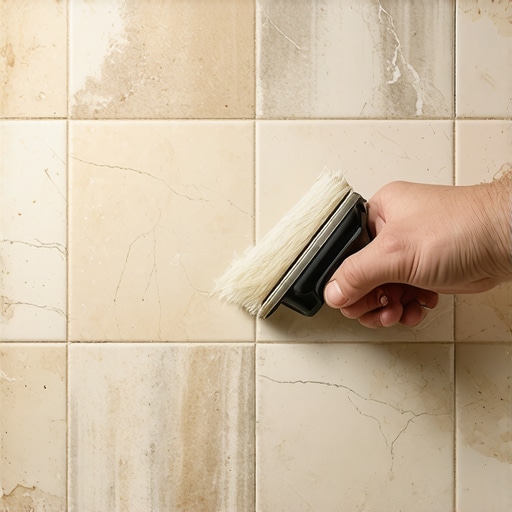
Most guys skip the leveling compound. They think the underlayment will hide the dip. It won’t. I spent three days grinding concrete on a job last month just so the floor wouldn’t click like a castanet. That job was for a high end marble installation. If I hadn’t spent those three days on my knees with a diamond cup wheel, those expensive slabs would have cracked within six months under the pressure of a standard footfall. This is the reality of stone. It is beautiful, it is permanent, and it is absolutely unforgiving of lazy craftsmanship. When you deal with natural stone in a bathroom, you are not just laying a floor. You are engineering a moisture management system that must survive constant thermal expansion and chemical exposure.
The invisible vulnerability of luxury materials
Natural stone tiles like marble, travertine, and slate possess a complex network of microscopic pores and capillaries that act as a vacuum for moisture. Without a high quality impregnating sealer, these stones will absorb water, soap scum, and skin oils. This absorption leads to permanent staining and the structural degradation of the stone matrix. Unlike laminate or ceramic, natural stone is a living material in a geological sense. It breathes. If you plug those pores with the wrong substance, or leave them wide open, you are inviting disaster. In a shower setting, the stakes are higher. The constant cycle of wetting and drying creates a pressure gradient that can force minerals to the surface, a process known as efflorescence, which looks like a white crusty salt deposit that ruins the aesthetic of your grout and tile alike.
Why your subfloor determines the fate of your tile
A stone floor is only as stable as the substrate it rests upon because stone has zero flexural strength. If your subfloor has even a 1/8 inch dip over ten feet, the stone will eventually bridge that gap and snap. I have seen million dollar homes where the marble in the master bath looks like a spiderweb because the builder thought standard plywood was enough. It is not. You need a rigid cement backer board or an uncoupling membrane to isolate the stone from the movement of the house. Unlike hardwood floors that can handle a bit of seasonal movement, stone demands absolute rigidity. Deflection is the enemy. If you can feel a bounce in your step, the floor is not ready for stone. I always tell clients that the money they spend on the subfloor is more important than the money they spend on the tile itself. You can replace a tile, but you cannot easily fix a failing foundation.
“A floor is only as good as the subfloor beneath it; deflection is the enemy of every joint.” – Master Flooring Axiom
The molecular reality of stone pores
The porosity of a stone is determined by its mineral composition and the geological pressure present during its formation. Sedimentary stones like travertine and limestone are incredibly porous. They are essentially sponges made of rock. Metamorphic stones like marble are slightly more dense, but they are still composed of calcium carbonate, which is highly reactive to acids. Even a drop of lemon juice or a harsh bathroom cleaner will etch the surface, creating a dull spot that no sealer can fully prevent. This is why we use impregnating sealers rather than topical coatings. A topical coating sits on top like a layer of plastic. It looks cheap and it peels. An impregnating sealer travels down into the capillaries, lining the pore walls with oleophobic and hydrophobic chemicals. This allows the stone to remain vapor permeable, meaning moisture can escape from the subfloor, while preventing liquid water from entering the stone from the top.
Critical benchmarks for stone protection
| Stone Type | Porosity Level | Sealer Frequency | Recommended Base |
|---|---|---|---|
| Marble | Medium | Every 12 Months | Solvent Based |
| Travertine | High | Every 6 Months | Water Based |
| Slate | Low to Medium | Every 18 Months | Solvent Based |
| Granite | Low | Every 24 Months | Solvent Based |
The 1/8 inch that ruins everything
Precision in grout joint spacing and sealer application determines the longevity of the entire bathroom system. If you crowd your tiles together without a proper grout joint, you leave no room for the house to move. Even the most rigid subfloor will experience microscopic shifts. Grout acts as a sacrificial lamb. It is designed to be the weakest point of the installation so it can take the stress. When you seal your stone, you must also seal the grout. Most people forget that grout is essentially liquid stone that hardens. It is just as porous, if not more so, than the tile itself. If you leave your grout unsealed in a shower, water will seep behind the tiles, rot the thin-set, and eventually grow mold in the wall cavity. I have ripped out showers that looked perfect from the outside but were black with mold inside because the installer skipped the sealer step on the grout lines.
Installation checklist for a lifetime floor
- Check subfloor deflection using a 10 foot straight edge to ensure no gaps larger than 1/8 inch.
- Verify moisture content of the concrete or wood substrate using a calibrated meter.
- Pre-seal porous stones like travertine before grouting to prevent grout haze staining.
- Apply the first coat of impregnating sealer using a lint free microfiber applicator.
- Allow the sealer to dwell for the manufacturer specified time, usually ten to fifteen minutes.
- Buff away any excess sealer before it dries to prevent a sticky residue.
- Conduct a water bead test 24 hours after application to verify protection.
The chemical bond of the penetrative sealer
Modern sealers use fluorocarbon aliphatic resins to create a tension barrier that repels both water and oil. These chemicals are engineered to bond with the silica or calcium within the stone. When you apply the sealer, the carrier liquid, which is either water or a solvent, evaporates, leaving the resin behind. Solvent based sealers generally have smaller molecular structures, allowing them to penetrate deeper into dense stones like granite. Water based sealers are better for very porous stones because they can carry more solids into the larger pores. One contrarian point to remember is that more is not always better. While most people want the thickest underlayment or the heaviest coat of sealer, too much cushion causes the locking mechanisms on laminate or LVP to snap, and too much sealer creates a milky film on stone that is a nightmare to remove. You want saturation, not a puddle.
“Natural stone must be allowed to breathe; trapping moisture beneath an impermeable barrier leads to spalling and structural failure.” – TCNA Handbook Standards
Regional moisture impacts on stone performance
The climate of your specific region changes how you must approach the sealing process. If you are in a high humidity area like Florida or the Gulf Coast, your stone will take longer to dry before it can accept a sealer. If you seal a damp stone, you are effectively trapping moisture inside. This leads to a cloudy appearance called moisture bloom. In dry climates like Arizona, the sealer might evaporate too quickly, not giving the resins enough time to bond with the stone. You have to work in smaller sections and keep the surface wet with the product. Always check the ambient humidity in the bathroom before you start. I keep a hygrometer in my kit for this exact reason. If the humidity is over sixty percent, I wait to seal. It is better to delay the job by a day than to have to strip and re-seal a cloudy floor.
The path to a permanent floor
Maintaining a stone bathroom is about consistency. You cannot use bleach or vinegar. Acidic cleaners will eat the sealer and then eat the stone. Use a pH neutral cleaner and a soft cloth. Every year, perform the water bead test. If the water stops beading and starts soaking into the stone, it is time for another coat. If you follow these rules, a marble or slate floor will outlive the house. It is a structural engineering challenge that pays off in a surface that never needs to be replaced. Don’t listen to the big box store employees who say stone is easy. It is hard work, it is technical, and it is the only way to build a bathroom that lasts forever.