
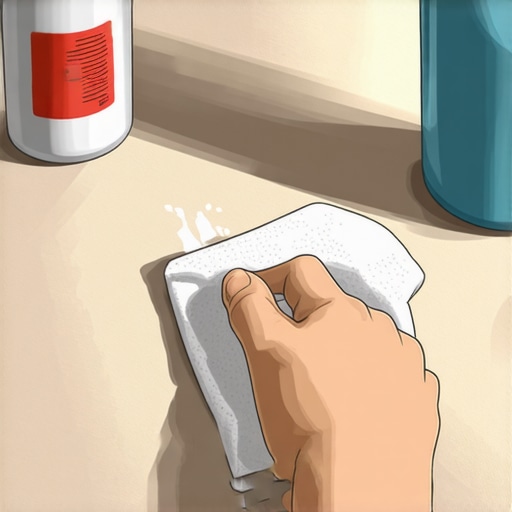
I have spent twenty-five years with my knees on the ground and sawdust in my pockets. I smell like wood wax and rubbing alcohol most days. Last year I walked into a kitchen where a homeowner had spent three thousand dollars on high-end laminate only to ruin it in an afternoon. She had used a metal putty knife to scrape up latex splatter. The result was a series of white gouges that cut straight through the wear layer into the decorative print. It looked like a cat had used the floor as a scratching post. You cannot fix a scratched wear layer. Once you break that aluminum oxide barrier, the floor is vulnerable to every drop of water that hits it. That is why we do not scrape. We use chemistry and patience instead.
The structural vulnerability of the melamine wear layer
Removing dried paint from laminate requires a deep understanding of the surface tension of the melamine resin and the aluminum oxide wear layer. Laminate is a multi-layered composite. The top layer is a transparent protective coating designed to resist abrasion, but it remains susceptible to sharp mechanical force and specific chemical solvents. This layer is usually a high-wear melamine resin infused with aluminum oxide particles. It is incredibly hard but thin. When paint dries on this surface, it forms a mechanical bond with the microscopic texture of the resin. If you take a metal blade to it, you risk catching the edge of the resin itself. Instead of removing the paint, you shear off the protection. This is why I always tell my apprentices that the goal is to break the bond between the paint and the floor, not the floor and the paint. We must address the molecular adhesion without compromising the structural integrity of the HDF core underneath. If a solvent seeps into the tongue and groove joints, the high-density fiberboard will swell. That is a permanent failure. You have to be precise.
“A floor is only as good as the subfloor beneath it; deflection is the enemy of every joint.” – Master Flooring Axiom
The chemistry of paint adhesion on non porous surfaces
Dried paint cures through a process of evaporation and cross-linking that creates a solid plastic film over your laminate planks. To remove it without scraping, you must select a solvent that softens the paint polymer without dissolving the floor resin. Most household paints are either water-based latex or oil-based alkyds. Latex paint is a suspension of acrylic or vinyl polymers in water. As it dries, these polymers fuse together. On a non-porous surface like laminate, this bond is mostly physical rather than chemical. This is our advantage. We can use localized heat or mild solvents to expand the paint film. Once the film expands at a different rate than the underlying laminate, the bond breaks. Oil-based paints are more difficult. They create a chemical cross-link that is much tougher. For these, we need to look at specific gravity and evaporation rates of our cleaning agents. We do not want a solvent that evaporates too fast to work, nor one that sits long enough to eat the floor finish.
Selecting the right solvent for the job
The safest solvents for laminate floors are isopropyl alcohol, white vinegar, and specific commercial floor cleaners designed for synthetic surfaces. You must avoid harsh thinners like toluene or pure acetone in large quantities because they can cloud the melamine finish. If you are dealing with a fresh latex splatter, a mixture of water and white vinegar usually does the trick. The acetic acid in the vinegar is mild enough to soften the latex without hurting the floor. For dried, cured paint, 70 percent isopropyl alcohol is the gold standard. It penetrates the paint film and breaks the grip. I have used it on thousands of square feet of flooring. It evaporates quickly, which is critical. You do not want liquids hanging around the edges of your planks. Unlike hardwood floors, which can sometimes be sanded and refinished, laminate is a one-shot deal. If you mess up the surface with a heavy solvent, you are replacing the plank. I always keep a bottle of alcohol in my kit. It is better than any scraper.
The danger of moisture at the expansion gap
Laminate floors are floating systems that rely on expansion gaps at the perimeter to manage changes in humidity and temperature. When you use liquids to remove paint, you must prevent them from entering these gaps or the click-lock joints. This is where most amateurs fail. They pour a puddle of cleaner on the floor and let it sit. The liquid travels by capillary action into the joints. Once it reaches the HDF core, the wood fibers expand. This causes peaking at the seams. It is the same reason we do not install standard laminate in showers or high-moisture bathrooms. While some modern laminates claim to be waterproof, that usually only applies to the surface, not the underside. If you are cleaning paint near a wall, be extremely careful with the expansion gap under the baseboard. Use a damp cloth, never a dripping one. If you see the edges of your planks starting to rise, you have used too much liquid. It is a slow death for a floor. I have seen entire living rooms ruined because someone tried to mop away a gallon of spilled paint.
Comparison of paint removal agents
| Solvent Type | Paint Compatibility | Risk Level | Dwell Time |
|---|---|---|---|
| White Vinegar | Latex/Water-based | Low | 5 Minutes |
| Isopropyl Alcohol | Latex and Thin Oil | Moderate | 2 Minutes |
| Commercial Goo Remover | Adhesives and Oil | High | 1 Minute |
| Warm Water and Soap | Fresh Latex | Very Low | 10 Minutes |
The step by step tactical removal process
Following a strict protocol ensures that the paint is removed while the laminate remains pristine and the core stays dry. This process prioritizes the chemical breakdown of the paint over mechanical force.
- Identify the paint type by testing a small hidden area with a damp cloth.
- Apply a small amount of 70 percent isopropyl alcohol to a microfiber cloth.
- Place the cloth over the dried paint spot and let it sit for sixty seconds.
- Gently rub the spot in a circular motion with the cloth to lift the softened paint.
- Use a plastic credit card or a plastic scraper only if necessary to lift the edges.
- Wipe the area with a clean, water-dampened cloth to remove any remaining solvent.
- Dry the area immediately with a fresh towel to prevent moisture from reaching the joints.
Comparing laminate to other surfaces like grout and hardwood
Every surface in a home requires a different approach to paint removal because of how they interact with moisture and chemicals. Laminate is unique because it is a synthetic sandwich that cannot be repaired. When you get paint on grout, you often have to use a stiff brush and potentially a grout whitener because the paint seeps into the porous cement. In showers, the constant presence of moisture means any paint that is not removed will eventually peel anyway due to the lack of a proper bond. Hardwood floors are different again. If you get paint on site-finished hardwood, you have more leeway because the polyurethane layer is often thicker and can be buffed. But with laminate, you are working on a surface that is essentially a high-resolution photograph covered in plastic. There is no depth to work with. You cannot sand it. You cannot stain it. You have to be right the first time. This is why the non-scraping method is the only way I permit on my job sites. It preserves the aesthetic and the structure.
“Moisture is the primary catalyst for failure in laminate assembly.” – NWFA Field Manual
The 1/8 inch that ruins everything
Precision is the difference between a clean floor and a ruined installation. A gap of just 1/8 inch can be enough for a solvent to ruin a plank if it is allowed to sit. I once had a client who tried to use a steam mop to remove paint. The steam forced moisture deep into the tongue and groove. Within two hours, the floor looked like a topographical map. The heat from the steam also caused the paint to liquefy and run into the texture of the laminate, making it nearly impossible to remove. If you have paint in the texture, use a soft-bristled toothbrush and alcohol. Never use heat and never use steam. The mechanics of the floor are balanced on the stability of the HDF. If you throw that balance off, the floor will click and creak every time you walk on it. It will buckle. It will fail. Stick to the solvents, stay away from the scrapers, and keep your floor dry. That is how you keep a floor looking like the day it was installed for twenty years instead of two.