
I spent three days grinding concrete on a job last month just so the floor wouldn’t click like a castanet. Most guys skip the leveling compound because they think the underlayment will hide the dip. It won’t. That same level of disregard is why people fail at cleaning grout. They treat it like a smooth, non-porous surface like glass when it is actually a complex, thirsty network of microscopic canyons. When rust hits those canyons, it is not just sitting on top. It is a chemical invasion. I have seen thousand dollar tile jobs ruined because someone used the wrong acid or a wire brush that chewed the grout right out of the joints. You have to understand the physics of the subfloor and the chemistry of the grout matrix before you pick up a sponge.
The chemical bond between iron and cement
Rust stains in a bathroom are the result of iron oxide molecules becoming trapped within the porous structure of cement-based grout. This occurs when moisture reacts with metal objects or mineral-heavy water, allowing metallic ions to migrate into the capillary pores of the cured grout joint through capillary action.
Grout is essentially a mixture of Portland cement and sand. On a molecular level, it is full of voids. When water carrying dissolved iron sits on that surface, the grout acts like a wick. It pulls the iron deep into its internal structure. Once the water evaporates, the iron stays behind and oxidizes. This is why you cannot just wipe it away. You are dealing with a stain that is physically integrated into the floor. The bond is deep. If you are working over a plywood subfloor that has flex, those pores are even more prone to opening up under foot traffic, allowing even deeper penetration of the orange sludge.
Why your grocery store spray failed
Common household cleaners often fail because they lack the acidic strength to break the ionic bond of iron oxide. Many contain bleach, which is an oxidizer that can actually darken rust stains or set the stain permanently into the grout matrix by accelerating the oxidation process of the metallic particles.
I see it every week. A homeowner buys a blue or green bottle of stuff that promises a miracle. They spray it on, it foams, and the rust stays right where it was. That is because rust is not dirt. It is a mineral. To get a mineral out of a mineral, you need a specific type of chemical reaction called chelation. You need an acid that is strong enough to dissolve the iron but not so strong that it eats the lime and calcium right out of the grout. If you use the wrong stuff, you might get the orange out, but you will also turn your grout into a sandy pile of dust that will wash away the next time you shower.
“A floor is only as good as the subfloor beneath it; deflection is the enemy of every joint.” – Master Flooring Axiom
The phosphoric acid solution for deep oxidation
Phosphoric acid is the industry standard for removing rust from tile grout because it effectively neutralizes iron oxide. This chemical agent converts the rust into ferric phosphate, which is a water-soluble compound that can be flushed from the porous grout joints without destroying the structural integrity of the cement.
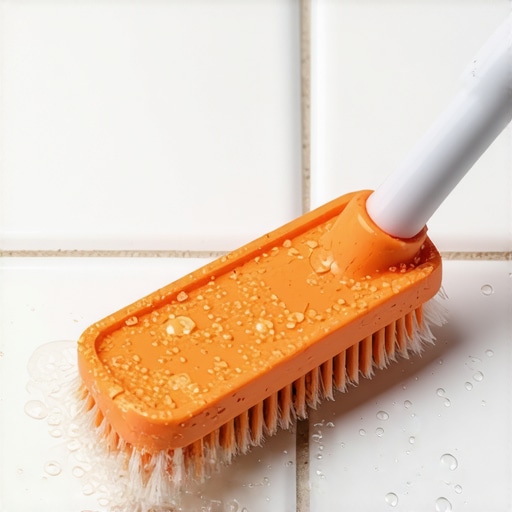
When I use phosphoric acid, I am looking for a concentration between five and ten percent. Anything more than that is too aggressive for residential tile. You apply it with a stiff nylon brush. Never use steel wool. If you use steel wool, you are leaving tiny shards of metal behind that will just turn into new rust stains tomorrow. It is a cycle of failure. You work the acid into the grout, let it sit for exactly five minutes, and then you neutralize it. Neutralizing is the part the amateurs skip. If you leave the acid in the grout, it keeps working. It will eventually degrade the bond between the tile and the thin-set. I use a mix of baking soda and water to stop the reaction cold.
Acid comparison for grout restoration
| Acid Type | PH Level | Interaction with Grout | Safety Profile |
|---|---|---|---|
| Oxalic Acid | 1.3 | High iron chelation | Toxic, requires respirator |
| Phosphoric Acid | 1.5 | Converts iron oxide | Moderate, needs ventilation |
| Citric Acid | 2.2 | Slow reaction time | Safe for most users |
| Acetic Acid (Vinegar) | 2.4 | Very weak on iron | Safe but ineffective |
The physical danger of over scrubbing
Mechanical abrasion using stiff brushes or abrasive pads can permanently damage the glaze on ceramic tile and erode grout joints. Excessive scrubbing pressure forces metallic debris deeper into the grout pores, leading to structural thinning of the joint and potential water infiltration into the subfloor or backer board.
I’ve walked onto jobs where the homeowner has literally scrubbed a valley into their grout lines. They thought they were being thorough. All they did was create a gutter for more water to sit in. When you thin out the grout, you are inviting moisture to get under the tile. Once moisture gets to the thin-set, the bond starts to fail. You will start hearing that hollow sound when you walk across the floor. That is the sound of money leaving your wallet. Use a soft touch. Let the chemistry do the heavy lifting. If the chemical does not work, the stain is too deep, and you need to look at mechanical removal of the grout itself, not more scrubbing.
The structural risk of grout failure
Grout failure caused by acidic over-cleaning or prolonged rust exposure allows moisture to penetrate the tile assembly. This leads to substrate rot, efflorescence, and the growth of mold within the wall cavity or subfloor, eventually compromising the structural stability of the entire bathroom floor or shower enclosure.
If you live in a humid place like Florida, this is a nightmare. The humidity is already trying to rot your house from the inside out. If you have a rust problem that keeps coming back, you probably have a leak behind the wall. That rust is a symptom. Maybe a galvanized pipe is failing. Maybe the installer used the wrong nails in the backer board. If you just clean the stain and ignore the source, you are rearranging deck chairs on the Titanic. You have to be a detective. Check the plumbing. Check the moisture levels in the subfloor with a pin-less meter. If that subfloor is at eighteen percent moisture, your rust stains are the least of your problems.
- Inspect the grout for cracks or pinholes before applying any liquids.
- Test a small, inconspicuous area to ensure the acid does not etch the tile surface.
- Wear nitrile gloves and eye protection to guard against chemical splashes.
- Always flush the area with clean, distilled water after the cleaning process.
- Apply a high quality solvent-based sealer once the grout is completely dry.
The invisible pores that trap metallic waste
Capillary porosity is the measure of void spaces within cured grout that determines its absorption rate. Most sanded grouts have an absorption rate between five and ten percent, meaning they act like industrial sponges for rust-laden water, requiring deep penetration of cleaning agents to achieve restoration.
Think of grout like a bunch of tiny straws all glued together. When you have iron-rich water from a leaky shaving cream can or a rusty shower caddy, those straws suck that orange water right down. This is why sealing is not an option; it is a requirement. But you cannot seal over a stain. If you do, you are just laminating the rust into the floor. You have to get the grout back to its original pH and its original color before you even think about opening a bottle of sealer. And don’t use those cheap, water-based sealers from the big-box store. They are basically watered-down wax. You need a penetrating sealer with fluoropolymers that will actually line the inside of those tiny straws.
“Grout is a porous material. It is designed to be a sacrificial joint, yet it often becomes the primary failure point in wet environments.” – Master Flooring Axiom
The 1/8 inch that ruins everything
Grout joint width and depth play a critical role in how rust stains are processed and removed. Narrow non-sanded joints are more brittle and prone to acid damage, while wider sanded joints provide more surface area for mineral accumulation, necessitating specialized tools for effective remediation.
When you are dealing with a 1/8 inch joint, you have very little room for error. If you start digging in there with a grout saw because you’re frustrated with a rust stain, you’re going to chip the edge of the tile. Now you’ve turned a cleaning job into a replacement job. I always tell people to take it slow. If the stain won’t budge after two rounds of phosphoric acid, the iron has probably bonded with the silica in the sand. At that point, you’re better off using a dremel with a diamond bit to shave off the top 1/16th of an inch and then floating a new layer of matching grout over the top. It is the only way to get a clean slate without tearing out the whole floor.
Final word on grout integrity
A floor is a performance surface. It has to handle water, weight, and chemistry every single day. If you treat your grout like an afterthought, it will fail you. Rust is just the warning sign. It tells you that moisture is staying in one place too long or that your minerals are out of balance. Clean it right, neutralize your acids, and seal it like your life depends on it. If you do that, you won’t be calling me in five years to replace a rotten subfloor. You’ll have a bathroom that actually holds its value. Keep your knees on a pad and your eyes on the moisture meter. That is how you maintain a professional grade floor. “