
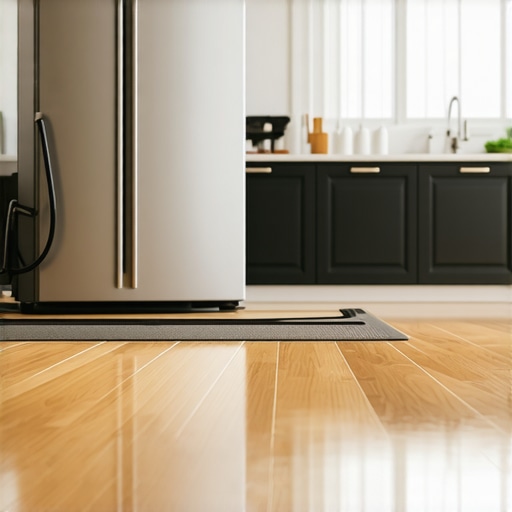
I have spent twenty-five years on my knees with a moisture meter and a level. I have seen the same tragedy play out in hundreds of kitchens. A homeowner spends thousands on a beautiful wide-plank laminate only to have a tiny plastic nut on a refrigerator ice maker line fail. I once walked into a house where a brand-new floor was cupping so badly it looked like a field of potato chips. The installer did not check the crawlspace humidity and the refrigerator had been dripping for a week. The core of that laminate was a wet sponge. It was a total loss. I could smell the damp high-density fiberboard from the driveway. It has a sour, metallic scent that tells me the resin bonds have already failed. Laminate is a marvel of engineering, but it is fundamentally a wood product. It lives and breathes. When you introduce a refrigerator leak, you are starting a chemical clock that you cannot stop. You need to understand the physics of your floor if you want to save it.
The invisible sponge under your kitchen feet
Laminate flooring consists of a high-density fiberboard core protected by a melamine wear layer and a decorative photographic film. While the top is water-resistant, the raw edges of the click-lock joints are the primary vulnerability point where moisture enters the core through capillary action and causes irreversible swelling. This material is essentially sawdust and resin compressed under immense pressure. When water reaches the core, the cellulose fibers absorb the liquid and expand. This is known as thickness swell. Most high-quality laminate has a swell rate of less than eight percent, but even that small increase is enough to ruin the tongue-and-groove locking system. Once the core expands, the edges of the planks push against each other. This is why you see peaking. The floor has nowhere to go but up. I have seen floors lift three inches off the subfloor because of the pressure generated by expanding wood fibers. It is a slow-motion car crash happening right under your refrigerator.
Why your refrigerator is a ticking time bomb
Refrigerator leaks are particularly dangerous because they often occur behind the appliance where they remain undetected for weeks or months. These slow drips saturate the underlayment and migrate across the subfloor, attacking the laminate from the bottom up and bypassing the protective surface wear layer entirely. Most people think a leak is a puddle they can see. In the flooring world, the most dangerous leak is the one you can’t see. A pinhole leak in a copper line or a cracked plastic fitting can release a few drops an hour. That moisture gets trapped under the vapor barrier. It has no way to evaporate. Instead, it sits against the subfloor and the bottom of your laminate. The subfloor acts as a reservoir. If you have a plywood subfloor, it will rot. If you have concrete, the moisture will sit on the surface and feed the laminate core. By the time you notice the floor is soft or the joints are turning grey, the damage is already done. You are no longer dealing with a surface spill. You are dealing with a structural failure of the material.
“A floor is only as good as the subfloor beneath it; deflection is the enemy of every joint.” – Master Flooring Axiom
The chemistry of swelling wood fibers
Water molecules penetrate the HDF core of laminate through the porous joints, breaking the chemical bonds between the wood fibers and the urea-formaldehyde or melamine resins. This hydration causes the individual wood cells to expand in diameter, leading to the physical deformation commonly known as buckling or cupping. When we talk about the molecular reality of a floor, we are talking about hydrogen bonding. Wood is hygroscopic. It wants to be as wet as its environment. When a refrigerator leaks, the relative humidity under that appliance spikes to one hundred percent. The wood fibers reach their fiber saturation point. This is the stage where the cell walls are completely saturated. In a factory-controlled environment, these fibers are dry and stable. In your kitchen, they are turning back into the trees they came from. You cannot just dry it out and expect it to shrink back to its original shape. The resin bonds have been snapped. The structural integrity of the plank is gone. This is why the industry standard is often replacement rather than repair.
The myth of the waterproof click lock
While many modern laminate products are marketed as waterproof, this term usually refers to the surface’s ability to repel standing water for a limited duration. The locking mechanisms remain susceptible to moisture infiltration if the water is allowed to sit or if the subfloor is saturated. This is the biggest lie in the big-box retail world. They show a picture of a floor in a fish tank. What they don’t tell you is that the edges were likely sealed with wax or silicone for that specific display. In a real home, the floor is moving. It expands and contracts with the seasons. Every time you walk on it, the joints rub together. This wear eventually creates microscopic pathways for water. If your refrigerator leaks, the water will find those pathways. It will travel along the underlayment like a highway. I have seen water travel fifteen feet from the source of a leak, following a dip in a concrete slab. Don’t trust the marketing. Trust the physics of the installation. A waterproof floor is only waterproof if every single joint is hermetically sealed, which is impossible in a floating floor system.
| Condition | Core Reaction | Recovery Potential |
|---|---|---|
| Surface Spill | Minimal Absorption | High (if dried in 30 mins) |
| Slow Drip (7 days) | Edge Swelling | Moderate (requires fans) |
| Subfloor Saturation | Core Delamination | Zero |
| Ice Maker Burst | Joint Peaking | Low (plank replacement) |
Immediate actions for a wet kitchen floor
To save a laminate floor after a leak, you must immediately shut off the water supply, remove the refrigerator to expose the source, and use a high-powered wet vacuum to extract all standing water from the surface and the perimeter expansion gaps. Speed is your only friend here. You have a window of about four to six hours before the HDF core starts to permanently deform. After you suck up the water, you need to pull up the baseboards. This is the step most homeowners skip because they don’t want to mess up their paint. If you don’t pull the baseboards, you can’t see the expansion gap. That gap is likely full of water. You need to get air into that gap. I tell my clients to use a shop vac on the blow setting or a specialized floor fan. You aren’t just drying the top. You are trying to drop the relative humidity of the air under the floor. If you can get the humidity down fast enough, you might stop the swelling before the resin bonds break.
- Shut off the refrigerator water valve immediately to stop the source.
- Extract all visible water using a wet-dry vacuum with a squeegee attachment.
- Remove baseboards and transition strips to expose the edges of the laminate.
- Use a moisture meter to determine the extent of the water migration.
- Set up professional-grade dehumidifiers and air movers to cycle the air.
- Monitor the floor for 72 hours for any signs of edge peaking or softness.
The 1/8 inch that ruins everything
Precision in the expansion gap is the difference between a floor that survives a leak and one that destroys itself. If the laminate is tight against the wall, any minor swelling caused by moisture will cause the entire surface to buckle upward because there is no room for lateral expansion. Most guys skip the leveling compound. They think the underlayment will hide the dip. It won’t. I spent three days grinding concrete on a job last month just so the floor wouldn’t click like a castanet. The same principle applies to water. If you have a proper half-inch expansion gap around the perimeter, the floor can swell a little bit without self-destructing. If you tucked that laminate tight against the drywall, the moment it gets damp, it will bridge. It will pop up like a tent. I have seen it happen in a matter of hours. The pressure is enough to crack the tongues right off the planks. You need to give the floor room to move. It is a living, breathing mechanical system. Treat it with the respect that structural engineering requires.
“Laminate performance is dictated by the equilibrium moisture content of the environment; ignore the ambient humidity at your peril.” – NWFA Technical Guidelines
The reality of subfloor remediation
If the subfloor beneath the laminate is plywood or oriented strand board, it must be dried to within two percent of its dry standard before new flooring can be installed. Failure to dry the subfloor leads to mold growth and telegraphing of imperfections through the new floor. This is where the real work happens. You might think you can just swap out the wet planks. You can’t. If the wood subfloor is wet, it will keep feeding moisture into the new laminate. You will be back in the same position in three months. I use a deep-probe moisture meter. I want to know what the moisture content is in the middle of that plywood. If it’s over twelve percent, I’m not putting a floor over it. I’ve seen guys try to seal a wet subfloor with Kilz. It doesn’t work. The moisture just gets trapped and rots the wood from the inside out. You have to be patient. Sometimes that means running a dehumidifier for a week before you even think about opening a new box of flooring. It smells like sawdust and hard work, but it’s the only way to do it right. Anything else is just a temporary fix that will fail when the seasons change. Don’t be the person who pays for the same floor twice.